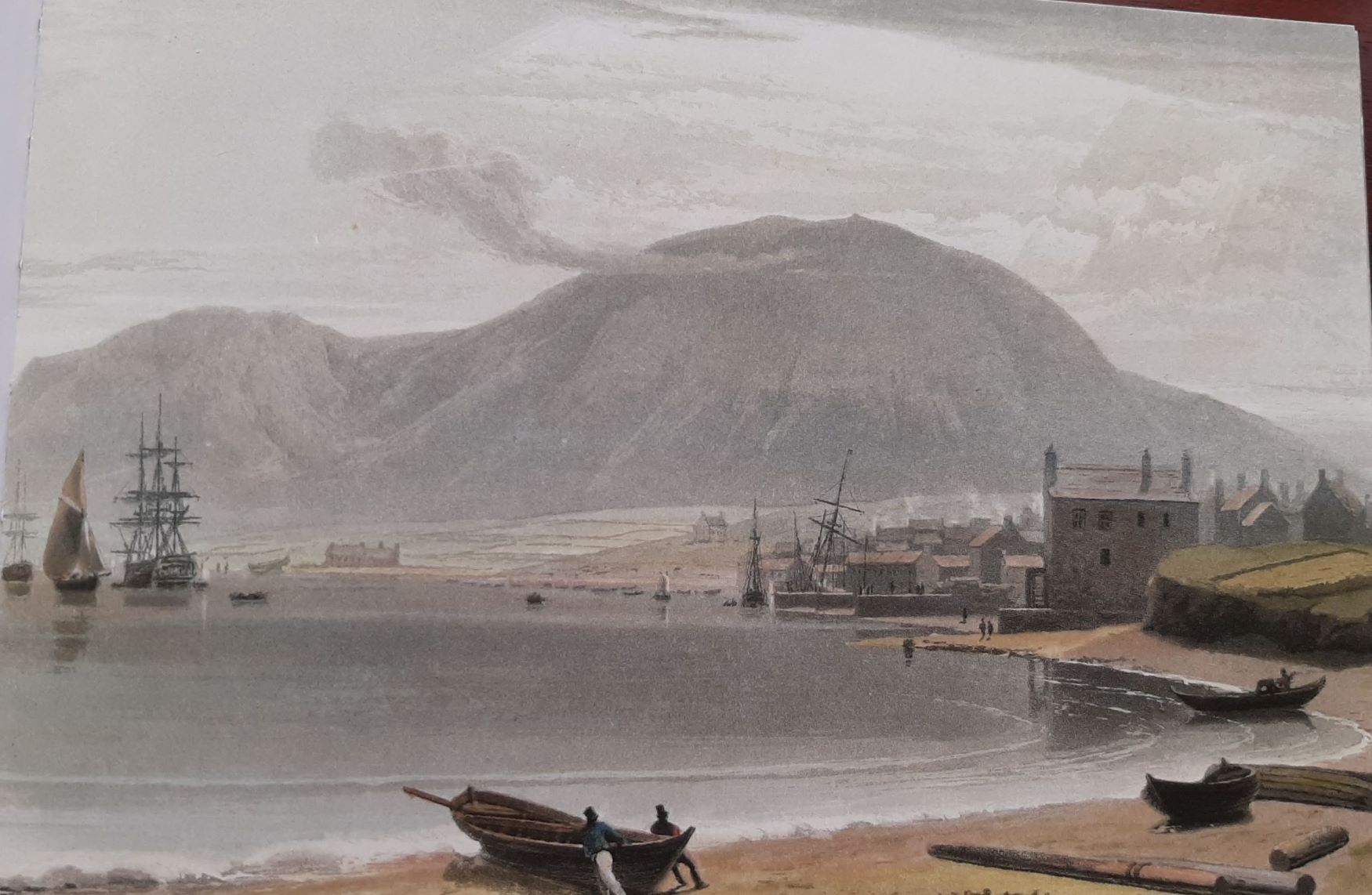
In 1700, Stromness was a village with five houses and a few scattered huts; ninety years later it had 222 houses. We owe the detailed picture of the town’s lively early history to the work of two men: Sir John Sinclair of Ulbster in Caithness and Rev William Clouston, minister of Stromness and Sandwick. Sir John organised a detailed survey of Scotland in the 1790s by sending a list of questions to every minister in the country. It is now known as the Old, or First, Statistical Account, because there was another in the 1850s, and one of the most detailed accounts of them all came from William Clouston, who entered into the project heart and soul. J Storer Clouston brought all the Orkney accounts together in a book called The Orkney Parishes, published in 1927. If you aren’t lucky enough to have a copy, you can now read them online. https://stataccscot.edina.ac.uk/Parish_record_for_Stromness_in_the_county_of_Orkney_in_volume_16_of_account_1
Here is a flavour of the Stromness entry.
This village, situated on the west side of the harbour, near the southmost extremity or ness of this parish, from whence it derives its name, was, in the beginning of the present century, very inconsiderable, consisting only of half a dozen houses with slated roofs, and a few scattered huts, the first inhabited by two gentlemen of landed property, and two or three small traders; the last by a few fishermen and mechanics. Two small vessels, of 30 tons each, were all that then belonged to it. These were employed in catching cod and ling at Barra, and made usually once a year a voyage to Leith or Norway.
Stromness owed much of its growth to the Hudson’s Bay Company, whose ships had called in on their way from London to Canada since the early years of the century, to take on water, supplies and men. By the end of the century there were almost twice as many women as men in the town: 851 to 493.
This Company fits out three ships, from 150 to 400 tons each, which carry out provisions, guns, powder, shot, hatchets, cloths, etc. to be exchanged with the Indians for beaver and other furs. These vessels usually arrive at the harbour of Stromness about the first of June, where they stop for two or three weeks to take aboard men for their settlements. They engage usually from 60 to 100 men, natives of this country, to go to these settlements every year. They have about 400 or 500 men in these settlements, of whom it is presumed three-fourths are Orknese, as they find them more sober and tractable than the Irish and they engage for lower wages than either the English or Irish. The yearly wages they give is, house-carpenters, from £18 to £25; blacksmiths from £20 to £30; sailors from £18 to £25; boat-builders from £20 to £30; masons from £20 to £25; tailors from £10 to £15; labourers from £6 to £18.
If the murmurs of the nation have been excited, because of the monopoly which this company enjoys; so also, of late years, there have been great complaints in this county, both on account of the small wages given to the labourers, and the great number of them engaged, while the farmers are left without servants. The constant drain of men from this county to the Greenland and Iceland fisheries, the coal-trade, and his Majesty’s navy, together with 200 fencibles raised, has tended to foster these complaints, which are principally directed against the Hudson’s Bay Company, because they make a yearly demand, and at once, and therefore the more perceptible.
… and although it is no doubt better for a country to keep its natives at home, provided they can be usefully employed, either in agriculture or manufactures, yet where there are not manufactures, or improvements in agriculture, thus to employ them, it is the better to hire them to those who can usefully employ them; and also better that they go to hunt the harmless and civilised beaver, than, like the Swiss, to fight the wars of other nations for hire. As to these men being idle and useless to their own country when they return, it may be observed, that several of them are perhaps so before they go there, and that this is what often induces them to go.
Another factor in the growth of the town was the frequent wars with our Continental neighbours. When shipping came north to avoid the English Channel, they were very likely to call at Stromness. 1237 ships came into Stromness in the four years 1789 to 1792. Most of them were Scottish and English but there were also Irish, Danes, Swedes, Prussians, Danzigers, Americans and Dutch.
Before the peace in 1763 [the end of the Seven Years War], 450 or 500 vessels have passed this way in a year. The reason why the number passing now is not so great as formerly is that many now go through Pentland Frith (sic), who formerly used to pass by Stromness, as they have now become better acquainted with that frith. And as a lighthouse is now erected on the Pentland Skerries in that frith, it may be presumed that still a greater number will pass that way, and a less number by Stromness. It has been suggested, that for the safety of the trade passing by Stromness, it might be necessary to erect a fort at the entrance of the harbour, since the French privateers, in time of war, have entered Hoy Sound, and have been within two miles of the harbour.
Rev Clouston even included a detailed record of the imports and exports in 1792.
| £ s d | |
| Linen yarn, 8500 spindles | 956 – 5 – 0 |
| Beef (salted) 240 barrels | 360 – 0 – 0 |
| Hides (salted) 390 | 182 – 0 – 0 |
| Feathers, 4424 lb | 258 – 1 – 4 |
| Rabbit skins 36,000 | 120 – 0 – 0 |
| Linen, 2000 yards | 100 – 0 – 0 |
| Stockings 1440 pair | 108 – 0 – 0 |
| Calf-skins, 1200 | 60 – 0 – 0 |
| Fish, 1000 ling | 50 – 0 – 0 |
| Butter (grease) 11 barrels | 39 – 12 – 0 |
| Pork (salted) 16 barrels | 28 – 0 – 0 |
| Pens 100,000 | 27 – 10 – 0 |
| Tallow 12 cwt | 25 – 4 – 0 |
| Pork hams 160 | 16 – 0 – 0 |
| Geese (salted) 10 barrels | 16 – 13 – 4 |
| Geese (smoked) 240 | 12 – 0 – 0 |
| Neats’ tongues 240 | 8 – 0 – 0 |
| Seal skins 36 | 4 – 10 – 0 |
| £2371 15s 8d |
The first surprise is that by far the most valuable export was linen yard. It is largely forgotten now that linen spinning and weaving was a significant source of income in several parts of Orkney, especially for the women.
The principal manufactures carried on here, are knitting stockings and spinning linen yarn. In the first of these they greatly excel, and from constant practice, make the stockings very smooth and glossy. Young girls of 10 and 12 years of age can knit well. A great part of these stockings is sold to sailors at 1s 6d to 5s a pair. They have been made so fine as to sell for 10s or 15s a pair.
I wonder how long it took to knit a pair of the finer stockings. 10 or 15 shillings seems extraordinary when a female servant’s annual wage was 12 shillings to £1 plus board.
It is easy to forget how important feathers were, for stuffing mattresses and cushions. 4424 pounds of feathers must have taken up quite a bit of space. Pens were, of course, the wing feathers used for quill pens. Neat’s tongue was the old name for beef tongue.
The main import was “bale goods, cloths, muslins, &c from Glasgow”, followed by groceries, tow, flax, wool, timber, leather and salt but William Clouston detailed everything. The sundries included 6 cwt of snuff, 50 cwt of soap, 30 reams of paper and 100 hats. [Cwt is a hundredweight, equal to 112 lb so approximately 50 kg.] The total cost was £4198, making a deficit of £1827 but this was more than covered by other revenue.
The sources from whence this deficiency is made up are these; remittances from seamen in his Majesty’s navy; freights of vessels belonging to this place in the carrying trade abroad; money received from shipping for fresh provisions, or spent by seamen in the public inns; remittances from those in the service of the Hudson’s Bay Company. These sources are more than sufficient to balance the amount of imports, as appears evident, since the style of living has been greatly increasing for some years past.
There were schools in Orkney long before the Scottish Education Act of 1872. The heritors, or land-owners, were supposed to provide a school in every parish and The Scottish Society for Propogating Christian Knowledge provided a schoolteacher for another school if there were children who lived too far from the parish school. Other schools were run as business ventures.
The Society for propagating Christian Knowledge gives £8 yearly to a schoolmaster and £3 yearly to a school-mistress, both in the village of Stromness. The school-fees are from 6d to 1s quarterly for teaching to read and write; and 1s 6d or 2s for writing and arithmetic. The schools are: In the village of Stromness, one grammar-school, where Latin is taught. Four schools, where the schoolmasters teach reading, writing and arithmetic. Three schools, in which school-mistresses teach reading, knitting stockings and sewing white seam.
Answering the questions about eminent men and the character of the people, Rev Clouston’s views were favourable, on the whole.
As the village of Stromness cannot be considered as of more than a century’s standing, there has not as yet, perhaps, been time enough to prove whether the genius of the people of this village may lead them to excel in literature and the higher attainments of science; and they are, perhaps, as useful to themselves and their country, in the professions they at present pursue, as they would be in these.
The people are industrious and attentive to their interest and this last is a leading feature of their character… Among a body of 3000 people [village and both parishes] it may be presumed that there are some of vicious character and depraved manners; but, in general, they are decent in their behaviour, respectful to their superiors and modest in their carriage and conversation, especially the women. In a sea-port such as Stromness, to which there is a great resort of shipping, it might be conjectured that immoralities and a depravity of manners might prevail but it is to be observed to their honour that there has been only one bastard child to a stranger for 10 years past. They are regular in attending divine service and are neither enthusiastic nor superstitious in their religious principles.
William Clouston finished with a list of comparisons between Stromness in 1700 and in the 1790s. After noting the increase in houses, shipping and trade, he looked at how life had changed:-
In 1700, the use of tea was unknown, even in the families of gentlemen of the first landed property.
In 1792, 860 pounds of tea were imported, and tea is drunk by tradesmen and merchants.
In 1700, the wives and daughters of gentlemen of landed property spun and manufactured their own wearing apparel.
In 1794, the wives and daughters of tradesmen and mechanics dress in cottons and printed muslins.
In 1700, no dancing school had ever been in these parishes.
In 1793, a dancing master opened a school, obtained 40 or 50 scholars and drew £50 in four months.