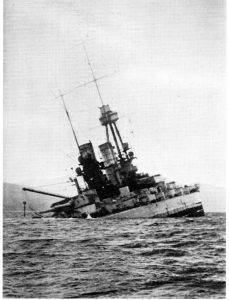
The battleship Bayern
This is not another re-telling of the facts of what happened in Orkney on 21 June 1919; this is a collection of people’s memories of that day, mainly gathered from the excellent books written about Scapa Flow. The first story is from the newest book, David Meara’s collection of eye-witness accounts, The Great Scuttle, The End of the German High Seas Fleet and is about my grandmother’s first cousin, Arthur Burnett.
Arthur was working on a farm in Orphir that morning. He lifted his eyes from the rows of neeps he was singling and noticed that several small boats were leaving the German ships interned in Scapa Flow and that the ships seemed to be lower in the water. Next time he looked up, some hulls seemed to be even lower and, when he saw the stern of one ship seeming to rise high in the air, he was sure that he had sun-stroke or was losing his wits. He cycled home to Stenness and went to bed but got up again and enjoyed his tea, after his mother shared the astounding news she had just got from the postman, that the German sailors had sunk their ships.
Bryce Wilson, in Graemsay, a history, published in 2015, told the story of someone else who couldn’t believe it was happening. Frank Davidson of Gorn said, “My uncle who lived in a neighbouring croft came up the hill, walked right past me without speaking and went into the house… I followed and heard him say, “Something strange has just happened. One of the German ships rolled from side to side and then turned bottom up and disappeared.” My mother did not reply, her face went pale … I learned later that her main fear was that her brother-in-law had gone mad… She took the binoculars from the dresser, we all went out and sure enough the great German fleet was at varying stages of being scuttled.
W S Hewison, in his comprehensive book, This Great Harbour Scapa Flow, published in 1985, told the well-known story of the funeral in Orphir that day.
The late Mr Kenneth Flett, Mussaquoy, County Councillor for Orphir in later life, recalled that on 21 June that year there was a funeral in the Orphir kirkyard by the shore. The deceased had just been laid to rest and the minister was in the middle of the commital service when a whisper went round the mourners – ‘Boy, the Germans is sinking their ships’. When the minister opened his eyes he was shocked to see not a single mourner left at the graveside – they were lining the kirkyard dyke above the shore gazing out at this unique spectacle. As far as is known he joined them.
Another witness quoted by Bill Hewison was Mrs Hester Scarth of Binscarth, who was at Swanbister that day.
One of her strongest recollections of that eventful day, she once told me, was not so much of the German ships going down, spectacular though that was, but of the British destroyers which had been on exercise outside coming back at full speed and ‘simply tearing across the Flow throwing up tremendous bow waves.’
Captain R C V Ross, then a junior officer on board one of those destroyers, was one of the servicemen who contributed to Scapa Flow, The reminiscences of men and women who served in Scapa Flow in the two World Wars, written and compiled by Malcolm Brown and Patricia Meehan in 1968.
“On 21st June 1919 the big ships and destroyers had proceeded to sea for gunnery and torpedo practice. I was on board one of the destroyers and we were actually picking up our torpedoes after a run when we received the electrifying signal: ‘German Fleet sinking. Return to harbour at full speed.’With our great speed we were back inside the Flow far ahead of the battleships; and what a spectacle met our eye. In all directions the great German super-dreadnoughts and cruisers were indeed sinking: some rolling over and going down with great bubbles, others settling on an even keel, or sliding under bows first.”
Chaplain G L Bourdillon was on board HMS Royal Sovereign and wrote to his wife that he had gone up into the fore-top to get the best seat for the show.
“The first sign we saw was the masts of a ship at a sharp angle over Flotta. Half the German ships had disappeared and several of the remainder were in a sinking condition! One battleship had her quarter-deck awash, and as we watched thro’ glasses, we saw her gradually lift her bows out of the water, roll over and disappear below the surface, leaving nothing but a vast patch of bubbling foam. It was one of the most thrilling sights I have witnessed…I then came down to see the prisoners coming aboard. Boatload after boatload, in they poured, officers and men, till we had over 400 of them on board! They were quartered mostly in the batteries both sides. All the arrangements worked smoothly, but there wasn’t much sleep for anyone last night.
Bourdillon went on to say that they left at 6 am to take the Germans to Cromarty. They arrived at noon and headed back to Scapa by 5 pm, having been told they were going to do some salvage work.
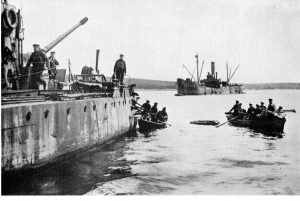
“We are now tidying up. The mess everywhere was awful, and the odour!!!” German sailors taking to the boats
Most of the pictures of the sinking ships, including those featured here, were taken by C W Burroughs, Cashier of the Dockyard Section in Scapa Flow from 1915 to 1920. He was a keen photographer and published Scapa and a Camera in 1921. Burroughs expressed some admiration for Rear Admiral Ludwig Von Reuter and his crews. “… the scuttling was undoubtedly organised and carried out with (from the German point of view) very commendable precision and thoroughness.”
One of the German sailors, Friedrich Ruge, who was in command of one of the destroyers, contributed to the 1968 book of reminiscences, describing what life had been like on the German ships since their internment at the end of November 1918.
We had to get all our food from Germany – it was not very much and not very good. So we started fishing and trying to get seagulls – the fish were good and the seagulls not. And we were not allowed to go ashore or to visit the other ships so we were thrown entirely upon our own resources. And we started lessons in languages and in geography and in mathematics. And when the weather got better we sat on deck and I had a guitar and we sang old songs, and then we even played tag around the funnels and the bridges – a destroyer is quite good for playing tag.Officially we were not allowed to have any contacts with the British but of course in seven months that couldn’t quite be carried out. We ourselves had quite a lot of contact with the crews of drifters… And we were in need of tobacco, soap particularly, our stuff from the war was awful and the drifters were well stocked so we tried to find things to barter. We hadn’t much alcohol – the big ships had a lot – so we furnished medals and ribbons and badges and so on as souvenirs. We invented most wonderful new Orders and so on and everybody was happy about it.
I came across an interesting story about the German sailors which doesn’t seem to appear in the official record. There is a letter in the Orkney Archive from Colonel Henry Halcro-Johnston to his sister Ann, about sailing past the German ships on the ferry to Orkney.
The ships have German crews on board and they are in a dirty ill-kempt condition. The German sailors are not allowed to land in Orkney but they are permitted to have exercise in rowing boats. Last Sunday however, several of them escaped on shore in Hoy but have since been captured at Finstown, having crossed over to the Mainland at night time. A party of Royal Marines and aeroplanes were sent out in search of them.
In Scapa and a Camera, C W Burroughs asked his readers to, “pardon the intrusion of a personal element”, and recounted his experiences of the day.
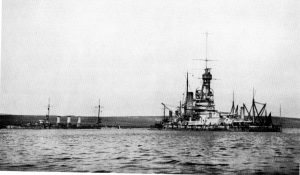
“It was at five minutes past noon that the signalman reported that the German ships had hoisted ensigns and burgees. The excitement which this announcement produced was intensified a short time later when it became apparent that the ships were sinking, and that the crews were taking to the boats. Lunch was completely forgotten and arrangements were hurriedly made to get all available small craft to the ships to ascertain if anything could be done to save any of them. I obtained permission from the Admiral to accompany him on an inspection of some of the nearer destroyers, from which it was ascertained that there was no possibility of saving any of the ships other than by beaching them, as the seacocks had not only been opened but the valves had been destroyed. Salvage Operations on Baden and Frankfurt beached at Smoogroo
Twenty-two of the ships were beached: eighteen destroyers and four larger ships: the cruisers Nurnberg, Frankfurt and Emden, and the battleship Baden. Burroughs wrote:-
A large amount of salvage work ensued on the vessels which had been beached, most of them being pumped out and docked in the Floating Dock, although it was not found possible to get some of the destroyers off, and these still remain as a memento of that eventful day.All the salved ex-German ships have now been towed south [in 1921], and have been apportioned amongst the Allied Powers. It is interesting to note that the Baden and Nurnberg have been alloted to Great Britain, whilst the Emden goes to France and the Frankfurt to USA.
Famously, those with the best view of the sinking were the Stromness schoolchildren on board the Flying Kestrel; one of the seven water boats which took water from the Stromness reservoir to the ships in Scapa Flow. The others were Flying Breeze, Supply, Aid, Progress, Fitful Head and Scandinavia. The badly-needed reservoir had been dug behind Stromness less than twenty years earlier and the people of Stromness had been paying water rates since then. By the end of the war, Stromnessians were no longer paying water rates because the water sold to the Navy had paid for the reservoir.
Between 200 and 300 children were on a Midsummer cruise to see the German ships. They had sailed through the Bring Deeps and past the ships lying between Hoy and Cava: Kaiserin, Derfflinger, Hindenberg, Von der Tann, Moltke and Seydlitz.The Flying Kestrel had reached Lyness and was heading north again when it was hailed by someone on a drifter, who told the crew that the Germans were sinking their ships and directed them back to HMS Victorious at Lyness. Once there, they were instructed to head straight for Stromness. The children arrived home at 2.30, to find the piers crowded with anxious relatives. What a story they had to tell.
Bill Hewison quoted from several of them in This Great Harbour Scapa Flow. Margaret Gibson, who had been ten at the time, was interviewed by Radio Orkney in her later years.
I saw twelve capital ships sinking. Some stood up on their bows, some went over on their sides and the water was boiling everywhere. Men were on rafts and in boats. We saw them landing on the island of Cava and running up from the shore. Every German boat had its flag at the top mast.
One of the teachers aboard the Flying Kestrel, Meg Yorston from Evie, wrote to her cousin, Frederic Yorston, who was Editor of the Montreal Standard and he included her account in a piece he wrote about Scapa Flow.
Some went down with their sterns almost vertical above the water, others listed to port or starboard with vast clouds of steam and rivers of oil pouring out of their vents and bubbling to the surface after the ships had reached the bottom and there was the roar of escaping steam and the shouts of thousands of sailors as they made off in their boats.
The teacher in charge of the expedition, headmaster David Hepburn, made what must be one of the most unusual school log book entries.
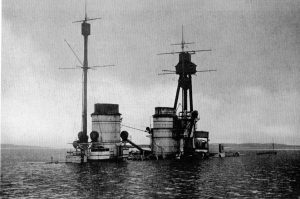
Battlecruiser Hindenberg resting on the sea bed By kind permission of the Rear Admiral Commanding Orkneys and Shetlands the pupils and teachers were conveyed by HMS Flying Kestrel to view the German Fleet in Scapa Flow. They had the unique experience of seeing the ships afloat, sinking, and sunk, with the Imperial German Ensigns flying at the mastheads, as their crews apparently by general agreement had made up their plans to sink them on this date. The crews were seen in small boats, pinnaces and rafts etc. By 4 pm only the Baden, a light cruiser ashore on the west of Cava and the turrets of the Hindenberg were to be seen from the school.