

Thanks to the internet, it is now possible to put together stories of how Orcadians have influenced the wider world. This leads to all sorts of surprising connections and I did a series of them for Radio Orkney several years ago. This is an extended version of one of them.
Michael Faraday was one of the world’s greatest scientists. He was also one of the first to recognise the importance of reaching a wider audience and he had the perfect venue for this, at the Royal Institution in London. The lecture theatre there is probably the most famous in the world, thanks to the Christmas Lectures he began in 1825, which have been televised since 1966. It was designed by an Orcadian, Thomas Webster. The theatre was rebuilt in 1927 but to the original plans.
Thomas’s father Alexander was English but his mother Mary was the daughter of Thomas Baikie, the minister of St Magnus Cathedral. Thomas was baptised at St Martin-in-the-Fields, London, on 11 February 1773 but grew up in Orkney. According to his entry in the Oxford Dictionary of National Biography, he attended Kirkwall Grammar School and then went to Aberdeen University in 1785, where “he assisted Professor Patrick Copland, a populariser of science”. Professor Copland was a pioneer of public education, whose extra-mural classes ran from 1785 to 1813. He also pioneered the use of demonstrations in his lectures so Thomas may have taken a few new ideas with him when he went to London.
Thomas Webster enrolled at the Royal Academy Schools in London as an architectural student in 1793 and had his own business by 1799. He began ‘a school for mechanics’ and this came to the attention of Count Rumford, one of the founders of what became the Royal Institution. Rumford’s aim was to encourage the use of mechanical inventions and improvements and to encourage “the Application of Science to the Common Purposes of Life”.
The story of the early years of the Institution can be read online, in The Royal Institution, its Founder and First Professors, written by Henry Bence Jones in 1871. https://archive.org/details/royalinstitution00jonerich
Mr. Webster, a young architect twenty-six years old, was engaged as Clerk of the Works. He had been educated at Aberdeen and had studied at the Royal Academy and with an eminent architect. At this time, he had also a small school for about a dozen mechanics. Mr. Webster was appointed clerk to the treasurer and secretary, as well as Clerk of the Works.
Webster superintended the transformation of a house in Albemarle Street into a suitable building. In January 1800, he was told to prepare plans for a new lecture room. Many years later he wrote,
The theatre of the Royal Institution is pronounced to be the most perfect room of the kind in the kingdom for possessing the properties of allowing the lecturer to be well heard and seen by the audience and for affording them easy entrance and exit, &c… it has been stated by Faraday, in his late examination before a committee of the House of Commons, to be ‘almost perfect as a lecture room,’ and that ‘although architects are continually measuring and drawing it to copy from, and many other rooms have been built in imitation of it in which he has tried his voice, yet none of them proved equal to that in question.’
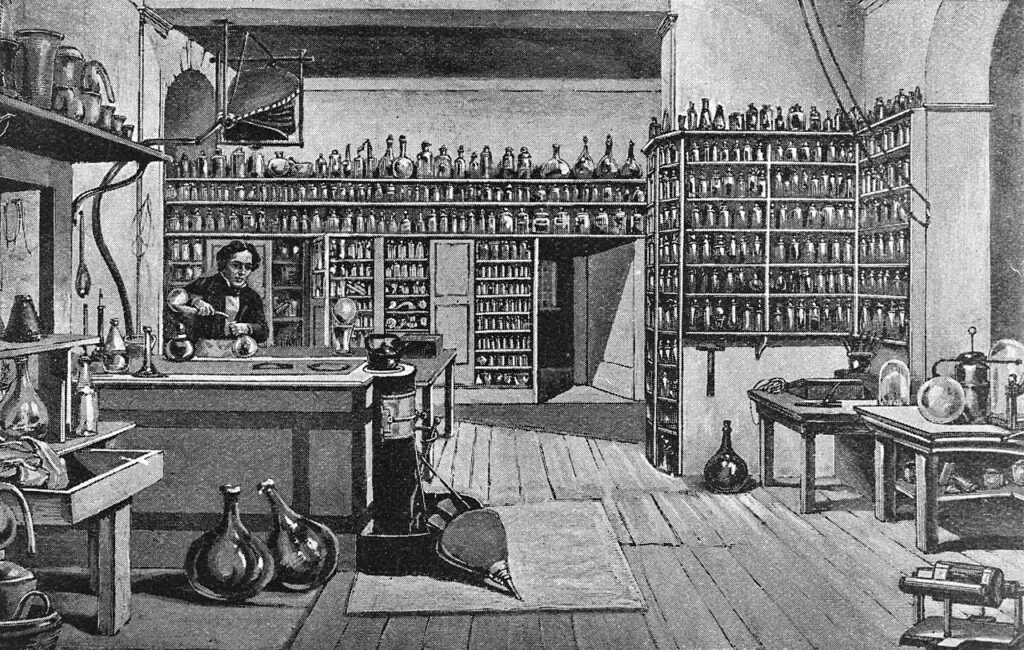
Sir Humphrey Davy was the first scientist to draw crowds to the lecture theatre, which could seat 900 people. Albemarle Street became the first one-way street in London, to deal with the traffic. Davy also made good use of the laboratory which Thomas Webster had installed, using electrolysis to isolate sodium, potassium, barium, calcium, strontium and magnesium. Webster wrote later, “The chemical laboratory in which so many valuable discoveries have been made was not only designed and built by me, but owes to me its very existence, for, though I inserted it in my plans, the managers did not at first consider it necessary.”
According to Webster’s obituary in The Literary Gazette, he had assisted at the lectures of Sir Humphrey and his predecessors, Dr Garnett and Dr Young and had “prepared the various experiments made at the lectures of natural philosophy and chemistry”
Count Rumford had assured Webster that he was going to establish a science school for workmen and, as he wrote to a friend,
It was through the prospect of being employed in this way, which would have been as agreeable to my habits of thinking as useful to my interest, that I was induced to give up the school which I then kept and the other business in which I was engaged, and to accept of a situation and salary in the Institution by no means equivalent to what I should have considered myself as entitled to under other circumstances.
Eighty years before compulsory education, he had found that new techniques in building needed better-educated workmen.
“Knowing from previous experience what it was possible to effect in their improvement, I conceived the idea of giving to mechanics for this purpose a species of scientific education suited to their condition, and I believe I was the first person in this country who took active steps for effecting so desirable an object. I was not unacquainted with the political feelings of that time, but I did not think a little learning was a dangerous thing if judiciously bestowed… My idea was to make good mechanics, not to force them like hot-bed plants out of the sphere in which they are so useful.
I proposed, then, to found a school for mechanics in the house of the Royal Institution, in which they should be taught such principles of science as would be useful in their several occupations, which I considered would in a great degree promote the ‘application of science to the common purposes of life.’ In the house of the Institution itself the men would be under the eye of the higher classes, and anything wrong would easily be put a stop to.
With this view I wrote a long letter to Count Rumford, detailing my views and plans. He was delighted with them, and he read my letter to the board of managers; the idea was favourably received, and my letter was inserted upon the Minutes of the Institution, where of course it may be seen (Managers’ Minutes, Sept. 14, 1799). Some difficulties were, however, suggested. It was thought that Sir Joseph Banks, then president, would object, and I was requested to take the minute book to him and do what I could to win him over. I accordingly saw Sir Joseph, and, by explaining to him how much the arts would gain by intelligent operatives, I overcame a few political scruples which he had.
At last, all objections were silenced, and everyone seemed to rejoice in the prospect that opened of adding to the Royal Institution a decided proof of liberal feeling. The general idea and intention with respect to this school were published in the Journals of the Institution and the news reached every corner of the kingdom that the managers of the Royal Institution of Great Britain, among whom were persons of the highest rank, instead of being adverse to the diffusion of knowledge, had actually formed a school for the instruction of mechanical classes…
It is unnecessary to enter into a detailed account of my plan, which was, in fact, intended as an experiment. It was generally to educate a number of mechanics sent by the proprietors of the Institution. At first all were to learn the same elementary principles, but afterwards they were to branch off according to their several trades.
My first intention was to instruct bricklayers, joiners, tinmen, and ironplate workers, as those were the trades most connected with our improvements at this time. In a large room on the ground floor, we built up for practising the men chimneys and fireplaces of all kinds in a slight manner, pulled them down, and built up others. We fitted up improved fire-places within, models of old-fashioned cottage chimneys, also boilers of various kinds, and showed how smoky chimneys might be cured, etc ; models of various culinary vessels were made from ideas of Count Rumford, and were put in the model room for the inspection of the public. Of the workmen to be instructed some were sent by Lord Winchelsea, by Sir Thomas Barnard, Lady Palmerston, &c., and when they were thought to be sufficiently instructed, they returned to the part of the country from which they had come and practised what they had learned and taught others. Thus, by degrees a laudable zeal was created amongst various classes of society, even the highest, for acquiring useful knowledge and diffusing it by their several exertions. Never was there a period when this was felt in a stronger degree, and the establishment of the Royal Institution ought to be considered as the commencement of a new era in the history of science in this country…
In 1801, Count Rumford reported on the proposed school to the Managers of the Institution.
There will be room in the house for the accommodation of a certain number of young men, from eighteen to twenty in number, of different mechanical professions, who, at the recommendation of proprietors, will be taken into the house to be instructed ; who will be boarded and lodged in the house and be employed in the workshops, and for whose improvement in drawing, practical geometry, and mathematics an evening school, under the direction of the Clerk of the Works (Mr. Webster), who was formerly a teacher in such a school, will be established in the house in a room adjoining the workshops.
As most of the young men who will be admitted to this seminary will probably come from distant parts of the country and will return home after a residence of three or four months at the Institution, carrying with them a perfect knowledge of such new and useful inventions applicable to the common purposes of life as may be deserving of being generally known and adopted, it is easy to foresee that this arrangement will be of great and extensive public utility. It is, perhaps, that part of the establishment precisely which will be the most interesting, and which will contribute the most powerfully to the attainment of the principal object of the Institution — the diffusing the knowledge and facilitating the general introduction of useful mechanical inventions and improvements.
Unfortunately, and almost incredibly, this eminently sensible idea was ahead of its time. Thomas Webster wrote many years later
But this project for improving mechanics, well intended as it was, which promised to be so useful, and which had already gained for the Institution ‘ golden opinions’ was doomed to be crashed by the timidity (for I shall forbear to speak more harshly) of a few. I was asked rudely (by an individual whom I shall not now name) what I meant by instructing the lower classes in science. I was told likewise that it was resolved upon that the plan must be dropped as quietly as possible. It was thought to have a dangerous political tendency, and I was told that if I persisted I would become a marked man! It was in vain to argue — the time was unfavourable — and I found the necessity of yielding. No notice was ever given publicly that the idea of instructing the mechanic was abandoned, and I have no doubt but that in many parts of the kingdom the Institution got the credit of great liberality long after the mechanics’ school had become extinct…
… my chief views being evidently thwarted, and there being no prospect of my situation becoming valuable in a pecuniary way, I thought it was high time to think of my own interest, and I determined on becoming a landscape painter, a profession which then offered considerable prospects in a very agreeable and independent occupation.

Webster did not spend much time as a landscape painter. His unusual combination of artistic skill and scientific knowledge led to a commission to produce a new edition of John Imison’s The Elements of Science and Art. The book was very popular and Webster updated it twice. In the Preface to the 1822 edition https://archive.org/details/elementsofscienc01imis/page/n5/mode/2up, he explained how he saw this as another way to make useful knowledge widely available.
He [the editor] engaged in the task the more readily, as he conceived that, by giving a general and concise view of the principles of Natural Philosophy and Chemistry, and of their application to the arts, he might be, in some degree, instrumental in promoting the diffusion of science among persons deprived of the advantages of a regular education.
Having had many opportunities, in the course of his profession, of observing the great use of even a small portion of scientific knowledge to a valuable class of the community, mechanics, he kept it particularly in his view to treat the various subjects, so as to render them as easily intelligible as possible; and, in general, to adapt the explanation of them to that class for which the work was intended by the original author.
In pursuance of this plan, the alterations from the original ” School of Arts,” and also the additions to it, became so considerable, that the work has assumed nearly the appearance of a new production and some apology is perhaps due for altering the features of Imison’s book so far, that it is no longer recognizable. In this form it has passed through several editions, a circumstance that induces the hope, that the labour of the present editor has not been altogether useless.
In a book intended to exhibit only the popular elements of science, it would be in vain to expect much original matter. To draw from authentic sources, and to arrange and describe with clearness and precision the principal known facts, appears to be all that the nature of the undertaking admits of. The following work, therefore, is derived from the discoveries of others ; but it will be found upon perusal, that in several instances, where the editor’s profession or opportunities of observation enabled him to add anything to the stock of particular knowledge, he has not failed to make the attempt.
It is hard to tell what led Thomas Webster to become the world’s first professional geologist. It may have happened because Sir Humphry Davy was one of the 13 founders of the Geological Society in 1807. Webster joined the society in 1809 and two years later was commissioned by Sir Henry Englefield to survey the Isle of Wight. This was one of the first geological surveys in Britain.
According to the Dictionary of National Biography,

During 1811–13, on a geological commission in the Isle of Wight and Dorset for Henry Charles Englefield (1752–1822), Webster made the first geological map of the region and elucidated the Mesozoic–Tertiary stratigraphy and structural geology of the Hampshire and London basins. His major paper on the Freshwater formations in the Isle of Wight (1814), published in the Transactions of the Geological Society, and his earlier-written illustrated descriptive letters in Englefield’s Picturesque Beauties of the Isle of Wight (1816) were highly regarded and established his geological career. Seven further papers followed (1821–9), including four on the Mesozoic stratigraphy of southern England.
In 1812, Thomas Webster was appointed to the first paid position in the Society, as its part-time Library and Museum draughtsman and Secretary to the Society. Sometime around then, the first President of the Society, George Bellas Greenough, commissioned him to draw a Geological Map of England. The map was drawn from the work of others so Webster didn’t do any of the surveying but the detail is extraordinary and it is no wonder that it took five years to complete. https://www.abebooks.co.uk/maps/Physical-Geological-Map-England-Wales-G.B/22762730400/bd#&gid=1&pid=1
Combining together certain portions of several branches of knowledge not usually united, owing to my having changed my profession so often, I at last thought that the subject of geology afforded an opportunity for bringing them into play successfully.”
Thomas Webster left the Geological Society in 1827 and became a public lecturer on Geology. His obituary in the Literary Gazette says that he lectured in Bath, Bristol and Birmingham and that, “Few lecturers had a happier talent of conveying instruction in a popular and pleasing manner.” His lectures brought him back to the Royal Institution. Notices of the lecture courses in the 1830s include Faraday on Chemistry and Webster on Geology. He gave the Christmas Lectures, “suitable for a juvenile auditory”, in 1830. How satisfying it must have been, to lecture in the theatre he designed.
University College London was founded in 1828 and Webster became its first professor of Geology in 1842. Unfortunately, science was still seen as the pastime of wealthy men and the position was poorly paid. A year earlier, friends had managed to persuade the Government to grant him an annual pension of £50 for services in promoting geology but he continued to work on his largest commission.

For the last ten years of his life, Thomas Webster worked on a commission from Longmans Publishing. The enormous Encyclopedia of Domestic Economy, brought together all “the information useful to persons who have to superintend domestic establishments.” Its 1200 pages begins with where to build your house and goes on to cover everything from the different options for heat and light to the preparation of every sort of beverage, from gin to coffee.
In the Introduction, Webster stressed the importance of practical education …
Without going into the subject of education, the present state of society, the use and abuse of time, it cannot but be admitted that it is extremely desirable, on many accounts, that those who occupy elevated positions in the social scale should possess that species of information which would assist them in fulfilling their domestic duties…
The editor ventures to hope that to many this suggested union of science with practice will not prove irksome; on the contrary, he is satisfied that much rational amusement may be derived from the experience. It may not be necessary for everyone to brew or to bake, make wine or light a fire; yet to go through each of these operations once, so as to comprehend the principles upon which success depends may really be made an entertaining occupation.

It is now fairly well known that Isabella Beeton helped herself to other people’s work for Mrs Beeton’s Book of Household Management, published in 1859. As Bill Bryson wrote in ‘At Home’ (2010),
Mrs Beeton stole shamelessly from the most obvious and traceable sources. Whole passages are lifted verbatim from the autobiography of Florence Nightingale. Others are taken straight from Eliza Acton. Remarkably, Mrs Beeton didn’t even trouble to adjust gender, so that one or two of her stories are related in a voice that, disconcertingly and bewilderingly, can only be male.
Her main source was Webster’s Encyclopedia, particularly on the Arrangement of the Kitchen and the General Observations, on beverages, bread, etc. Thomas Webster was unable to complain about her plagiarism. He had died aged 72 in December 1844. He was a man ahead of his time so got neither the payment nor recognition that he deserved but his writing, though uncredited, has stood on more bookshelves than all other Orcadian writers put together. Mrs Beeton’s Cookbook sold two million copies in its first decade alone.



Thank you so much for this post. Fascinating. I was looking for information on Thomas Webster’s Dictionary of Household Management, so great to find your page.
Thank you for your comment. I am very pleased to learn that you are interested in Thomas Webster’s Dictionary and glad that you found my post useful.