

Kathleen Leith, nee Leask, was born in the heart of Stromness in 1928 and thinks there wasn’t a better time and place to be a child. The close-knit community provided the perfect balance of security, interest and activity.
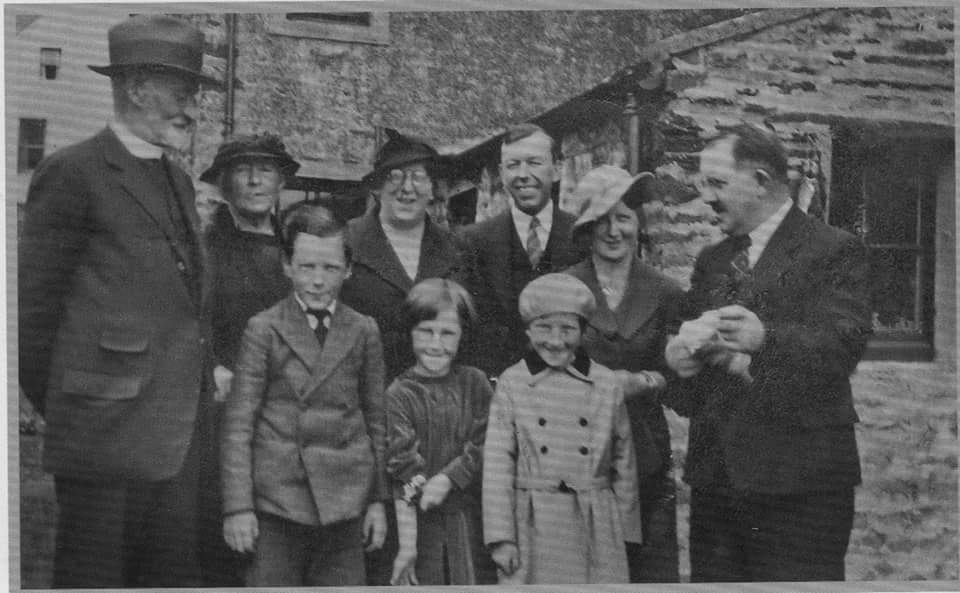
Kathleen’s parents were Hargrave and Kate and she had two older sisters and a brother: Joyce, Betty and Walter. Hargrave, known to everyone as Hardy, was a draper. His shop, H W Leask, was at 55 Victoria Street, where the Royal Hotel is now. As well as working clothes, Sunday Best dresses, suits, children’s clothes, underwear and bed-linen, he sold boots and shoes, wool, dress-making materials and linoleum. After she left school, Kathleen helped in the shop but she was involved in the business long before that.
Between the wars, the Stromness shops struggled. The country-wide recession was especially hard in Stromness, where too many shops competed for what business there was. Kirkwall’s trade was growing and Oxendales and JD Williams catalogues were making their first appearance. Hardy was heard to remark that he would do just as well with a shop on Suleskerry.
Every effort had to be made to keep your customers and one way to do this was by visiting them, so Hardy travelled all over the West Mainland. During the school holidays, Kathleen would go with him but it was strictly on her terms.
“I’d check where he was going before I agreed to come and I’d decide which car hire firm we’d use, as I liked some o’ the drivers better than others. Dad had to spend a while in each house and I’d often stay out with the driver. The firm I chose wis usually Johnna Willa (John William Sutherland), who lived right opposite the shop, in a hoose above the arch, and hid a garage at the North End somewhar.
Dad would have twa-three suitcases fill o’ drapery: working trousers, peenies, sheets and that kind o’ thing and I’d pack me own peedie case. I took what wis called “small wares” – bias binding, needles, black and white purms and anything else that took me fancy. I remember wan trip I made £8, though I didn’t get tae keep it, of course.
Hid wis very handy for Dad tae have me as an excuse no’ tae accept hospitality. In chist aboot every hoose you’d be offered a cup o’ tea or asked tae stay for dinner. You could have eaten yer wey around the West Mainland but if you hid something in wan, bit no’ at the next, this wis soon found oot and gave great offence. Dad chist said he’d promised the bairn a picnic and I’d be upset if we didn’t have it. We’d get hot water fae the last hoose we visited, tae mak’ the tea, and then we’d sit oot on a heathery brae or chist in the big roomy car if the weather wisn’t great.
Of coorse, Dad widn’t go in a hoose as if he’d come tae sell anything. He’d sit doon and speak aboot everything bit the cases he hid wae him. Hid wis only when he made motions tae go that the folk wid sae, “Bit ye’ve no shown us whit’s in yer cases”.
Birsay, especially Marwick, wis the favourite stamping ground. Although Dad came fae Barnhouse in Stenness, he wis very fond o’ Marwick and every time hid cam’ in sight, he’d say, “Ah, the gairdeen o’ Orkney”. I remember an odd peedie sweetie shop somewhar on the road past the Barony Hotel. There wis chist some shelves on wan waal o’ the sitting room. I don’t know if she selt anything else. There wis anither wife in Birsay who hid never been tae Stromness or Kirkwall in her life. She wis a busy fairmer’s wife and she hid the local shops and aal the shop vans for everything she needed.”

School was an unavoidable part of childhood, though as soon as Kathleen started school, it closed. A large part of Stromness Academy was pulled down and rebuilt and for about three years the children were taught in various buildings around the town.
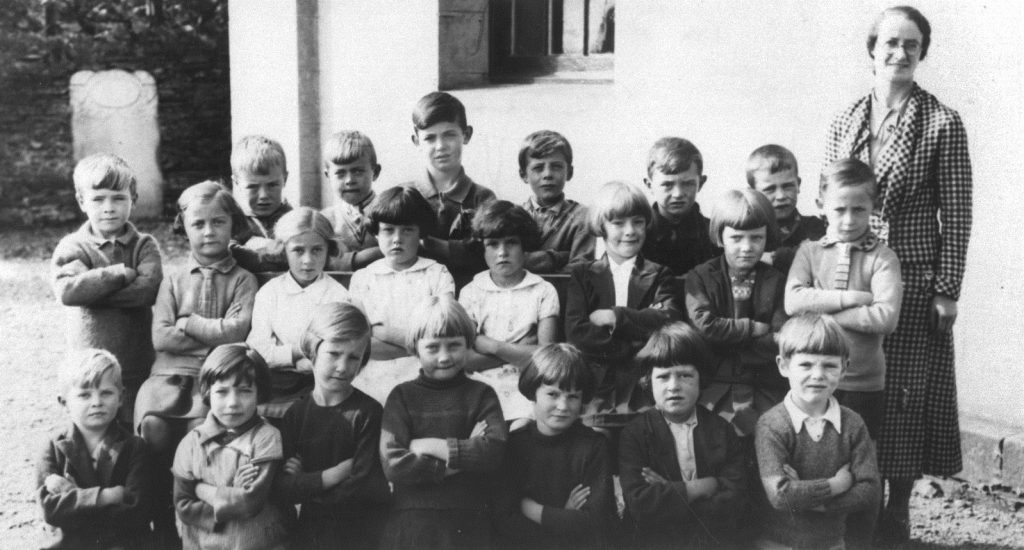
“I think I remember gaan to the Academy on me first day and the infants flittan doon tae the Owld Kirk hall. This wis St Peter’s, that’s noo the Community Centre and the hall that Upper and Lower Infants shared is noo whar they have the Flower Show at Shopping Week. I seem tae remember being given a big ink bottle tae cairry doon the road. I spent two years there, in the infants, and then anither year in the hall o’ the Free Kirk (now the Town Hall). Me first teacher was Miss Matheson and then I was taught by Ruby Brown, George Mackay Brown’s sister, for five years. I liked her, as she wis a good and fair teacher who didn’t have favourites.”
Kathleen isn’t sure exactly when she started school but thinks it probably wasn’t before her fifth birthday in October because that was marked by having her tonsils out. The operation was performed by the local GP, Dr Shaw, whose son Robert went on to Hollywood success. Kathleen remembers playing with the Shaw children and Robert breaking his toes in an accident on a swing and having to be wheeled around in an old pushchair.
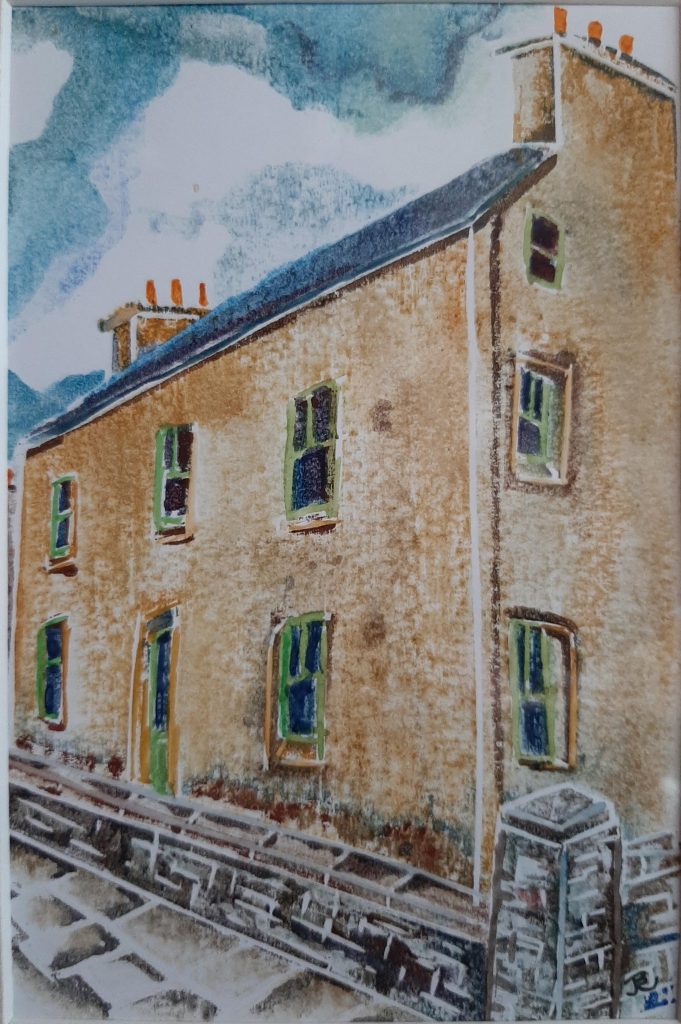
During their spare time, the children were free to amuse themselves wherever they liked. Those who lived in the centre of the town gathered on the dyke in front of Lyness House, next door to Kathleen’s home at 6 Graham Place, to decide what they were going to do. Rounders in the Square itself was always popular and so was Leave-Oh, a version of Hide and Seek that was played over a large part of the town. Skipping, ball games and walking on home-made stilts all had their seasons.
When she wasn’t playing with the other children, Kathleen often headed to one of the nearby bakehouses, where the bakers were happy to chat. Stockan’s bakehouse right next door was a bit too busy for that but Buck Spence, whose bakehouse was at the foot of Porteous Brae, was always pleased to have her sit and watch him work.
“I wis always entertained by Buck’s way of measuring out buns. He’d scoop up a handful o’ cake mixture and squeeze until a blob formed on top of his fist. He flicked this onto the tray tae mak’ a penny bun and pit six o’ them taegither tae mak’ a sixpenny bun.”

The brae gets its name from Porteous’ Shop, that used to be further up on the left, just below where readers may remember Drever and Boyce’s licensed grocers. Porteous’ bakehouse, which Kathleen also visited regularly, was surprisingly far from the shop, on the left side of the lane beside where Stromness Books and Prints is now. The other shops in Graham Place were Provost Marwick’s draper’s shop, where Cream is now, and a little cobbler’s shop, now demolished, at the foot of Pigeon Creek, the little lane to the right of the Wide Close.
When Kathleen was eleven, her father commissioned a rowing boat from Mr Mackay and Kathleen regularly visited his shed at the far end of the harbour after school, to check on progress. When it was complete, he only charged one pound per foot for the ten and a half foot boat. Hardy thought he was being undercharged and gave him a bit more. The boat became Kathleen’s pride and joy, providing activity and entertainment for the next ten years. Like most of the Stromness children with access to a boat, Kathleen went fishing for sillocks, usually with Hardy or Walter. In those days before leisure wear, Hardy went fishing in the same suit he wore in the shop. When there were two in the boat, it was usual for one to row and one to fish. The fisher sat on a plank across the stern of the boat, with a rod in each hand, sitting on a third. Each rod had three hooks on it so on a good night you could easily catch more than thirty fish.
“When you got in, you just hoped that your neighbours were anxious for some sillocks. They were fine when they were fresh but there wis nothing else you could do wi’ them, unless somebody wanted some for their cat. You only went fishing for sillocks after they’d had ‘three drinks o’ the May flood’: after the first three high tides in May. And you never fished for sillocks in the harbour – nobody wid eat a fish that wis caught there. You only started fishing after you’d passed the beacon. Ma used tae say the fish chist followed us oot, and she wis probably right.”
Kathleen isn’t sure what age she was when she became a Brownie but she does clearly remember sitting on the stairs, not wanting to enlist. Her mother, who was the District Commissioner, was sure she’d like it, as her sisters had, and coaxed her to go, saying that if she didn’t enjoy it, she didn’t have to go again. Kathleen stomped home later saying, “Well, I didn’t like it,” but she was prevailed upon to keep going and concedes she did have fun once she got there. She even went on to join the Guides and remembers Lady Baden-Powell visiting the troop.
Electricity didn’t come to Stromness until after the war but the town had coal gas, supplied by works at the North End. Kathleen has fond memories of winter nights in the town, with the brightly lit shop windows. One of the gas lamps was right opposite their house and cast enough light into the bedrooms to save having to take a light if you went upstairs for something. It was the street-sweeper’s job to light the lamps, usually accompanied by a small group of boys. In earlier days, they had been put out again late in the evening but Kathleen remembers them being left on all night. Some gas was saved by not having the lamps lit on moonlit nights.
Many houses had gas cookers, as well as gas light and one unfortunate Christmas, families returned from the church service to find the goose uncooked and the oven cold. One housewife marched up to the gas-works, to find the men, who had been celebrating unwisely, asleep on the coal. She woke them, exclaiming, “My goose isn’t cooked!” “On, missus,” one of them replied unhappily, “mine is.”
One of the highlights of winter was the Sunday School Christmas party. Kathleen’s family attended the Victoria Street UP Church, just across the road, and the party was held in the hall at the back. There were great preparations, as the frock and party shoes had to be bought and the party-piece learned. Not everyone did a party-piece: only those picked by the Sunday School teachers or the natural show-offs, who volunteered. The more musical and confident children sang and the others, like Kathleen, did recitations. A lot of work went into finding something good that no-one else was likely to have. Likely sources, such as the back of the People’s Friend, were scanned for weeks beforehand.
The evening began with supper, which came in a paper poke, of course. There was a jammie cookie, a piece of cake and probably a sandwich. As soon as they’d finished their supper, the children blew up the bags and burst them. Kathleen felt sorry for the teachers, who sat at a table beside the fire and had to use cups, saucers and plates, rather than getting a paper poke.
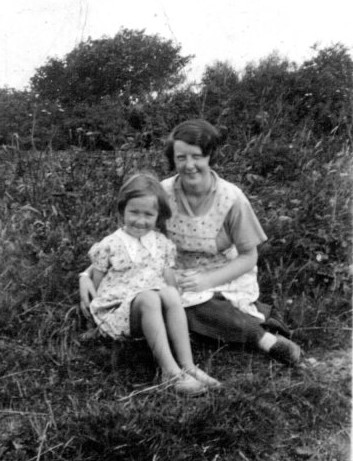
“While the tables were being cleared, the bairns were allowed tae play in the kirk. The cocoa-matting in the aisles was great for slidan on in wur new shoes and we aal hid a turn in the pulpit. We were called back intae the hall wance hid was cleared and played games. The favourites were Here We Go Gathering Nuts in May; In and Out the Dusty Bluebells; I Sent a Letter to My Love; There Was a Jolly Miller and The Farmer’s in his Den. Wir party-pieces came efter the games, hid wis probably tae calm us doon before we went home. The minister, Mr Wilson, tried community singing wan year bit stopped it early, as soon as he realised we were singan words he hidn’t heard before, like ‘She’ll be wearing khaki bloomers when she comes’.”
Before Shopping Week was invented, the biggest day of the year for the shops and people of Stromness was Market Day, on the first Tuesday in September, when all roads in the West Mainland led to the town and boats came from Graemsay, Hoy and Flotta. Kathleen’s mother Kate prepared a picnic that was eaten in the little back office, because there was no time to go home for dinner. By the end of the day, there would be boxes all over the floor, as there hadn’t been time to put them away.
The ‘showies’, or sideshows, spent all week at the Pierhead and the main attraction was the shooting stall. Anyone who scored at least twenty-one out of twenty-four could come back to the shoot-off in the evening. The prizes were quite substantial and the competition drew a crowd of spectators. Hardy was a very good shot and the family had two gramophones that he won. His best prize was the large American clock that is still going today but he ran into problems getting it home.
“He’d gone in by the Commercial Hotel tae have a drink wi’ Mr Robertson and wis headan home gey late, tryan no’ tae disturb the family or the neighbours. Then, chist as he wis crossan Graham Place, the clock, which turned oot tae have a very loud chime, began tae strike midnight.”
More regular entertainment could be found at the foot of the Hellihole Road, every Thursday and Saturday night. In those pre-television days, going to the pictures in the Town Hall was a weekly event, no matter what the film was. The audience settled down on long wooden forms, those with reserved seats sitting on padded forms in a raised section at the back. The settling down took a while after the lights went down because young couples never went in together. To avoid the inevitable whistles and comments, boys and girls went in separately then, as soon as the lights went down, the boys crawled under the benches to squeeze in next to their girlfriend.
As speculation of a war with Germany grew, Hardy Leask, like many others, bought a wireless set to keep in touch with the news. To ten-year-old Kathleen, the talk seemed to go on for so long that it was almost a relief when war was declared. Stromness had no idea just how much life was about to change.
This article about my mother appeared in Living Orkney in March 2010.