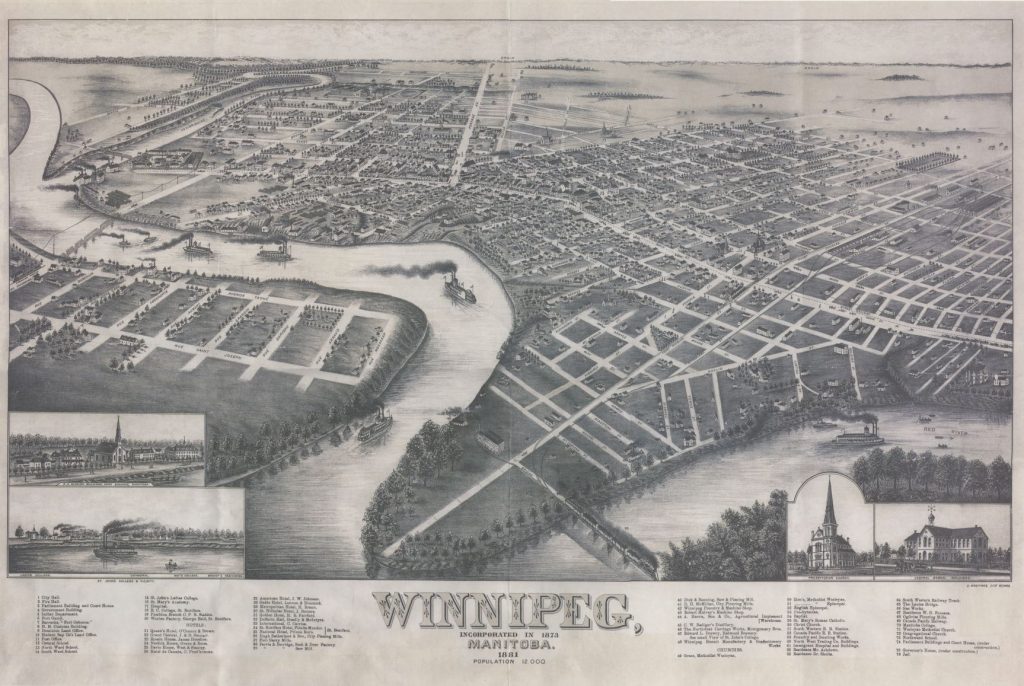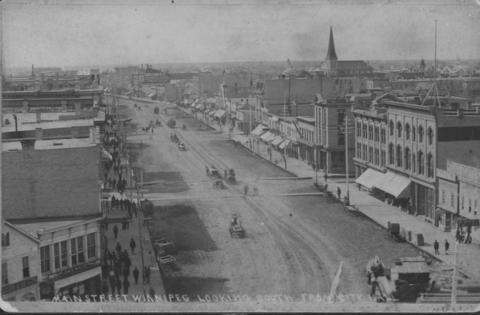
When Manitoba became a province of Canada in 1871, the first parliament building was the Winnipeg home of a man from South Ronaldsay, Andrew Graham Ballenden Bannatyne. His house was so large that he could let the legislature use four rooms. He was one of the wealthiest men in the town but he was not the only successful Orcadian businessman there. About a quarter of the men who formed the first Winnipeg Board of Trade, in March 1873, were Orcadians or the sons of Orcadians: John Inkster and his son Colin, William Drever, Robert Tait, James Clouston, William Flett and George Kennedy.
Three of the Board of Trade members have had roads named after them: Bannatyne Avenue, Inkster Boulevard and Tait Avenue. There are two more named after Orcadian settlers: Mowat Road after Edward Mowat from Orphir and Setter Street after Andrew Setter, or Seatter. It is no surprise that Orcadians played such a prominent part in the early life of Winnipeg because they were there right from the start.
When I learned a square dance called Red River Valley at Girl Guide camp many years ago, I had no idea, as I swung with the girl from the Valley and swung with the Red River girl, that they might have had Orcadian ancestry. Ernest Marwick was the first to write about ‘The Orkneymen of the Red River’, researching the history of the settlement that grew into the city of Winnipeg.
Ernest was a journalist and local historian who was fascinated, as I am, by 19th Century Orkney. He came to realise that emigration to Canada played a big part in the story and so turned his attention across the Atlantic. He read a paper to the Orkney Antiquarian Society in 1952, which was published in Volume I of the Orkney Miscellany the following year.
Emigration to Canada had begun much earlier, thanks to the Hudson’s Bay Company. Stromness was the last port of call for their ships before they headed out across the Atlantic and very early in the 18th century, they began to recruit Orcadians. By the end of the century, the HBC played an important part in Orkney’s economy. In the First Statistical Account, the Stromness minister, Rev William Clouston, wrote:-
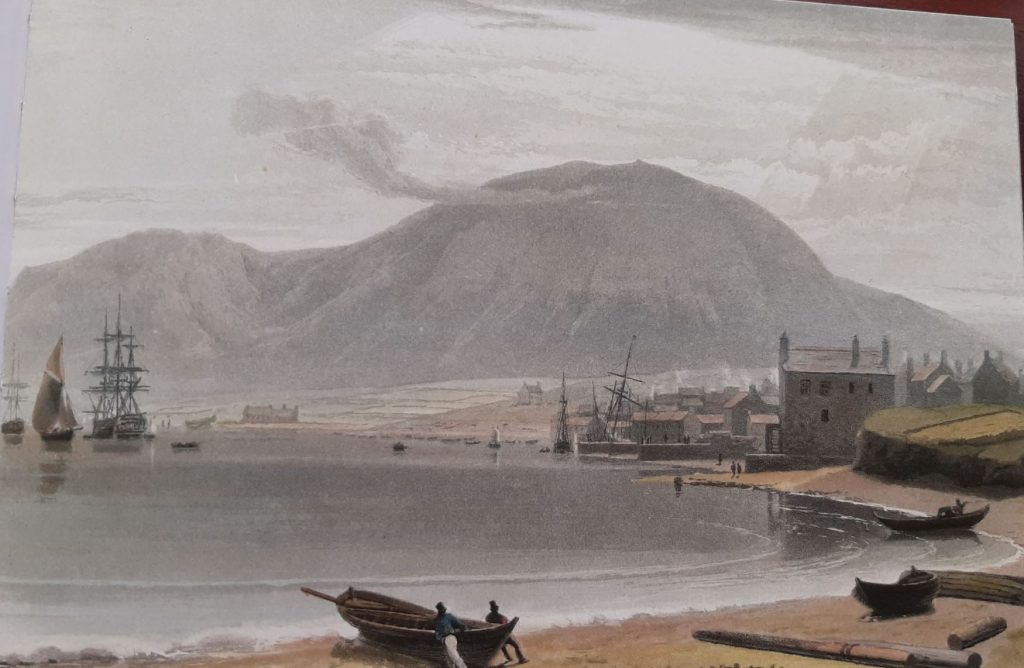
This Company fits out three ships, from 150 to 400 tons each, which carry out provisions, guns, powder, shot, hatchets, cloths, etc. to be exchanged with the Indians for beaver and other furs. These vessels usually arrive at the harbour of Stromness about the first of June, where they stop for two or three weeks to take aboard men for their settlements. They engage usually from 60 to 100 men, natives of this country, to go to these settlements every year. They have about 400 or 500 men in these settlements, of whom it is presumed three-fourths are Orknese, as they find them more sober and tractable than the Irish and they engage for lower wages than either the English or Irish.
… and although it is no doubt better for a country to keep its natives at home, provided they can be usefully employed, either in agriculture or manufactures, yet where there are not manufactures, or improvements in agriculture, thus to employ them, it is the better to hire them to those who can usefully employ them; and also better that they go to hunt the harmless and civilised beaver, than, like the Swiss, to fight the wars of other nations for hire.
At its peak, in 1800, 418 of the Company’s 524 employees were Orcadian. Most of them came home; many, like my g-g-grandfather Adam Kirkness had saved enough to buy a small farm. But a good number stayed in Canada and settled in the Red River Valley.
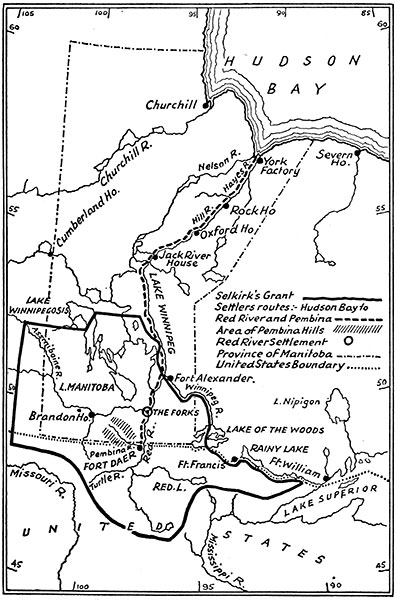
The Red River rises on the border between Minnesota and North Dakota and then flows through Manitoba into Lake Winnipeg. When Thomas Douglas became the 5th Earl of Selkirk in 1799, he focused his energy on establishing a colony in North America for Highlanders displaced by the Clearances and thought the rich river valleys of southern Manitoba were perfect for the purpose.
The Hudson’s Bay Company finally agreed to grant 116,000 square miles in the Red River Valley, on condition that he settled one thousand families in the colony within ten years and that one-tenth of the area was to be set aside ‘for servants of the Hudson’s Bay Company who might wish to settle there’.
According to Ernest Marwick, recruitment of the colonists began in Scotland in 1811. After many problems and delays, the first settlers arrived in the Red River at the end of August 1812. The group included four Orkneymen, John Cooper and Magnus Isbister, both in their twenties, 34 year-old Nicol Harper and 50 year-old George Gibbon.
The colony struggled through its early years but things settled down after the union of the HBC with the North-West Company. Ernest wrote:-
To quote Isaac Cowie (a Shetlander whose writings on pioneer days are valued in Canada):
“Prior to the firm establishment of the Red River Settlement on the union of the rival companies, in 1821, many of the Orkneymen, retiring from the Company’s service, took their native wives and offspring with them to Orkney. But after the union these and their fellow employees from the Highlands were encouraged to resort to Red River, where in numbers they soon exceeded all Lord Selkirk’s other settlers…. And it was these Orkneymen, with other veterans of the fur trade from their neighbouring Highlands and Islands and the French-Canadians of the North-West Company, who, coming in sufficient numbers to defend it, made permanent the settlement of Red River.”…
Although the early settlers were largely supported by hunting and fishing, their aim was to become an agricultural community. Many experiments were made to introduce suitable cereals and livestock. Around 1817, there is a record of barley, most probably bere, being imported from Orkney as suitable seed for a severe climate… Many of the community’s first implements and utensils were imported from Stromness. Querns and knocking-stones were very plentiful and some of them remain in the possession of Canadian families. Spinning wheels and looms also found their way across the Atlantic…
In The Opening of the Canadian West, 1967, Douglas Hill wrote of another factor that may have contributed to the high percentage of Orcadians. In 1826 unusually heavy snowfall resulted in a catastrophic flood covering miles of the Red River Valley. Only one life was lost but everyone had to retreat to high ground.
When the flood subsided the more stolid among the colonists started the work of reclamation. Two positive side-effects of the disaster then emerged: the soil was even more enriched by its inundation, and the more restless and unproductive of the settlers decided they had had enough and left for America. Some Irish and a few Scots moved east, to the more placid backwoods of Canada. The most valuable pioneering stock remained: the sturdy Kildonans, the former HBC men (mostly Orcadians) and, of course, the metis.
It didn’t take very long for the settlement to prosper. Ernest Marwick quoted an unnamed writer who described Red River in 1843
We had a population of 5413, 730 dwelling houses, 1219 stables and barns, 18 windmills and 1 water mill, 1570 horses, 3894 horned cattle, 1976 pigs and 3569 sheep, which I consider a splendid showing for the farming portion of the community, as fully half of the population of the Settlement made their living by hunting, tripping and trapping, and besides all these things we had churches, schools, an academy, a public library, court house, jail, a judge, a sheriff, a doctor and thank goodness there were no lawyers to annoy us with insolent letters, no mortgages, no banks to trouble us with falling due notes. It was paradise.
Douglas Hill described the birth of Winnipeg, within the Red River Settlement, when the first free traders in furs set up warehouses and stores near the HBC’s Upper Fort Garry.
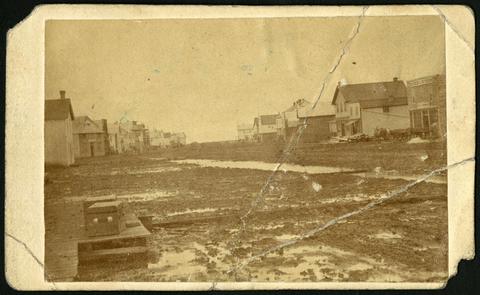
“The collection of ramshackle log or frame buildings, with one or two solid houses, was at first called McDermotville after its leading citizen, an Irish settler-turned-trader named Andrew McDermot, who with his son-in-law, A G B Bannatyne, erected Winnipeg’s first buildings. Soon the town’s shops were thriving, and challenging the Fort as the settlement’s focal point…
Rev George Young, the first Methodist missionary in the west, paints a picture of the village as he saw it in 1868:
…what a sorry scene was presented by that long-thought-of-town of Winnipeg on the day we entered it! What a mass of soft, black, slippery and sticky Red River mud was everywhere spread out before us! Streets with neither sidewalks nor crossings, with now and again a good-sized pit of mire for the traveller to avoid or flounder through as best he could; a few small stores with poor goods and high prices…
Young adds that in 1868 the population could not have been more than 100. In the 1890s, however, when Young was writing, Winnipeg held almost 40,000 people…
In 1871 the prairie path that had been graced with the name ‘Main Street’ was properly surveyed, graded and furnished with one or two culverts (but no sidewalks). It was a symptom of the magnificent optimism that prevailed. Yet the optimists were justified: Winnipeg and Manitoba were on the threshold of great things…
By 1873 Winnipeg’s certainty of future greatness demanded some manifestation in the present. The 2,200 residents clamoured for incorporation as a city – passing grandly over the intermediate stage of ‘town’. The provincial legislature discussed the idea, but due to some procedural technicality the Speaker had to rule the debate out of order, and incorporation was postponed. Proof of the Winnipeggers’ strong feelings on the subject came when the Speaker, the following night, was attacked by a mob, beaten senseless, and tarred and feathered. At the next parliamentary session, needless to say, no further delay arose: the city of Winnipeg was incorporated in 1874. Its name had created some argument: some wanted it to be renamed Selkirk, others advocated Garry, a few suggested Assiniboia. But its early residents had dropped ‘McDermotsville’ in favour of Winnipeg, after the lake, and the name remained.
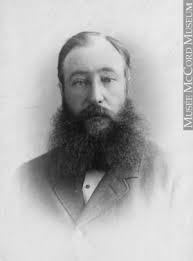
AGB Bannatyne was born in South Ronaldsay but grew up in Stromness, where the Hudson’s Bay Company ships called every year and where the Company Agent was based. His grandfather and uncle, both called John Ballenden, had been Chief Factors in the Company so it is unsurprising that he headed west as soon as I could.
Bannatyne’s second posting was to Red River, where Irishman Andrew McDermot was flourishing as the first free trader that the HBC had allowed to operate. When his contract ended in 1851, he didn’t sign a new one but went into partnership with McDermot and married his daughter Annie. He went on to be an enormously successful businessman and a leading citizen of Winnipeg, earning an entry in the Dictionary of Canadian Biography. http://www.biographi.ca/en/bio/bannatyne_andrew_graham_ballenden_11E.html
Long before Bannatyne arrived in Red River, McDermot’s partner had been James Sinclair, son of Chief Factor William Sinclair, from Eastaquoy in Harray, and his Cree wife Nahoway. Like many of the sons of HBC officers, James had been sent to school in Orkney. He is even said to have attended Edinburgh University but by 1827 he was back at Red River using a bequest from his father, who had died in 1819, to set up as a free trader and go into partnership with McDermot.
In 1841, the Hudson’s Bay Company employed him to lead 23 families, 138 people half-way across Canada, from the Red River to British Columbia. His achievement in leading his group over the Rockies is commemorated in Mount Sinclair and Sinclair Canyon and he too has an entry in the Dictionary of Canadian Biography. http://www.biographi.ca/en/bio/sinclair_james_8E.html
The Manitoba Historical Society has a website full of interesting articles. Hunt through their catalogue of Memorable Manitobans and you will find a lot of Orcadian names, including two sons of Orcadians who became Premiers of Manitoba; John Norquay http://www.mhs.mb.ca/docs/people/norquay_j.shtml and http://www.mhs.mb.ca/docs/people/garson_ss.shtml