When the Italian PoWs left the island of Lambholm in Orkney in 1944, they must have assumed that their beautiful little chapel would be demolished with the rest of the camp. More than 70 years later, it is still here and this is the story of what happened after the Italians went home.
A Nissen hut lined with plasterboard had been transformed, with nothing more than paint, concrete and scavenged bits and pieces, by the artistry and skill of Domenico Chiocchetti and his band of helpers. It was too lovely to be pulled down but, at first, the little chapel struggled. A souvenir booklet was published by The Orkney Herald in 1957 and Ernest Marwick felt the need to write this,
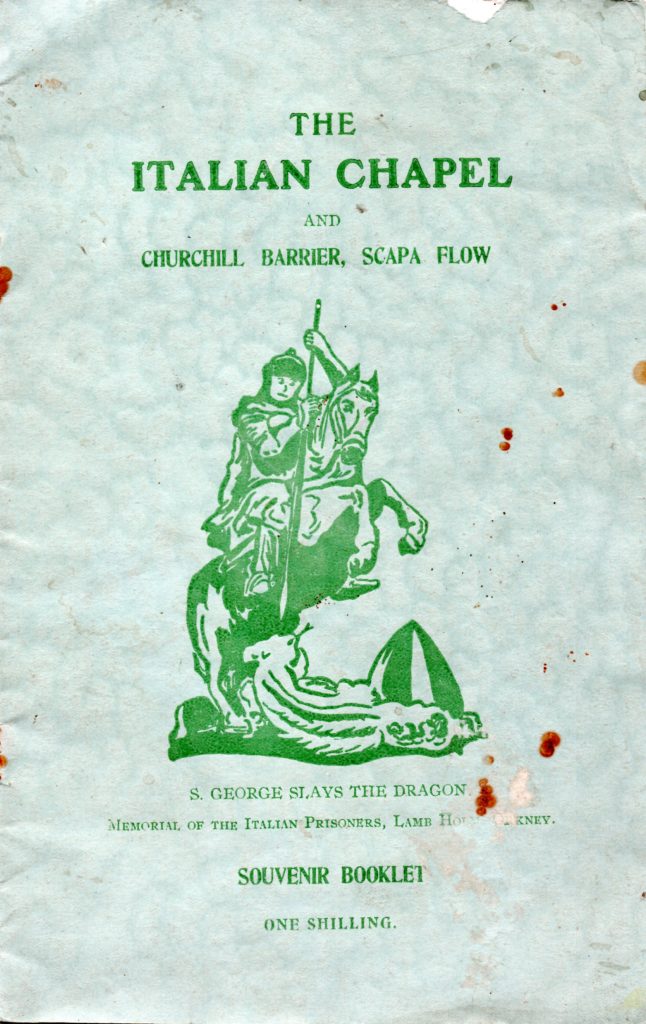
“Visitors will discover with regret the signs of deterioration which are now visible. To forestall criticism of the Orkney people, who have a strong affection for this souvenir of the war years, it should be said that the Chapel has been examined several times with a view to permanent preservation, but experts have found that the condition of the pulp boarding, which gives the whole interior effect, and the absence of the original craftsmen, makes such a generally expressed wish impossible of realisation.
Despite the experts’ gloomy opinions, The Committee for the Preservation of the Italian Prisoners-of-War Chapel was formed on 22 June 1958. The Committee’s existence was only publicised in December because, as The Orkney Herald reported, “It was decided at the time that publicity should not be sought until there was something tangible to record.”
The Committee’s purpose was “to care for the chapel and raise funds for its preservation” and one of the first things they did was to put in a collecting box. Visitors had already been leaving donations but they were now being encouraged to do so and over £100 was collected in the summer. By the end of November, over 7000 names had been entered in the Visitors’ Book. The list of countries included Egypt, Nigeria, Hong Kong and Ceylon.
The Committee employed the local contractor Alfie Flett to make a start on repairs. There was a lot to do, including repairing large cracks in the concrete, replacing broken windows and fitting a self-closing push to the door. The Committee were satisfied by the end of the summer that the Chapel now looked cared for and in better condition than had been thought possible. The article ended by noticing how interest in the Chapel was spreading,
“Various articles about the chapel have appeared in periodicals at home and abroad. A recent one in “Everybody’s Weekly” by Mr Harold Lowenstein, created interest, resulting in a generous offer by the BBC to endeavor to put the committee in touch with the former Italian prisoners-of-war through the agency of its Italian service. The committee is also in communication with Colonel T P Buckland, who was Camp Commandant at Lamb Holm and who is still very interested in the chapel. It was due to his sympathy and help that the building of the chapel was made possible.”
According to The Orkney Herald, Signor C W Riconi, South European Productions Supervisor of the BBC and Signor Finoglio, who worked on the story, were at first unsure of what could be done about the chapel and came to see it before contacting Domenico Chiocchetti.
“They were doubtful if the shrine could be preserved but decided to collect opinions at a dance in Kirkwall. They discovered to their surprise that everyone questioned showed an intense interest in the Chapel, whereupon they determined to get in touch with Signor Chiocchetti”
In December 1959, the Orkney Herald printed an article by Domenico Chiocchetti, entitled Memories of Lambholm and its Chapel.
I was born at Moena on May 13th 1910, the youngest of twelve children of a peasant family. I began to feel drawn to drawing and painting while I was still at elementary school. On leaving school I wanted to go to an art school but family circumstances made it impossible, so when I was fifteen I went to study the art of painting statues and decorative work in a studio at Ortisei….
Domenico was called up and spent six months fighting in Libya before being taken prisoner by the Canadians. He spent another six months in a camp in Egypt before arriving on Lambholm as one of the PoWs chosen to help build the Churchill Barriers which were to permanently block the four channels on the east side of Scapa Flow.
The little island could hardly have appeared more desolate: bare, foggy, exposed to the wind and heavy rain. The camp consisted of thirteen dark empty huts, and mud… In a very short time the prisoners had transformed Camp No 60 into a garden with flower beds and cement paths…

At first Padre Giacobazzi used to celebrate Mass on a table in the mess. When I was talking to him one day I suddenly had the idea of the church. He spoke to the commandant who put a free hut at our disposal. Major Buckland called me and, in his halting Italian, explained to me that we could make some sort of chapel. I told him that if I did it at all I should do it really well. The Major didn’t understand – in fact he thought that I was refusing and annoyed he called the Interpreter. When the misunderstanding had been cleared up, he slapped me on the back and said, “Bravo! Make a good job of it.” That was how the work started.
In March 1960, the Orkney Herald announced that Domenico was coming to restore the chapel and would fly in on the 21st. They said that the visit had been made possible by the great interest taken in the project by the BBC and particularly by members of the Corporation’s Italian Service, though the writer, almost certainly Ernest Marwick, didn’t go into details. He described Domenico as a house-painter by trade but an artist in spirit and aptitude.
Domenico had sent a letter to the Orkney Herald, addressed to Friends in Orkney. He wrote,
One thing I feel I ought to do, or rather, must do, is to express to you all, my friends, my real pleasure and warm thanks for the interest with which, after such a long interval of time, you regard our chapel, and for the fine sentiment which has induced you to form a committee whose aims will be to see to the repairs and the maintenance of the characteristic structure of the shrine thereby making of it a symbol and a remembrance.
I have been touched by your initiative and, let me admit it, have been filled with legitimate pride. I must say too that the time spent in prison has been for me transmuted into something precious if it has allowed me, along with my dear companions, to create a work which you have shown that you hold in high esteem...

Most of all, I remember my own dear Madonna of the Olive which, while war was raging over all the world, came from my brush like an invocation, the more ardently evoked because of exile and the privations from which I was suffering.
All the same, it was not without a sense of sadness that, at the end of the war, I left the island of Lambholm, because that little church and that Madonna depicted above the altar had remained in my heart and I felt I was leaving a part of myself.
With what joy I shall see again the little church and with what renewed enthusiasm I shall attend to the repairs which the usage of time has rendered necessary.
On 5 April, the Orkney Herald reported that the restoration was nearly complete.
The sanctuary of the Italian Chapel has been almost completely restored, and the colours are bright and clear once more. The wrought-iron rood screen, which was covered with rust has been cleaned, coated with red oxide and repainted. Much painting has also been done in the rest of the chapel, which now shows few signs of interior decay. Panels which were broken and defaced have been so cleverly replaced that they cannot be detected. A fresh rosette has been fixed in place on the damaged roof above the altar.
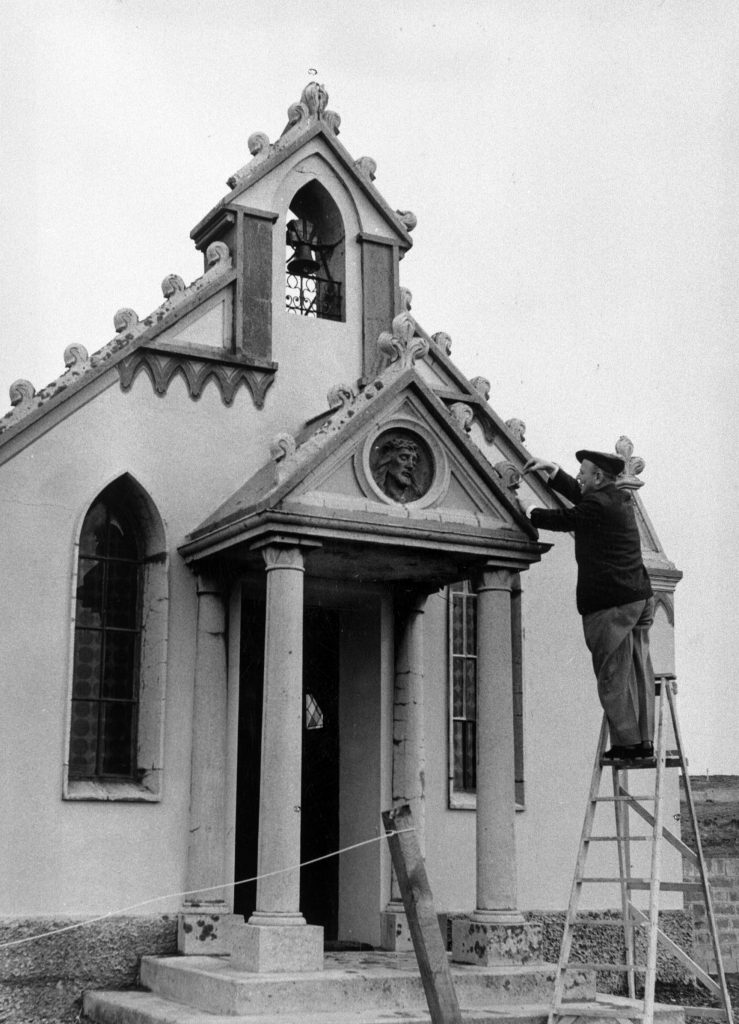
At work on the Chapel exterior [Orkney Photographic Archive] 
Replacing a trompe l’oeil panel [Orkney Photographic Archive]
Throughout the period, Signor Chiocchetti has been assisted in the painting, and in many other ways, by Mr Stanley Hall. Mr Hall has been of the greatest service to the Preservation Committee, by taking in hand the multifarious tasks that had to be done to make Signor Chiocchetti’s work possible, as well as pleasant and companionable… The materials have been of the simplest: his own much worn hog-hair brushes, a few tins of good quality white distemper and a dozen little jars of poster colour.
The Dedication Service was held on the 12th of April, Palm Sunday.
The first of the congregation to go forward to receive Holy Communion was Signor Chiocchetti, who knelt at the altar. His obvious emotion communicated itself to the audience, who found this moment the most moving in the service... Parts of the service were broadcast in the Italian National Programme yesterday evening (Easter Monday) radiated by about fifteen stations. It lasted half an hour.
Four years later, the Orkney Herald reported on Domenico’s return to Orkney. This time, he could show the chapel to his wife Maria. She said,
“The chapel is more lovely than I imagined and people are kinder than I thought possible. The idea that I might come one day to Orkney was only a dream. Now it has come true. I am satisfied and very, very happy.

[Orkney Photographic Archive]
The Chiocchettis brought greetings from the Mayor of their hometown of Moena, in the Dolomites, and from the Mayor of their province, Trento. The Mayor of Moena wrote that the visit was a symbol of peace and brotherhood. He sent his warmest thanks for the warm esteem in which Signor Chiocchetti was held and expressed his gratitude for the way in which the chapel had been preserved. Domenico managed one more visit to Orkney, bringing his two oldest children, Fabio and Letitzia, in 1970.
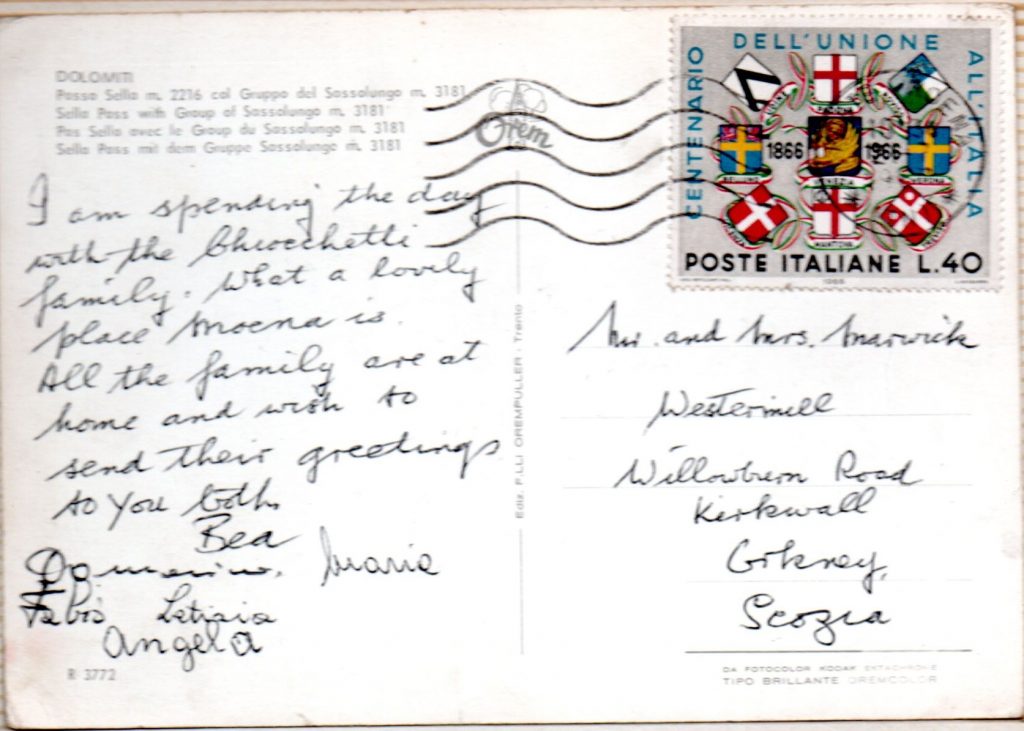
The bonds forged between Orkney and Italy remain strong, with many visits in both directions. The postcard was sent to Ernest Marwick, the Chairman of the Chapel Preservation Committee, by Beatrice Linton, the Latin teacher at Kirkwall Grammar School, who acted as interpreter and translator for the family. I am very happy to have inherited it, as the Italian Chapel is one of my favourite places to visit on tour. The beauty of the Chapel and the story of the triumph of the human spirit never fails to move me and my guests.
.