
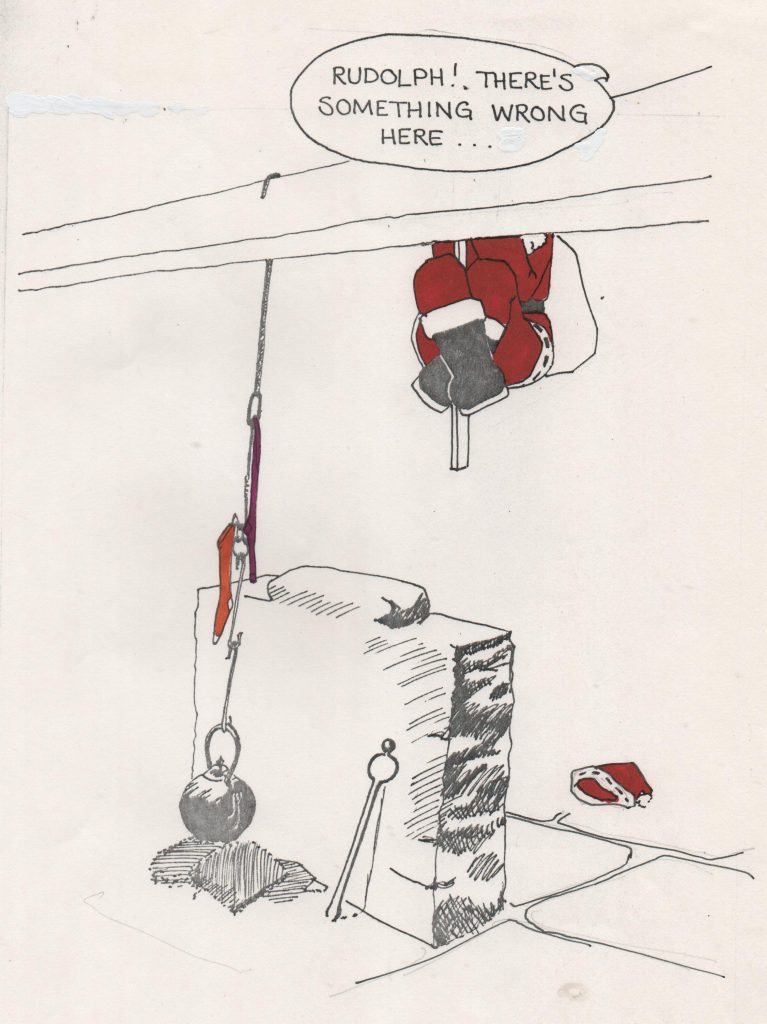
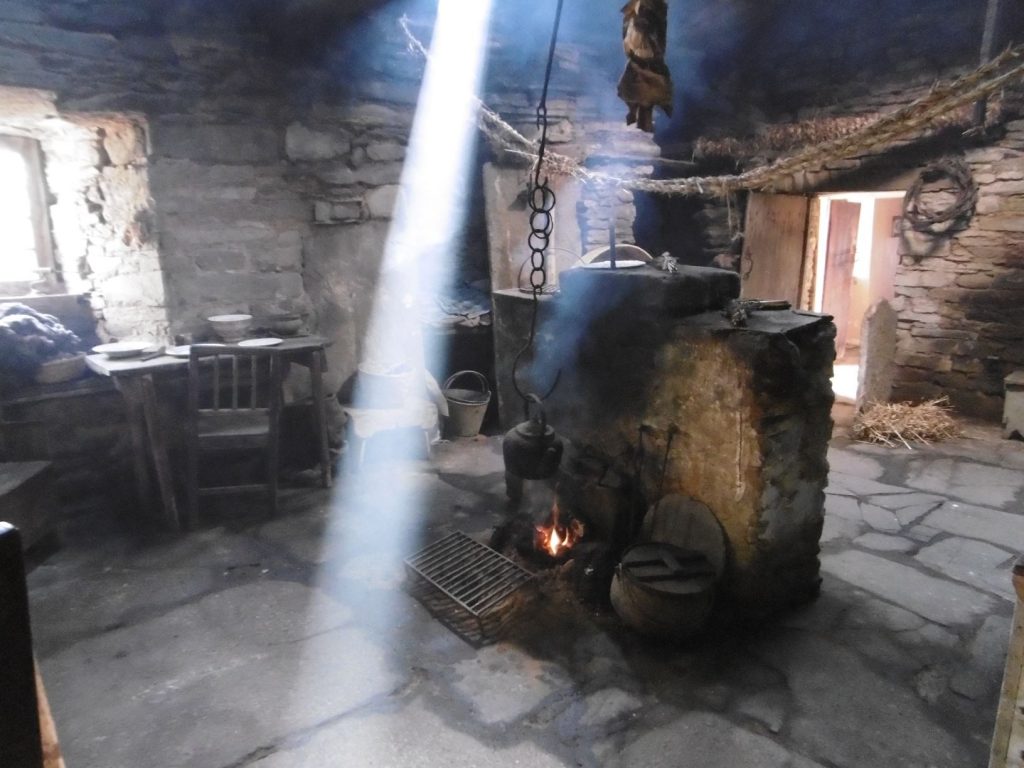
My sister Anne Brundle was Curator of Archaeology at the Orkney Museum and for many years drew a cartoon for the Orkney Museums Service Christmas card. This was one of the first and shows Santa having problems in the house that is now the Kirbuster Farm Museum. It is the last surviving example of a house with a fire in the middle of the floor. The smoke goes out through a hole in the roof and Santa is clinging to the skylar: the pole with which you could adjust the opening, depending on the ‘airt’ of the wind.
By the time John Firth’s book, Reminiscences of an Orkney Parish, was published in 1922, there would have been very few houses like this but the Yule season would have been little changed.
“Though the time was changed in the year 1752, Orcadians held to the old style, which was twelve days later. Even within forty years back, one old residenter in Finstown stuck tenaciously to old Yule Day and old New Year’s Day.
Preparations for these feast days were made by baking scones, brewing ale, and by taking in an extra quantity of peats on Yule Even, the paety neuk being filled up to the rafters with a supply sufficient to last over New Year’s Day. On Yule Day no work was done, the day being spent in visiting and treating. If open weather, one or two of the old men made a pilgrimage in the early morning to the top of the hill, to see if any trace of frost could be found, for a green Yule augured ill for the health of the community. A dance for the young people was held in the evening, all returned to their homes for supper, for that was the event of the day. The other meals of the day consisted of the usual cheese and bread accompanied with ale, but there was always “flesh” for supper.
It took a while for Christmas to take over from New Year Day as the main celebration in Orkney and probably happened at different speeds in different districts. John Firth lived in the parish of Redland, north of Finstown. This lovely family story from about the same era happened near Stromness

When oatmeal and kale made up a lot of the Orkney diet, the New Year dinner was a very special event. Jimmy Burnett, a cousin of my grandmother’s, was a boy of five, living in a little house at the top of the brae of Clouster, just outside Stromness. The next summer, he was going to be a herdie-boy at the farm of Clouster so he had been invited to the New Year dinner. His excitement at the prospect was only matched by his disappointment on New Year’s morning, when he woke to drifts of snow too deep for a little boy to walk through. Then he saw one of the servant-men, trudging up through the snow, just to carry him down the hill for his dinner. About sixty years later, when he told my father the story, the thought of that man’s generosity still brought a tear to his eye.
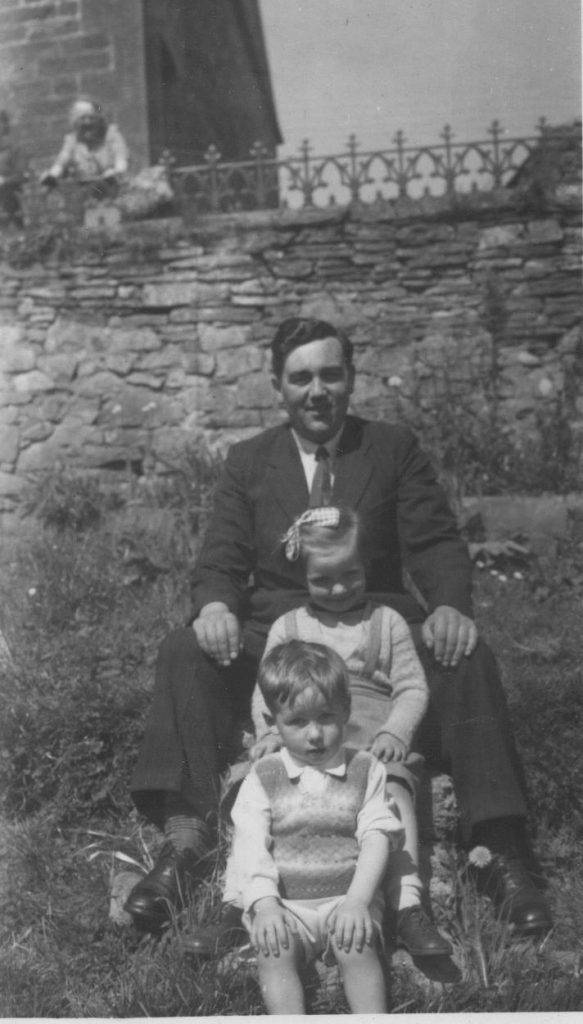
Even in the 1950s, many Orcadians worked on Christmas Day; the ferry sailed, the post office was open and the shop vans went on their rounds but celebrations were still fitted in. Jimmy Garson, who married my mother’s sister Betty, was driving a shop van for Stockan’s Bakery in Stromness and went out as usual, but not before sitting down to a full Christmas Dinner that Mrs Stockan provided for the bakers, before they went home to bed, and the van men before they set out. Now, Orcadians are famous, you could almost say notorious, for their hospitality and, in my parents’ and grandparents’ time, it was impossible to leave a house without a cup of tea and some substantial home baking, at the very least. When Jimmy delivered to Flett’s Shop in Dounby, just as the staff were sitting down at the table, there was no way to refuse his second Christmas dinner of the day. He had been invited to spend Christmas evening with his fiance’s family. I don’t know whether he realised before he got there that they always had their Christmas dinner in the evening.
In 2017, I and my friend Jeanne Rose published The Heart of Stromness, Stories My Mother Told Me, a little book of my mother’s stories about growing up in Graham Place, in the heart of Stromness.
Kathleen loved the street on winter nights, with the brightly lit shop windows. The first sign of Christmas approaching were the little suggestions in the window of Marwick the Tailor’s in Graham Place: A Present for Auntie; A Present for Grandad or A Present for a Friend. Kathleen enjoyed helping her father fill their display cases [in his draper’s shop] with Christmas gifts but did wonder if any man really wanted gent’s suspenders with armbands to match. In the years of rationing, there were no boxes of chocolates so boxed handkerchief sets were popular: two men’s or four ladies’ for one clothing coupon.
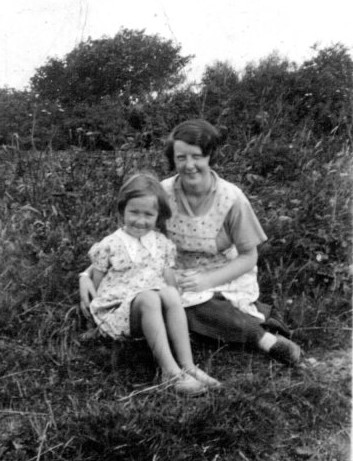
One December when Kathleen was about eight, her eyes were drawn to something new in John Rae’s brightly-lit window: a toy sewing machine. When she got home, her parents could tell something was wrong but she refused to talk about it. After a day or two of this, Walter was asked to find out what the problem was, as Kathleen always confided in her big brother. She told him about seeing the sewing machine, just days after she had sent her letter up the chimney to Santa. Walter sympathised with her and then suggested there might be a solution. Kathleen agreed it was worth a try, so she shouted her request up the chimney and was thrilled when she discovered on Christmas morning that it had worked.
Mum was born in 1928 so she didn’t remember the Yule Log contest which stopped in the early 1930s. It was reintroduced in 2017 but in a very different format. This is how George S Robertson described the earlier version in History of Stromness 1900-1972.
Each Christmas Eve there was the contest of the Yule Log on the streets between the Northenders and the Southenders. It is not known if the original was a real log but in this century it was a tree. You would be wrong to conclude that a public-spirited person donated a tree for this melee, for the facts were very different. Under cover of darkness, the selected tree was mainly sawn across, to permit of a quick get-away on the vital night. It is recorded that the Revd. James Christie stood guard on his precious trees on the occasion and doubtless others were doing likewise. With ropes attached to the tree, the streets were soon strewn with broken branches as the tree advanced south or north towards the goals – Ma Humphs for the Southenders and the Pier for the Northenders. This game mercifully ceased about 1930 for our trees could not sustain the loss of one per annum, ad infinitum.
Kirkwall’s Ba Game, played on Christmas Day and New Year’s Day, [unless those days are Sundays, in which case the games are moved back a day] is world-famous, to the extent that it even featured in The Simpsons cartoon series. Groundskeeper Willie revealed that he came from Kirkwall and had been traumatised by his parents supporting different teams – one was an Uppie and the other Doonie. Traditionally, you cannot choose your team, it depends on where you live in Kirkwall or in which direction you first entered it. I think it is a little more flexible now. Many other parts of Orkney used to have a Ba’ game. The Stenness game was played in a field near the Mill of Ireland and in Stromness the teams and the goals were the same as for the Yule Log. The Stromness game ended in the late 1920s, probably because Guilio Fugaccia installed plate glass windows in his ice-cream parlour.
Mum remembered the Christmas parties in the Victoria Street Church Hall in the 1930s.
The Sunday School party was usually held in the hall behind the Church and was one of the highlights of the winter. Anticipation built, as the party piece was prepared and the party frock and shoes were bought. Like parties and socials everywhere, supper, usually a sandwich, a jammy cookie and a piece of cake, was served in a paper bag, which was blown up and burst as soon as it was empty. Kathleen felt sorry for the Sunday School teachers, who were served their supper on a plate.
While the tables were being cleared, which can’t have taken long, the children were sent into the kirk. They made good use of the one chance in the year to play in there. The girls’ party shoes had smooth soles, perfect for sliding on the cocoa matting in the aisles, and everyone took a turn in the pulpit.
Once they were back in the Hall, the favourite games were Here We Go Gathering Nuts in May; In and Out the Dusty Bluebells; I Sent a Letter to My Love; There was a Jolly Miller and The Farmer’s in his Den. After the games came the party pieces, probably to calm the children down before they went home. The minister, Mr Wilson, once tried Community Singing but stopped when he realised the children were singing words he didn’t know, such as, “She’ll be wearing khaki bloomers when she comes”.
By the time I was going to the Christmas parties run by the Women’s Guild in the Stenness Hall in the 1960s, a few things had changed. Supper was mince and clapshot, followed by jelly. We still slid around but on the Slipperine-dusted floor. We still played I Sent a Letter to My Love and the Farmer’s in his Den but the other games had been replaced by The Grand Old Duke of York, Musical Chairs, and Pass the Parcel. We played all the games to live music, supplied by Jean Muir on the piano, Dan Coghill and Willie Harvey on the fiddle and Jimmy Seator on the accordion.
At eight o’clock, there was loud knocking on the hall door, we all sat down and Santa was escorted in. I don’t think we ever heard him speak, for the very good reason that we might have recognised his voice, as our fathers took it in turn. The minister, Rev David Williams, told us what he had said and read out the names on the parcels. Every child in the parish up to the age of 12 received a present. I remember a game of Happy Families and a Magic Drawing book.
After Santa left, to the sound of us all singing Jingle Bells, the evening was still far from over. Fathers would arrive, most of them having finished working in the byre, and there was supper, with large wooden trays of meat paste or egg sandwiches and every kind of cake. I remember there was dancing after supper and I presume there would have been the St Bernards Waltz, Eva Three Step and Strip the Willow but the only clear image I have is of lines of dancers doing the Palais Glide. Finally, about ten o’clock, it was time for home, after five hours of almost non-stop fun and games.
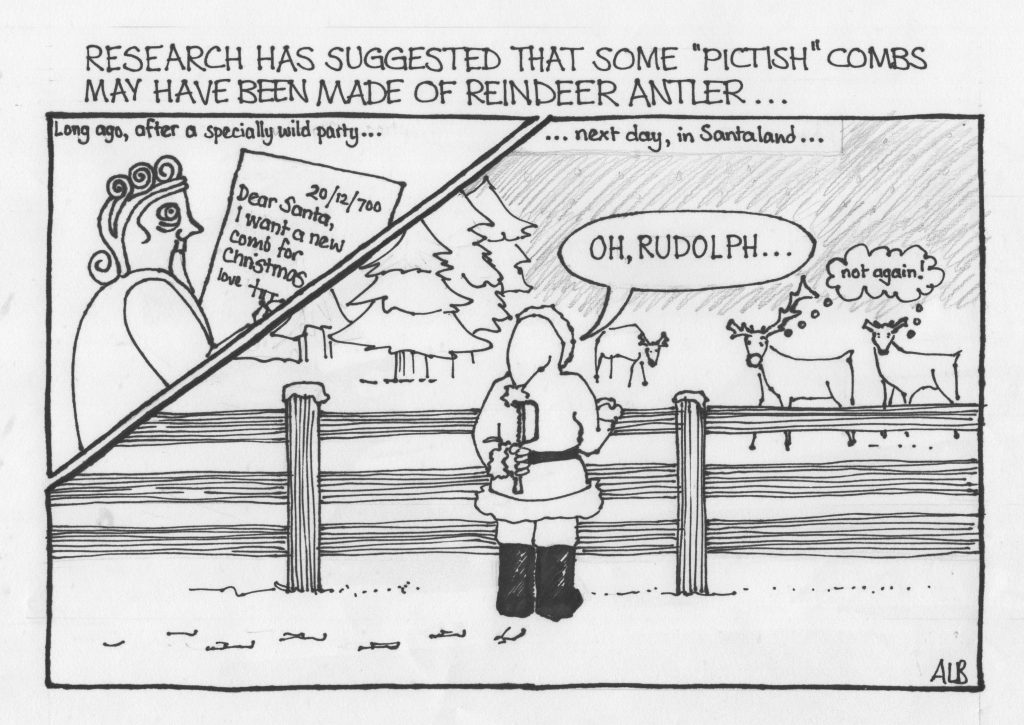
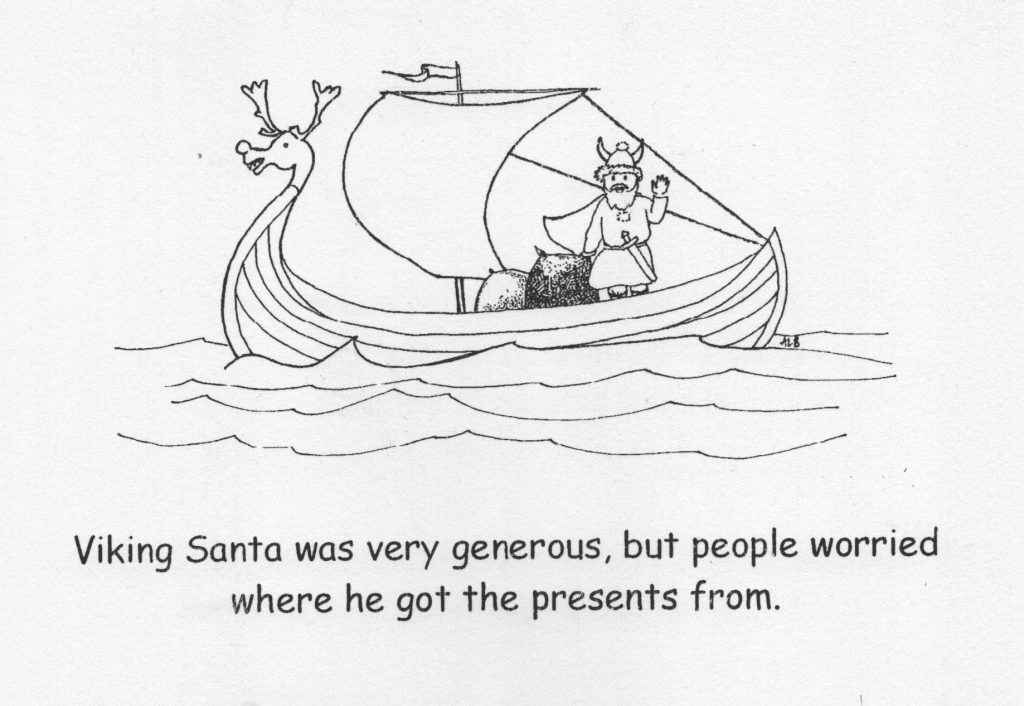
The American author Washington Irving, whose father William came from Shapinsay, and whose story is in the People section of the website, https://www.aboutorkney.com/biography/washington-irving/ had a surprisingly profound effect on our Christmas. In his first book, Dietrich Knickerbocker’s History of New York he changed St Nicholas’s image to a jolly dutchman smoking a pipe and riding a sleigh over the treetops. Some years later, he and his friend Charles Dickens agreed that something should be done to revive the celebration of Christmas. Irving described spending Christmas in the English countryside in Geoffrey Crayon’s Sketch Book and Dickens freely admitted drawing heavily on this in his more famous depictions of Christmas in A Christmas Carol and Pickwick Papers. Irving wrote,
Of all the old festivals, however, that of Christmas awakens the strongest and most heartfelt associations… It is a beautiful arrangement, also, derived from days of yore, that this festival, which commemorates the announcement of the religion of peace and love, has been made the season for gathering together of family connexions, and drawing closer again those bands of kindred hearts, which the cares and pleasures and sorrows of the world are continually operating to cast loose….
There is something in the very season of the year that gives a charm to the festivity of Christmas. At other times we derive a great portion of our pleasures from the mere beauties of nature… The dreariness and desolation of the landscape, the short gloomy days and darksome nights, while they circumscribe our wanderings, shut in our feelings also from rambling abroad and make us more keenly disposed for the pleasures of the social circle. Our thoughts are more concentrated, our friendly sympathies more aroused. We feel more sensibly the charm of each other’s society…
Amidst the general call to happiness, the bustle of the spirits, and stir of the affection, which prevail at this period, what bosom can remain insensible? It is, indeed, the season of regenerated feeling – the season for kindling not merely the fire of hospitality in the hall, but the genial flame of charity in the heart.
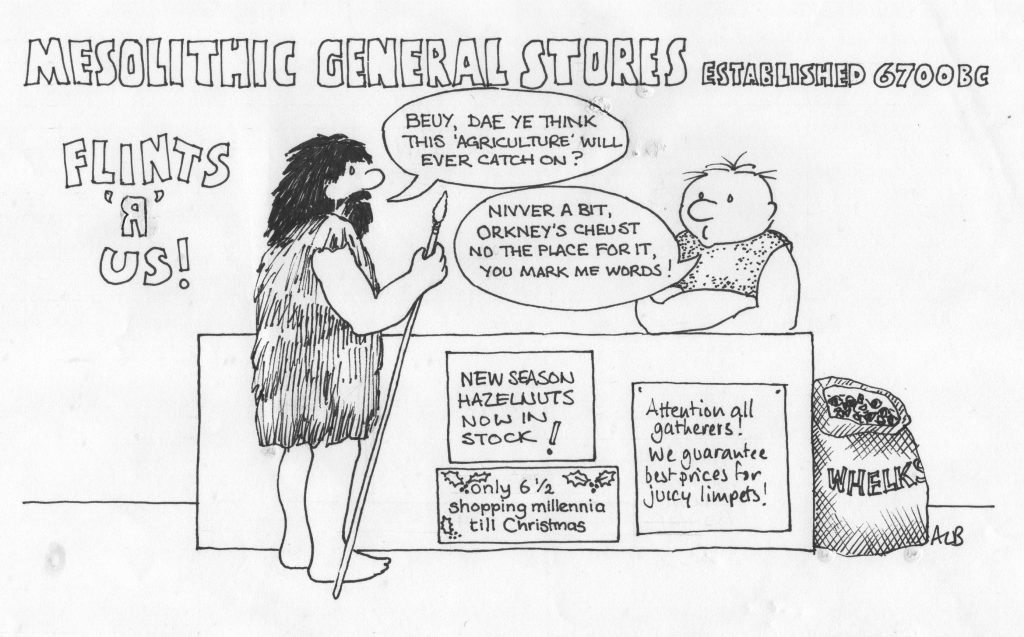
A charred hazelnut found in the East Mainland in 2007 was carbon-dated to c 6700 BC, giving the first evidence of Mesolithic activity in Orkney 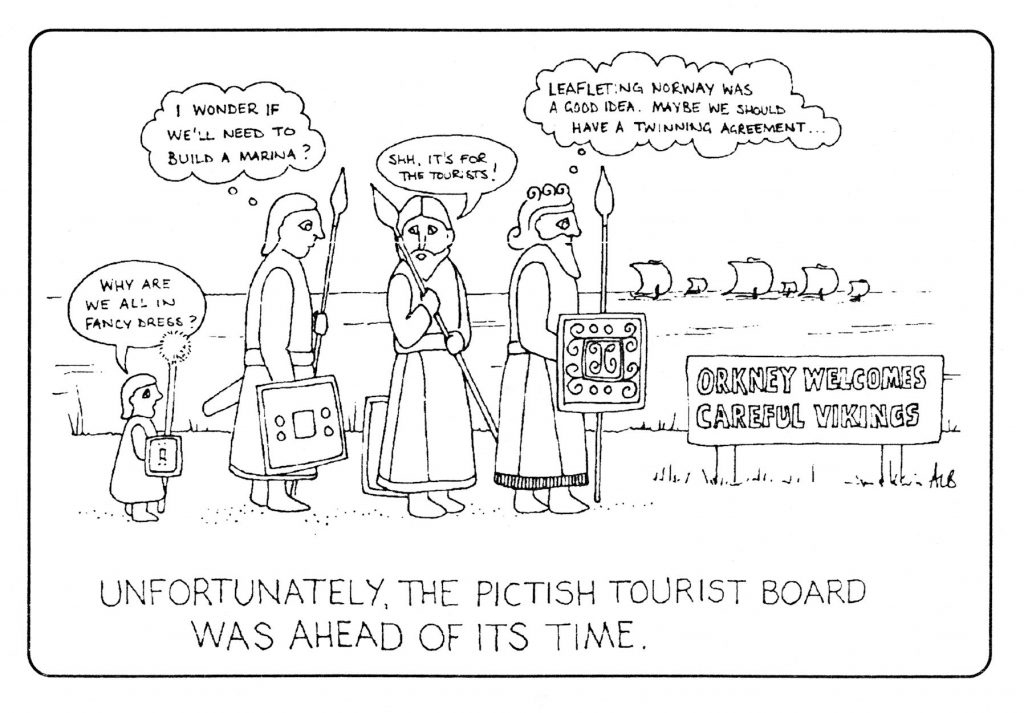



Adorei conhecer seu blog, tem muito artigos bem interessantes. https://resultadoviva.com.br/