
This picture must have been taken at the Ring of Brodgar about 1960, as I  would guess I am about three years old. I couldn’t have realised then how familiar the Ring would become. Since I became a tourist guide in 2013, almost all my tours include a walk around one of the best-known stone circles in the country. Brodgar is 104 metres in diameter, making it the third largest in Britain, after the Outer Circle at Avebury and the Great Circle at Stanton Drew in Somerset.
Lieutenant F W L Thomas R.N. surveyed Brodgar in the winter of 1848-49 and the paper he presented to the Society of Antiquaries was published in 1851. He wrote,
“It appears that the number of standing stones, on the assumption that they were placed at nearly regular distances apart, was originally sixty, but there are now only thirteen erect and perfect; ten others are nearly perfect, but prostrate; and there are the stumps and fragments of thirteen more; in all thirty-six.”
The Ancient Monuments Protection Act was passed in 1882 and the Ring of Brodgar was one of 21 sites listed in Scotland: one of only two Neolithic sites included. The other was Maeshowe. General Pitt-Rivers, the Inspector of Ancient Monuments, visited them in 1885 but nothing was done for twenty years.
Orkney and Shetland’s MP, Cathcart Wason, approached the Society for Protection of Ancient Buildings and they sent an architect, Basil Stallybridge, to survey our Neolithic sites. His report was published in January 1906 and is in the Orkney Archive. He advised that some leaning stones should be secured and that cracks should be grouted but didn’t think anything else should be done.
“Though it is known many were blown down by a gale at the beginning of 1800, [I have never heard of that and it seems unlikely] there is no record as to which were the stones in question. As therefore it cannot be known now with certainty whether any particular stone now prostrate was ever erect, I cannot advise that any of them should be raised.”
Luckily, in that same year the sites were taken into state care and the Ministry of Works took a different view. They re-erected the stone which had been pulled down at the Standing Stones of Stenness and then turned their attention to the Ring of Brodgar. M.M. Charleson, writing in the Scotsman on 22 September 1908, described what had been done that year.
 “The operations have been continued this year, and especially during the last few weeks, and the result up to the present time is that seven stones have been raised and set in their old sockets in the Circle of Brodgar… The seven stones in question have been placed in the segment of the circle between south and east, which is now almost complete. At the present time then, twenty-one of the stones in the Circle of Brodgar are standing; seven are broken and cannot be erected in their integrity, one is still prostrate, and may be set up at some future date, while at least nine have been removed altogether.”
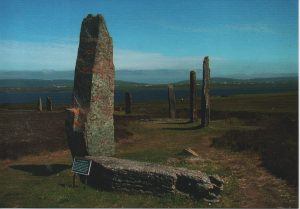 There are still 21 stones standing at least head high, though one of them is much slimmer than it was, having been struck by lightning in June 1980.
My sister Anne Brundle, who was Curator of Archaeology at the Orkney Museum, wrote the questions when someone chose Orkney Archaeology as their specialist subject on the BBC quiz show, Mastermind. The first question was, “What is a henge?”. When she tried the questions out on me, I learned that the Ring of Brodgar isn’t a henge, it is in a henge, which is defined as a circular or oval area enclosed by a bank and internal ditch. If there ever was a bank, it is long gone but we certainly have a ditch.
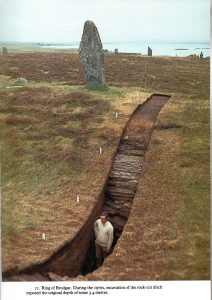 I point out to visitors that the ditch has silted up and is actually about 3.5 metres (11 feet) deep but didn’t realise how deep that actually was until I saw this picture in The Prehistory of Orkney edited by Colin Renfrew (now Professor Lord Colin Renfrew) in 1985. The picture was taken during Lord Renfrew’s excavation in 1973. As you can see, the ditch is dug into the bedrock. Without metal tools, it is estimated to have taken up to 80,000 man hours.
I am often asked what the Ring was used for. My response is usually to quote local historian and writer Ernest Marwick. Just a few generations ago, the night before a wedding, a guard would be kept on the bride’s house, to prevent ill-disposed persons walking anti-clockwise around it carrying a dried fish. If we are puzzled by our recent ancestors, we stand no chance at all with the Neolithic people. I also quote Doctor Who; “I’m a time-traveler. I point and laugh at archaeologists.”
 There is an interesting alignment at Brodgar during the Winter Solstice, which my father noticed. This picture of the rising sun was taken on 16 December 2006. We didn’t have to set the alarm; the midwinter sun rises on Brodgar at 9.40.
It used to be thought that all the stones came from Vestrafiold, a hill to the north of Skara Brae, but it now seems that only the stones on the west side of the ring came from there. Some stones on the other side of the ring came from Orphir. There are differing opinions on how many quarry sites there were but it is an interesting idea that different communities brought their own stone to the communal site. There are many single stones all over Orkney so perhaps communities erected a stone at their own meeting place as well. Perhaps this explains why so many of the Brodgar stones fell over. You are not going to gain much expertise in stone raising if you are only erecting two. However, there does seem to have been someone in overall charge. All the stones have their cut face looking into the circle.


1 thought on “Recent History of the Ring of Brodgar”