
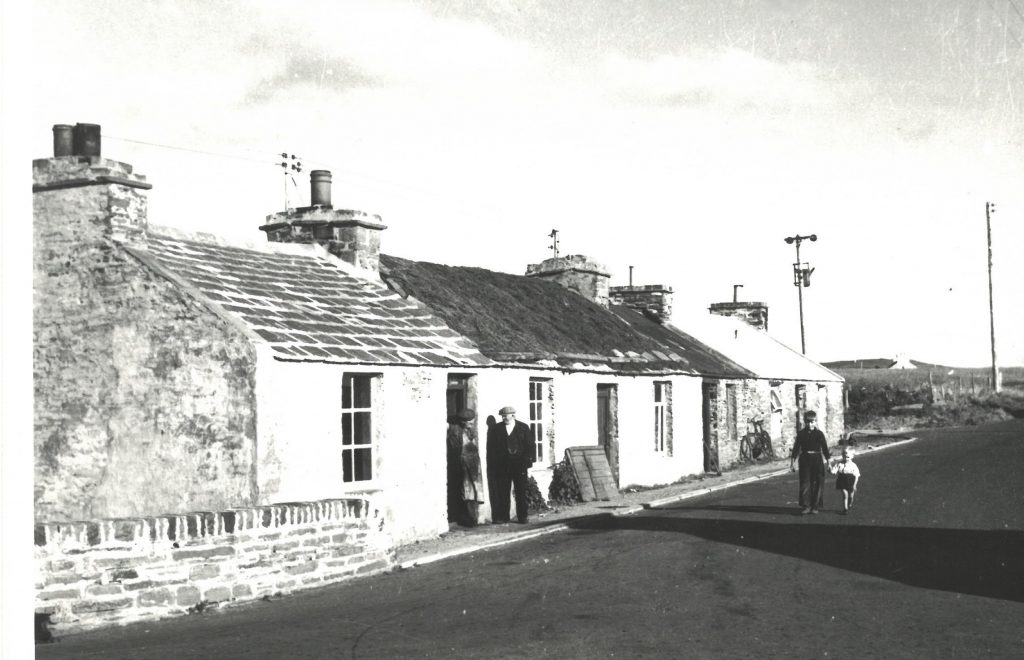
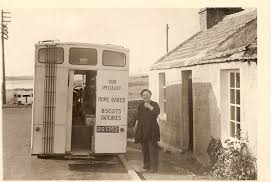
This peaceful afternoon scene at the junction near the Brig o’ Waithe shows Willie Farquhar at the door of his cobbler’s shop, chatting to his neighbour Albert Leask, while Albert’s grandson Eric Knight poses in the middle of the road with little Thorfinn Clouston. But all is not as it seems, because we are looking at Orkney’s premier nightspot, the Golden Slipper.
The junction was almost 100 years old when this photo was taken in the late 1950s. The Orkney Roads Act was passed in 1857 and the Finstown to Stromness stretch opened in March 1860. The new road to Orphir, replacing the old road along the shore, followed soon after.
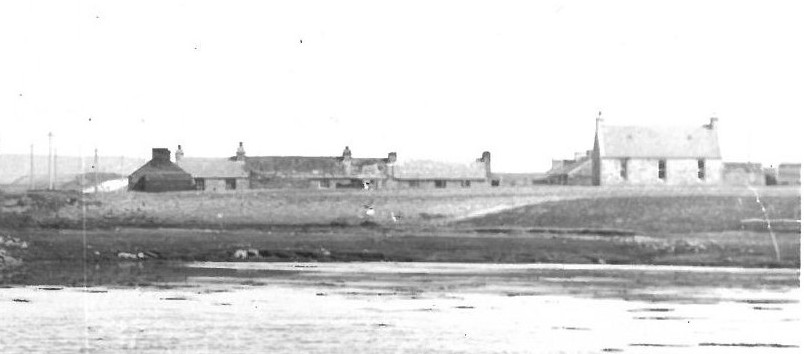
Almost immediately, there was a smithy at the junction. That is the building whose gable end you can see on the left. The blacksmith was Thomas Lyon and he and his wife Margaret lived in Smiddybanks, the house that still stands gable-end on to the Orphir road
Before 1871, Margaret’s father John Paplay built the house that was to become so famous. John had been a sailor on the Royal Mail, the mail boat that began the run between Stromness and Scrabster in 1856. He added an extension towards the main road and that was the first post office in Stenness. The mail coach stopped there on its way to and from Kirkwall.
By 1881, John had built a second house in line with the first and the space between them had been roofed over. John’s sister Isabella lived in that little space with her daughter Maggie but John and Isabella soon fell out and she and Maggie moved along the road.
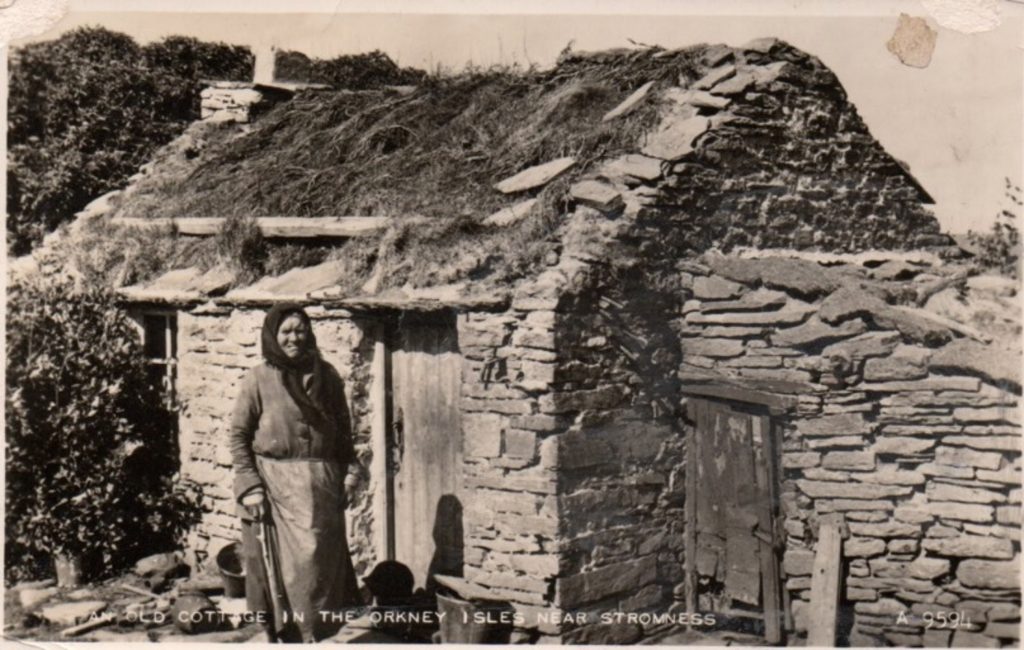
When the new Orphir road was built, a corner of a field belonging to the farm of Cuminess had been cut off and Isabella was given this to build a house on. You can see that the chimney is very short. Dad told me that Isabella called up to the mason on the roof, asking him what the cost was so far. He replied £5 and she said, “Don’t lay another stone.” Maggie Paplay lived on there for many years, working on neighbouring farms and keeping hens.
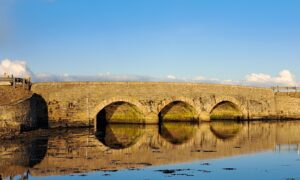
So, long before the days of the Golden Slipper, this little corner of Stenness was a busy spot, with the smithy, the post office and a cobbler, John Paplay’s son John. Older than all of these was the ale-house. The two-storey house beside the Bridge of Waithe was built by Robert Croy in 1881, to accommodate tourists who had come to fish in the Stenness Loch but there had been an ale-house there for more than a hundred years. When they needed to be licensed in 1828, it was one of six in Stenness, spaced out along the old Kirkwall-Stromness road. https://www.aboutorkney.com/2024/01/02/the-bridge-of-waithe/
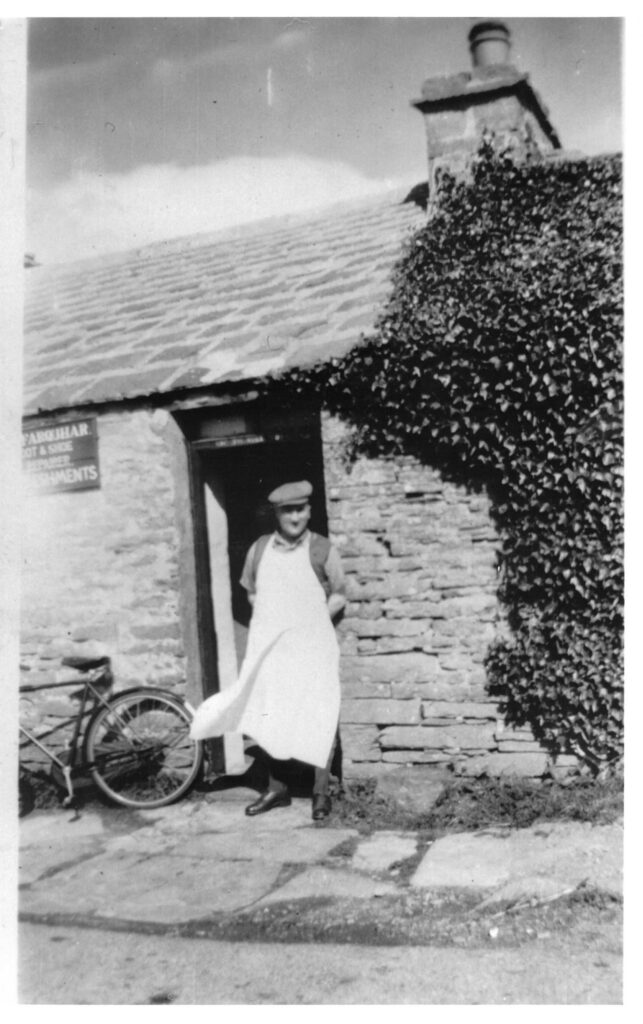
But this story is about unlicensed premises and begins in 1934, when Willie Farquhar and his widowed mother Helen moved to the junction. William Alexander Watt Flett Farquhar had been born in Finstown but grew up working with his father Charles on the family farm, Nearhouse in Orphir. Willie married Mary Ivy Rendall in 1930 and their son James was born in 1932 but the marriage wasn’t a success and Ivy later re-married. Willie had tried his hand at cattle-dealing but wasn’t good at driving bargains so came to the busy junction by the Bridge of Waithe to repair boots.
Cobbler’s shops, mills and smithies, like the one just across the road, were places men could expect to find a warm fire and someone to have a yarn with. This was especially true at Willie’s. He was a cheerful soul who never seemed to go to bed. His mother began to stock sweets and lemonade.
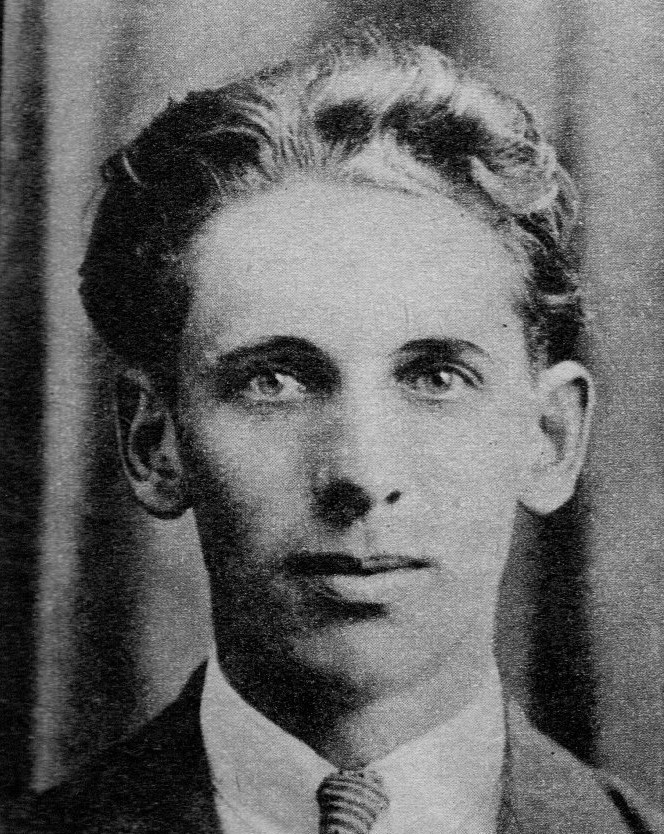
Then, on Saturday 16th March 1940, the war came to this quiet corner and Willie and Helen’s next-door neighbour, 27-year- old James Isbister, became the first British civilian to be killed by enemy action. Bombs fell around the junction, probably because the airfield used by Allied Airways before the war had been incorrectly identified as a military airfield. https://www.aboutorkney.com/2021/03/15/when-the-bombs-fell-on-stenness/
Willie was hit by shrapnel and needed 37 stitches in his thigh but was soon busy again. At his trial in 1961, Willie said that he had been asked by “some high officers and officials” to provide a canteen for the troops and was then open more or less day and night. Asked by his lawyer James Flett whether it was profitable, Willie said, “Not so bad, sometimes more profitable than others.” He and his mother would certainly have had plenty of trade from Waithe camp, just about 100 yards to the east, and many army lorries would have stopped at Willie’s through the war years.
When the soldiers had all gone home, Willie and his mother needed to diversify. He said at the trial that after the war he carried on selling tea, lemonade, pies and so on and that his busiest nights were Wednesday and the week-end.
When it wasn’t so easy to get to town, it was common practice to order things from Kirkwall or Stromness and ask for them to be put on the bus. Willie’s shop was the obvious drop-off place for everyone in the district. From there it would be a small step, and much easier for everyone, if they could just buy basic necessities directly from Willie, so he may have begun to operate as a very small occasional shop. Lamont Inkster remembers collecting loaves and cookies for his relatives at nearby Biggings farm when he was a boy and, when he worked there after leaving school, he got his weekly newspaper from Willie.
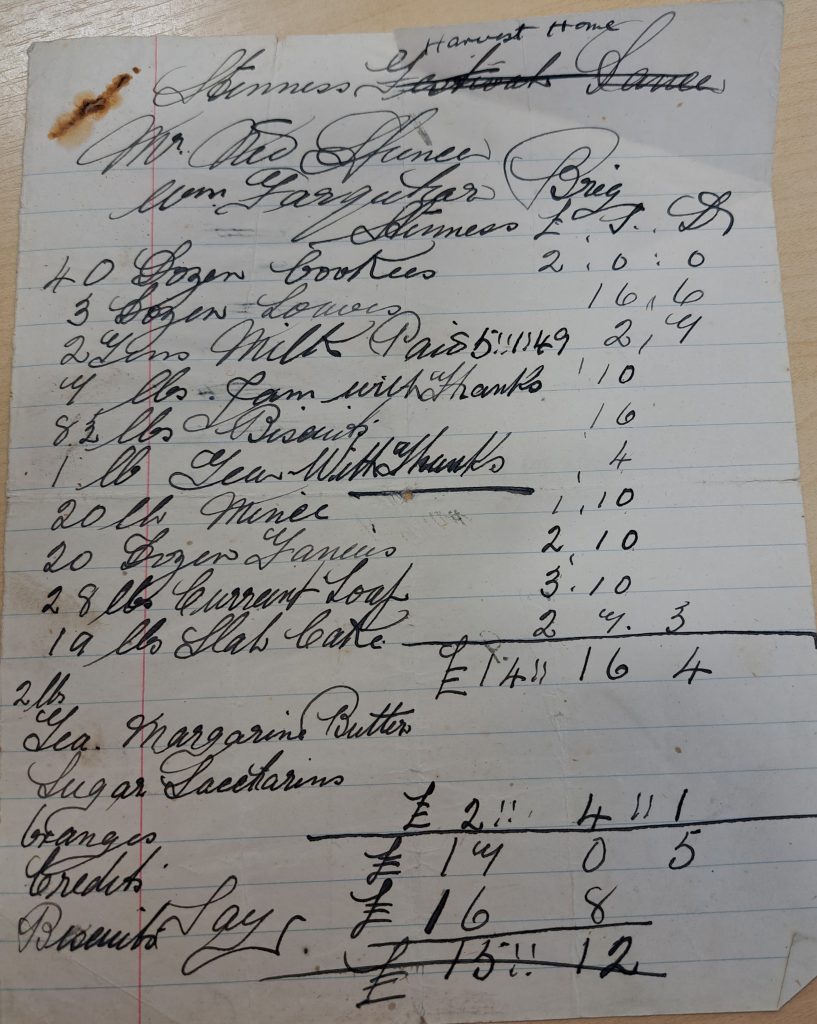
Willie seems to have sometimes operated on a larger scale. A company was formed in Stenness in 1922 to buy a hut when the Houton Air Base was being dismantled, to become the Stenness Recreation Hall. The Cash Book in the Orkney Archive contains some invoices from the early 1950s, including two from Willie, catering for a Harvest Home and Christmas Festival Dance. Willie still had the catering licence and regular suppliers in Kirkwall. For those who didn’t grow up in Orkney a long time ago – cookies are sweet bread rolls, usually spread with jam and ‘fancies’ means a variety of small cakes.
In amongst this trade, it isn’t clear when Willie was first asked to get whisky from Kirkwall and when it then progressed to Willie keeping whisky in stock. Did it cross his mind that his catering licence no longer covered everything?
George Mackay Brown and others have described the Golden Slipper as a shebeen. I have also seen it described as a notorious pub and a house of ill-repute. This is one of the reasons that I began this research. Willie was an elder of the Victoria Street Kirk in Stromness. He just took an over-relaxed view of regulations.
GMB’s description of the Golden Slipper was included in Northern Lights – A Poet’s Sources, published in 1999.
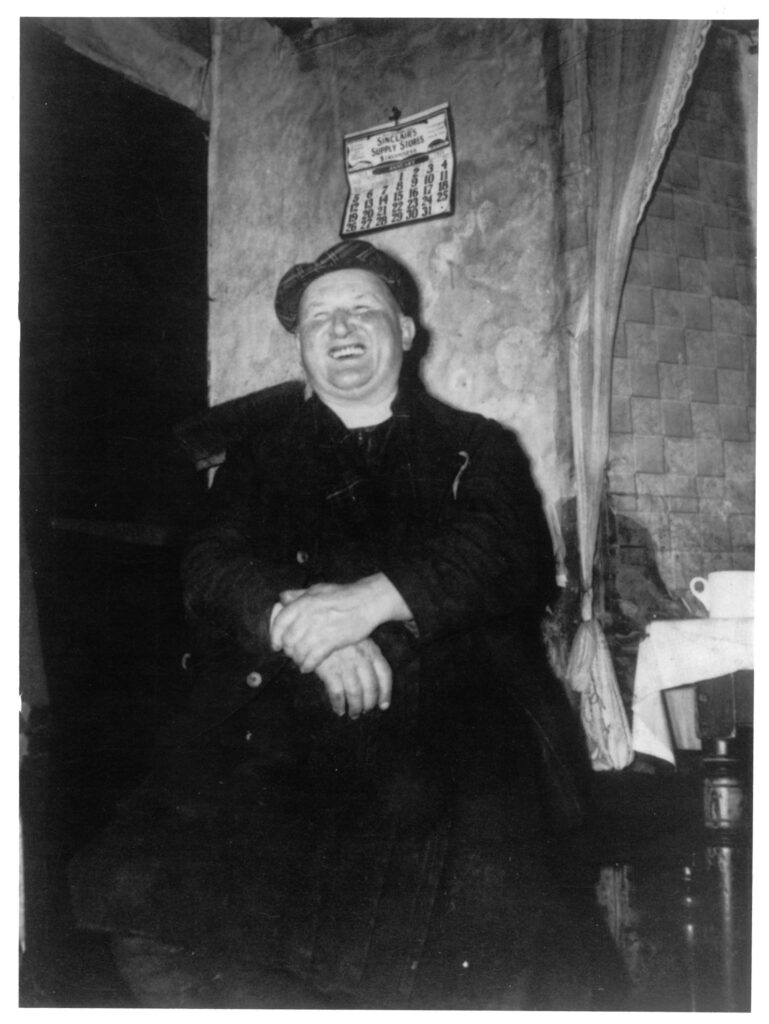
Willie Farquhar was like a toby jug come alive. He was always smiling out of his rubicund round face.
He wore a cloth cap, and an apron so greasy it shone like a dark mirror. He seemed to be delighted to see everyone, he agreed with everything that was said to him, he was all benignity and good-fellowship. You had the feeling he wanted to be among happy folk, and he did his utmost to stoke the fire of contentment. The kettle burbled on the hob, for those who might want tea or coffee, or to make a hot grog or toddy.
The interior of Willie’s had an earthiness, rather like (I imagine) the knowes the young fiddlers played inside. Spiders and moths and mice found comfort there as well as people. The chilliness of modern hygiene was utterly absent…
There are different stories as to whether Willie sold whisky by the glass, or cup, as well as by the half-bottle. It seems clear that he did, but discreetly and only to those he thought should have it. It has been said that more people were sobered-up by a visit to the Golden Slipper than got drunk there. It seems that the good time being had by all was very largely fuelled by tea and Sunjoy orangeade.
This plan was drawn up with help from Eric Knight and Victor Muir, who grew up nearby, and checked with a few others with fond memories of visits there.
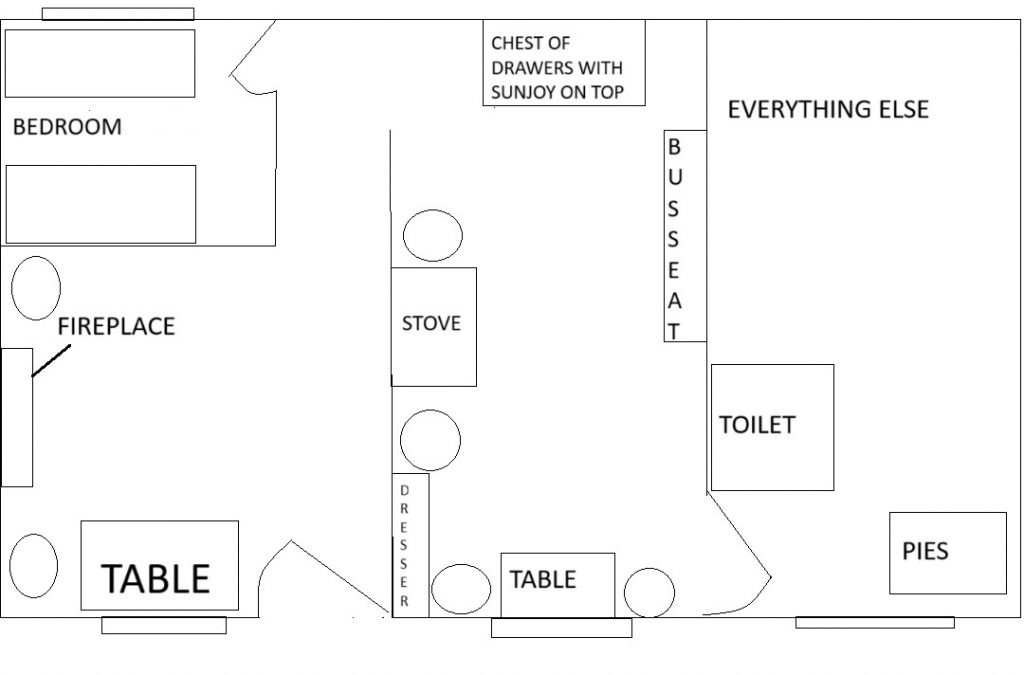
The front door opened into the room where Willie still did some boot repairing, though you didn’t leave your boots with Willie if you needed them in a hurry. The circles are chairs. Opposite the stove was an old bus seat. At some time Willie’s son Jim had his bed there because I have been told two stories of people sitting on the edge of it and only realising Jim was sleeping there when he moved.
Orkney’s Chief Constable, Gaythorne Cheyne, decided that this couldn’t go on. The first raid was aborted, when his daughter was found to be one of the customers, but the police came again, on 24 October 1957.
The Orcadian reported,
Police swooped early on Sunday morning on a well-known West Mainland establishment near the Bridge of Waithe.
The raid occurred at about 2 am. Four policemen, including Orkney’s Chief Constable, Mr Gaythorn Cheyne, spent over two hours on the premises – which is popularly known as the “Golden Slipper Club” (and also as Smokey Joe’s).
It is understood that the police questioned eight or nine people who were present and took their names. The police went away with over 70 bottles of whisky. They also took with them a number of empties.
Police headquarters in Kirkwall refused to make any comment yesterday.
No court case followed this raid and the whisky was eventually returned to Willie. Perhaps no one was willing to testify that they had bought whisky from him.
Willie’s luck ran out more than three years later, on 14 January 1961, when Sergeant James Archibald came to the Golden Slipper late in the evening, making enquiries about a missing man. He found five people in the kitchen and Willie in the back room, pouring whisky from a large bottle into a smaller one. At the Sheriff Court on 21 March, Sgt Archibald said that he had warned Willie to stop selling whisky and Willie had replied, “Yes, I will. It will only get me into trouble”. Willie and his son Jim both testified that Jim was going out and the small bottle was for him. Willie’s lawyer James Flett objected that the Sergeant didn’t have a warrant but Sheriff Keith’s view was that Sergeant Archibald could report what he saw, just like any member of the public.
The sergeant then questioned the people in the other room and discovered that the man he didn’t recognise was John Colligan from Gorebridge near Edinburgh, manager of a team of vacuum cleaner salesmen. For the first time, someone had been found who was willing to testify that he had bought whisky at the Golden Slipper. Colligan said that he had bought two rounds of whisky for himself and his three Orcadian companions, Mrs Birnie, Mrs Linklater and Malcolm Thomson.
The new Chief Constable, James Cormack, now applied for another warrant and the police arrived on 1 February. This was the raid in which the police dug in a pile of sand. Willie had decided to re-point his outside walls and the sand had been delivered at the side of the road. Unfortunately, before he could do anything with it, heavy rain began to wash the sand into the burn, so it was shovelled into the house, where his late mother’s box bed used to stand, where the pies were stacked later, as shown on the map.
It was said that, while the policemen were digging fruitlessly there, whisky was actually being handed out of the window. Whether this is true or not, they didn’t manage to hide it all and Willie was charged with having 3 gallons, 3 quarts and 11/12 pints of spirits and one and a half pints of beer, which the police seized, having reasonable grounds for believing that exciseable liquor was being trafficked in. He was also charged with trafficking in exciseable liquor without holding a certificate.
Mr Colligan was brought north to testify that Willie had sold him whisky. Willie and Malcolm Thomson claimed that Colligan had brought the whisky with him and Willie just provided the glasses, but the Sheriff was unconvinced.
Then there was the question of the quantity of liquor found at the Golden Slipper. There were 21 full bottles, four partly filled, three pints of beer and a bottle of rum, partly empty. Willie had objected to them taking the rum, saying that it belonged to his son Jim, who needed it for his breakfast. Jim was a plumber’s mate with P A Sutherland.
The Fiscal asked Willie whether all the whisky was his. Willie replied, “Yes, I used to have more. I had 72 bottles returned to me two years ago.” He said it was to treat anyone to a drink; friends or anyone like that who came in. It was not for sale. He agreed that the bottles were worth about £40 and the Fiscal suggested that it was unusual to have so much whisky in the house just for friends. Willie replied, “Well, it always gets less”.
Willie had thought that he faced a jail sentence and bought a single ticket on the bus, but he was only fined £15. It is said that some of those at the trial, including the policemen, were concerned that Willie might not be able to afford the fine and had a whip-round, to make a contribution.
Sadly, Willie had felt that he had to resign as an elder of the Victoria Street Church in Stromness after the police raid. He cycled to the kirk almost every Sunday and, on Communion Sundays, Len Wilson remembered seeing him cycle there in a tail-coat and top hat. The suit is said to have belonged to his grandfather William Isbister, the Laird of Bigswell.
It would have been a very elderly suit, as Willie’s mother Helen was born in 1870, when her father was 65. He had married 21-year-old Jane Bews nine months earlier. Helen provides a pleasing link between two of the most cheerful places in Stenness. The house now known as Happy Valley was built as William Isbister’s retirement home and must have been a lively place, with six children born between 1870 and 1882. The last one, John, was born two years before his father died, aged 82.
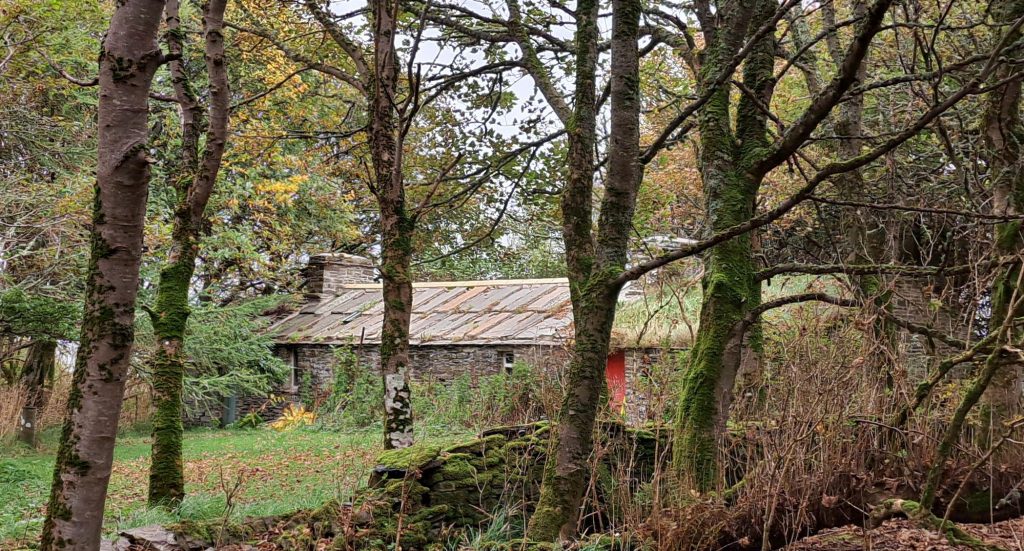
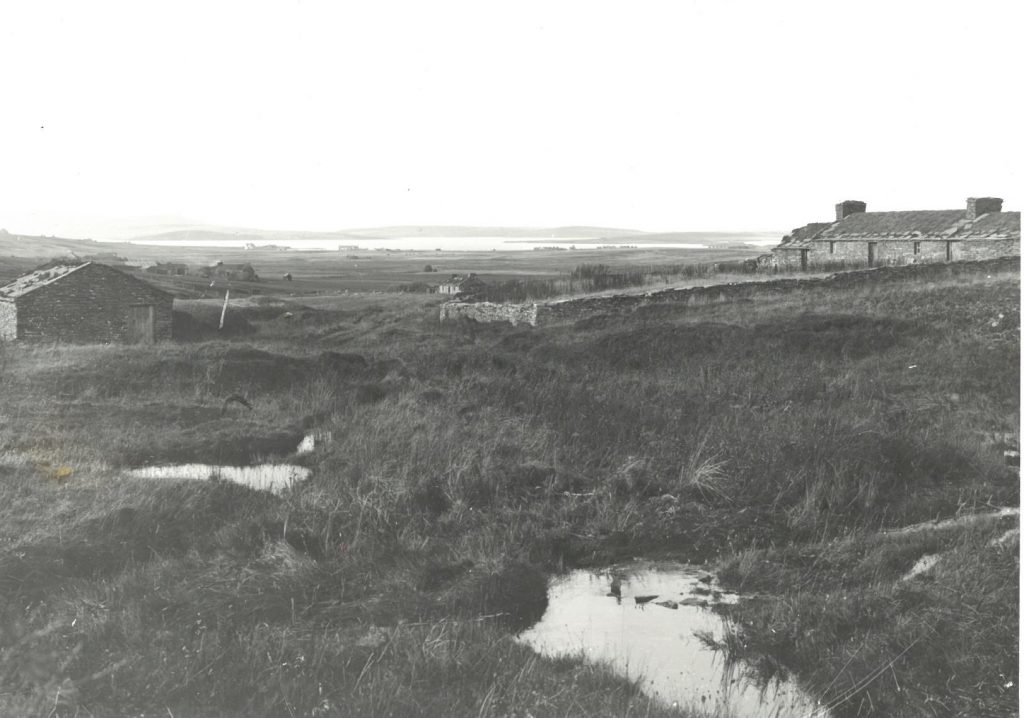
The subsequent lack of alcohol doesn’t seem to have diminished Willie’s trade, as there was still plenty of tea, Sunjoy, crisps and pies. The first thing that anyone mentions about the Golden Slipper is the pies.
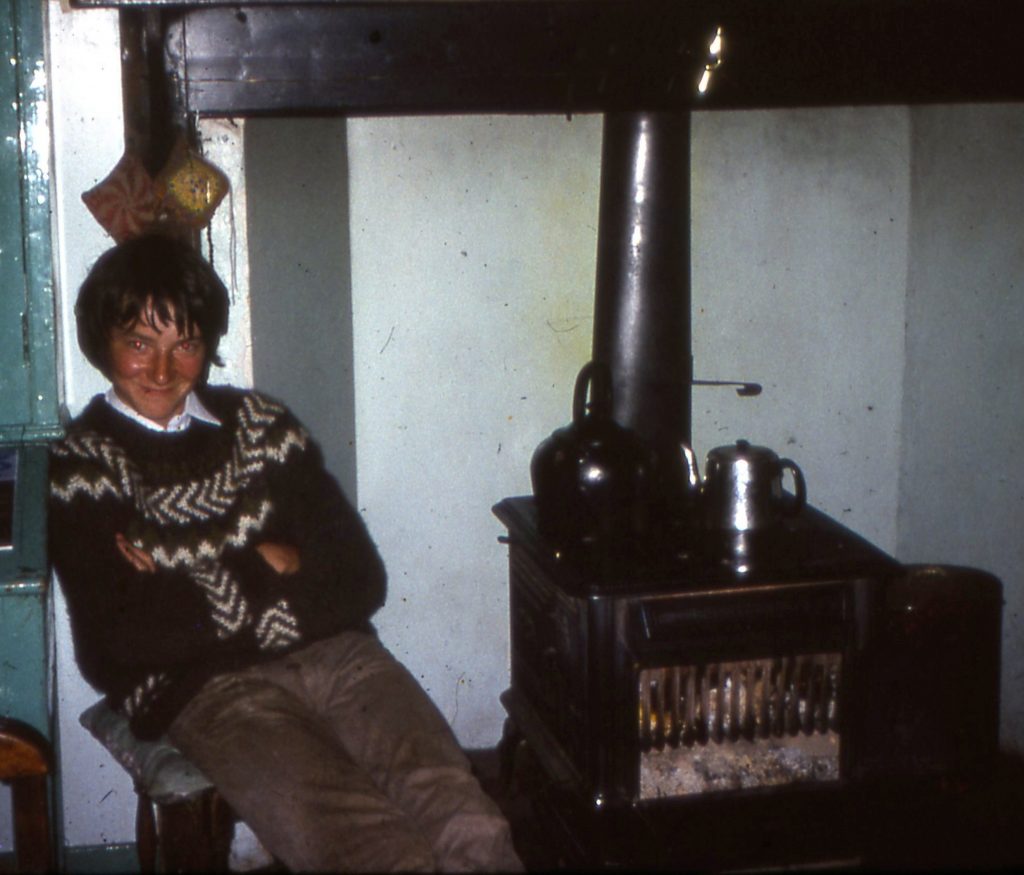
The stove in the Golden Slipper was a Victoress, like the one I grew up with. The stove at the Kirbuster Farm Museum is an Enchantress, very similar but a little smaller. The oven at the back has a door on either side. The pies were put on a biscuit tin lid and pushed in one door and pulled out of the other. When trade was brisk, their stay in the oven was quite brief. There is more than one story of Willie dropping a pie as he was handing it over and putting it back in the oven. There were at least two pie suppliers: Argos in Stromness and Flett & Sons in Kirkwall.
The late May Shearer was a physiotherapist and told me about getting shelter at Willie’s one night while waiting to be collected from the bus. She discovered that he was frying sausages on a shovel. I don’t know whether they were for his tea or for prospective customers.
Piped water and electricity slowly spread out to the country districts in the 1950s but never penetrated the Golden Slipper. The water for the tea came from the well on the other side of the main road and stood waiting in enamel buckets with lids. Cups were “washed” in a bowl of water on the table. Paraffin lamps hung from hooks in the ceiling.
Unsurprisingly, the authorities came for the pies. Bill Spence was cycling past the Golden Slipper one day when Willie was escorting Mr Barry, the Sanitary Inspector, to his car. After he had driven off, Willie told Bill that the man had no idea what he was talking about. According to George Mackay Brown, Willie was prosecuted for carrying on selling pies though I have so far failed to find any evidence for this. No wonder he took a gloomy view of regulations when talking to William Hunter of the Daily Express in October 1962.
Nicht Club Ben the Hoose– Scottish Daily Express October 1962
Time has no meaning at the sign of the Golden Slipper. The ancient clock on the brown painted mantleshelf is stuck permanently at five minutes past six. The calendar on the wall reads for last January… inside all is still, save for the hiss of the paraffin lamp, the whisper of the kettle singing, ready in the inglenook. Willie looks up at the clock. It seems to tell him something though the hands haven’t moved. “Sometimes people come, sometimes they don’t. Maybe they are getting afraid of the Regulations.” I never discover what these “Regulations” are, but Willie always mentions them with a capital R in his voice. “Even up here a lot of people are trying to regulate all the pleasure out of life.”
But the Golden Slipper was far from finished. In the mid 60s, my cousin William Watters remembers leaving the Cosmo Dance Hall in Kirkwall early so that they could get a seat in the Golden Slipper for crisps and Sunjoy. On the Saturday night of Shopping Week, cars were parked from Willie Harvey’s, on the bend of the main road, to Cuminess House on the Orphir Road.
In August, I gave a talk to the St Magnus Friendship group. Several of the ladies were happy to share their memories of the Golden Slipper. Their general recollection was satisfaction at having visited the place they had heard so much about and fear that their parents would find out.
The best story of the afternoon was from the lady who had visited in a car with bench seats. When it was time to go, they had to wait for one of the men, who quietly got in beside the teller of the story. She realised that she was beginning to feel cold, and a bit damp, on that side and, looking to her left, saw that he was soaking wet. Feeling the need to go out round the back of the house before getting in the car, he had fallen in the burn.
Willie sometimes had a lot to put up with. There are tales of the lamps being carried outside, of neeps or slates being put on top of the chimney, to smoke everyone out, and even of putting petrol on the fire before Willie came through to light it. Boys will be boys and most of his customers were male, perhaps largely because they were more mobile. I have heard of regular visitors from Tankerness. Young women could probably think of better things to do with their time though Ella Duncan and her friends sometimes walked there on Sunday mornings from Stromness – in their stilettos. Her mother’s reaction when she learned about the visits still makes her laugh.
Willie provided another useful service, selling condoms from a biscuit tin. Sitting in the back room, patrons watched Willie go through to the front room when he heard someone come in. The tin was opened, a car drove away and Willie would return, saying “That was – , but don’t say a word.” When Thorfinn Clouston was growing up next door, he discovered the tin and asked Willie about the contents. Willie was never at a loss for an answer and told Thorfinn that they were for putting on lamb’s tails.
I don’t know when the last customer left the Golden Slipper, probably sometime in 1966. Whatever the regulations said, Willie was a man who made the world a better place and you could say he still does. People’s eyes light up when they talk about their own visits or the stories they have heard. Willie died in April 1968 and is buried with his parents, Charles and Helen, in the Stromness kirkyard but he and his unique creation live on and I would love to add more stories to my collection.
If you have a story that you would like me to add, please let me know at pat@aboutorkney.com or share it in the comments below.

*The day Willie entertained a Stromness Academy school party back in the 60s*
We’d been on a very interesting educational trip to the Mill of Ireland, and had time on our hands while waiting for transport back to Stromness.
One of the more precocious of the group [middle name Keith, later a deputy rector somewhere not far away] suggested to our new history teacher, Jim Troup, we could walk back along the road to a shop near the Brig o’ Waithe for crisps and lemonade, and this was readily agreed.
A few of us boys from the group were entertained by Willie, who I remember was making what looked like cabbage soup on his old stove. Certainly qualified as an educational visit!
Being later picked up by the bus, the look on the other [Frank Eunson] teacher’s face, who no doubt knew more about local history than Jim , was a memorable picture!
Thank you. That is a great story. I wish I could ask Jim about it. I am impressed that you were taken to see the Mill. I have good memories of going their with Dad when he was getting oats bruised for cattle feed.
Aye, keep telling the tales Pat.
When researching family history I found Willie was a far out relative.
as an aside:
Most Orkney registrars were helpful, and I remember one verbose male registrar warning[?] me *every family has a prostitute and and a sheep thief*
and from Ida Garson, *the Stangers and Garsons are like the sands of the sea, you’ll never separate them*
One Stanger relative went on to become the head of the largest intelligence operation in history, to this day [British Security Coordination]
I remember my sister, Noreen, a bit older than me, telling me of her experience of being at the Golden Slipper after a dance. She was offered tea, which she got in a white mug. She noticed black stuff floating in it and discovered it was Jim’s shaving mug.
My memory is of when I worked in Argo’s, a Saturday job when I was at school. I had to make up Willie’s order, which was handwritten by Willie, for two dozen pies “danses the night” his spelling. The order went by bus for Willie to pick up at the end of the road of the Golden Slipper.
Marvellous tale of one of life’s richest characters. We always went to Willie’s when staying at Bea just along the road in summertime. it was supposedly for cookies but really just to enjoy him and hear his rich Orkney tongue and deep belly laugh, ‘Yaas beuy, yaas,’ followed by the deep rumble of that ready laugh. My father said it reminded him of the ‘landlord’s ready chorus’ in Tam o Shanter but Willie was a great character.Thanks so much for stirring up happy memories on Christmas morning.