
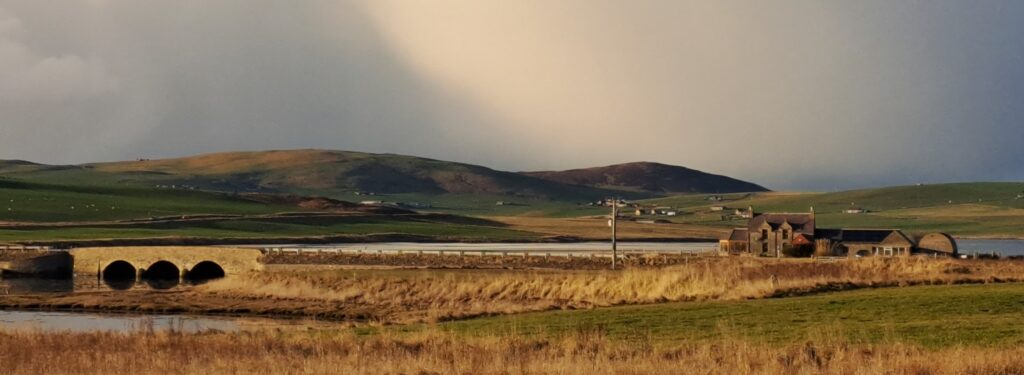
My father and grandfather, Peter Leith (1927-2021) and Peter Leith (1886 -1958) recorded an enormous amount of Orkney’s history, especially of our home parish of Stenness. I am making a start on sharing the vast family archive and have decided to begin in the west.
The Leiths came to Stenness in September 1546, when they exchanged the farm of Campston in the East Mainland for Onston in Stenness. John Leith and his half-brother Edward Omand probably sailed across Scapa Flow and then through the strangely named Bush, the channel through which the Stenness Loch meets the sea. Their new farm lay along the loch shore immediately to the east.
There was already a bridge across the channel when the Leiths arrived, though the name, Waithe, shows that there used to be a ford there. Jo Ben, who visited Orkney in 1529, wrote
“There is a bridge there very dangerous for travellers, named ye brig of Vaiche where very many people perish.”
Jo Benn is a notoriously unreliable guide to Orkney but, in the Statistical Account of Scotland written in the 1790s, Rev John Malcolm wrote:
There is a bridge at the strait, which joins the loch of Stenness with the sea, of large and strong logs of wood laid across the openings between the stone pillars. It has never been properly finished; and having no railing at the sides, young children and weakly people run no small risk of being blown over, and drowned.
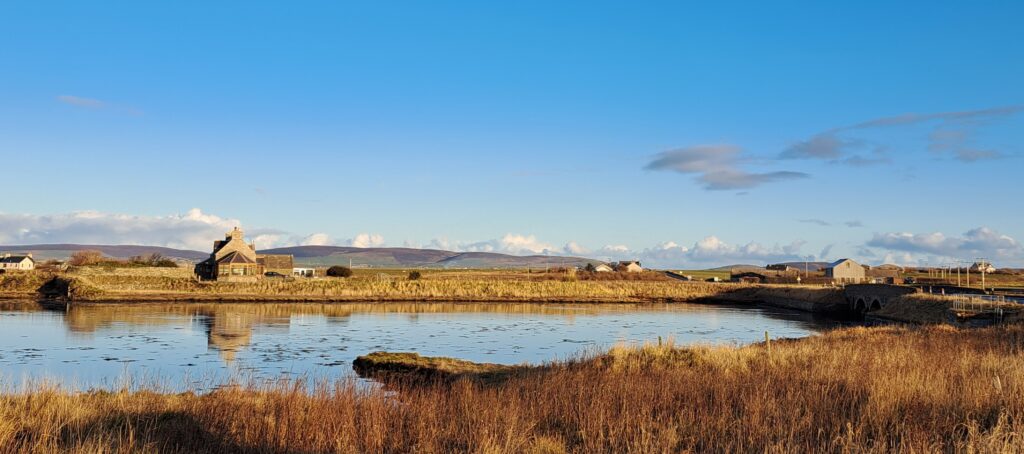
As you approach the Bridge of Waithe, or Brig o’ Waithe as it is called locally, from the west, you can clearly see where the old bridge was. The house beside it is called Bridge-End and there has been a building there since at least April 1752, when there was a case against David Redland, merchant at the Bridge end of Weath at the Sheriff Court. The most likely business for him to have had beside the main route between Kirkwall and the new town of Stromness is an ale-house. It would, presumably, have been especially welcome beside such a dangerous bridge, either before or after crossing.
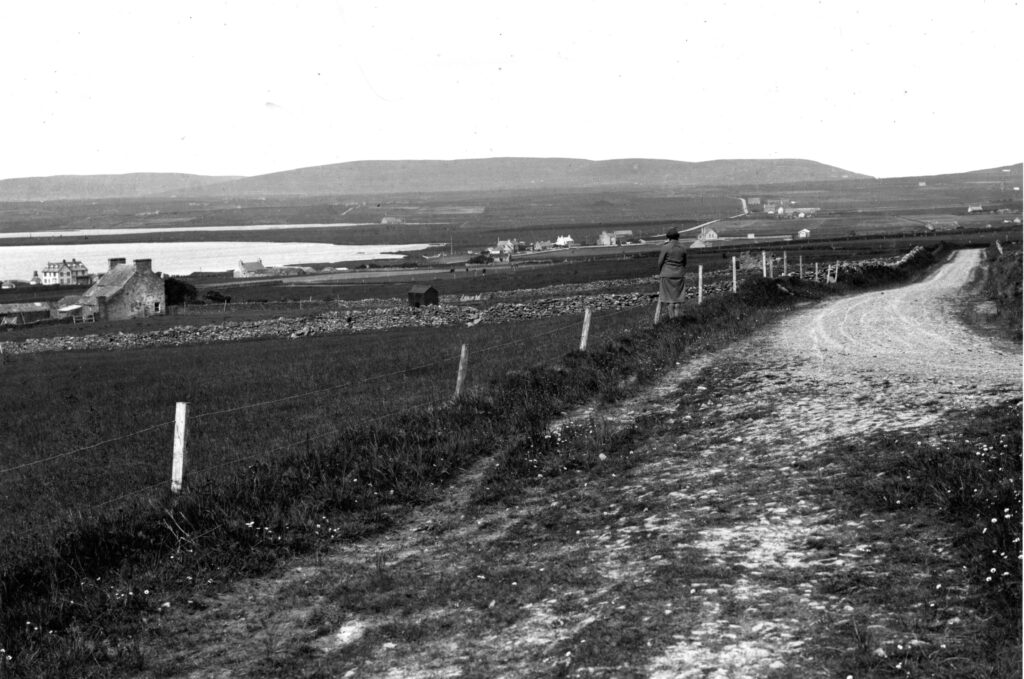
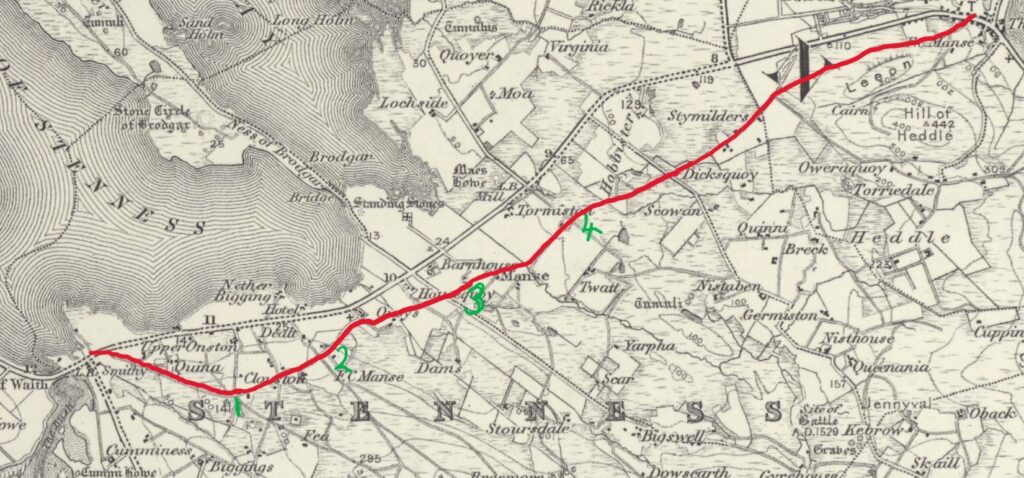
According to Dad, there were ale houses at the Brig, Negheads, the foot of the brae of Kethesgeo, Knockhall, Quoynamoan and probably others. These were all houses beside the old road through Stenness, which crossed the Burn o’ Villas, the boundary between the districts of Onston and Ireland and went up the hill in the direction of Negheads.
The picture on the right was taken near Negheads, on what was once part of the old road. The new road, up the Brae of Negheads and over the hill, is coming in from the right. The old road carried on down the Brae of Kethesgeo, passed to the right of where the school now stands, and on past Knockhall near the Manse and Quoynamoan near Tormiston. It then passed Midhouse in Germiston and the school at Stymilders, on the boundary of Firth and Stenness, before joining the present road at Finstown.
Six ale-houses were licensed in Stenness when the first Licensing Court was held in Stromness in 1828 but, unfortunately, the names have been lost. The oldest list in the Orkney Archives is from 1845 and by then the Brig was the only licensed ale-house in Stenness and the licence-holder was my g-g-g-grandfather, James Oman.
He and his family are there in the first full census, in 1841.
1. James Omand, (M), 55, , . Farmer. Orkney
2. Margaret Omand, (F), 55, , . . Orkney
3. Elizabeth Omand, (F), 20, , . . Orkney
4. Peter Omand, (M), 15, , . . Orkney
5. Thomas Omand, (M), 11, , . . Orkney
6. Isobella Harvey, (F), 35, , . Independant. Orkney
7. Margaret Harvey, (F), 1, , . . Orkney
8. William Tailor, (M), 20, , . Carpenters App. Orkney
My g-g-grandfather Simon had already gone to sea but there was still a full house, as it looks as if they took in boarders.
James held the licence until 1851. In the census of that year, he and his wife were still there but their daughter Elizabeth was married to a farmer, James Sutherland, at Castle Folly in Stromness. Peter had died in 1846 and Thomas is nowhere to be found in any records after 1841. James died sometime before the official registers began in 1855 and Margaret went to live with her now-widowed daughter Elizabeth so a new family were in the ale-house when the mail-coach began its run between Stromness and Kirkwall. Dad wrote:
When a regular postal service came to Orkney, landing at Stromness, the mails were taken to Kirkwall by a four-horse coach. The contract for supplying the horses and coach was held by Allan of Heathhouse. At the bridge the coachman was supposed to unyoke his lead pair and lead them across and then take the coach across the narrow bridge with a more manageable two. In his old age the coachman would recall, “When I haed a drink in, I would take the fower across fine”.
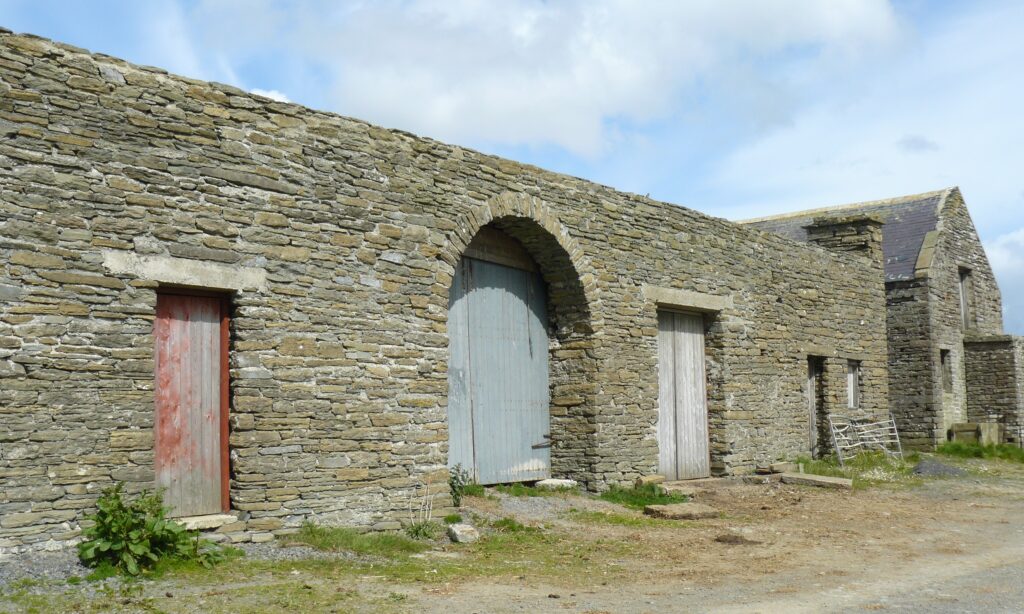
Fortunately, the driver of the mail coach would not have had to deal with the old bridge for very long, as the Royal Mail paddle steamer only began to cross between Scrabster and Stromness in April 1856 and the mail-coach arrived in July 1858. The Orcadian reported that a large four-wheeled coach, capable of carrying 14 passengers and their luggage, had arrived on the steamer on the 10th and had begun to run between Kirkwall and Stromness a week later. It belonged to Mr Allan of Culfosie, Aberdeenshire, who had lately purchased a property in Stenness. George Allan and his family farmed Heathhouse, next to Seattersquoy and Ramsquoy, at the top of the Brae of Ireland, for many years.
The Orkney Roads Act was passed in 1857 and a new road between Kirkwall and Stromness was, of course, the first to be made. The last stretch, from Finstown to Stromness, was opened to traffic on 13 March 1860 and it was reported in May that the total cost of the road from Kirkwall to Stromness was £7384-12-3½ and that the Bridge of Waithe had cost £677-2-10.

The bridge is such an important part of Orkney’s road network that during WWII holes were made in the structure for explosive charges, if Orkney was invaded. The Army practised guarding the bridge and Dad enjoyed the story told by his friend, Freddie Muir of Cuminess.
One Sunday during the war, Mrs Muir of Cuminess was walking to the kirk in Stromness while the army was conducting an exercise at the brig. Her son Freddie, an Orkney Territorial soldier, was taking part in the exercise. He watched as a sentry stopped her and asked to see her identity card. After a lengthy rummage in her handbag she said that she didn’t have it and added, “Bit here’s me communion card. Will hid do?” The sentry let her through and she then added to her son’s embarrassment by peering down at where he lay camouflaged in the ditch and asking, “My, is that thee Freddie?”
Peter Croy and his wife Barbara Peace came from Stronsay to the Bridge of Waithe in 1858. In 1871 Peter appeared as a witness in a court case, when three young men, John Omand, Donald Coghill and Thomas Anderson were each fined 7s 6d for riotous and disorderly conduct in the ale-house. Peter Croy said then that he had been at the Bridge of Waithe for thirteen years.
In 1871, Peter was a widower with a house-keeper called Euphemia Leask. Despite the Brig being remembered locally as Effie Croy’s ale-house, there is no record of them being married. Euphemia, widow of James Leask and daughter of Robert Ballantine and Ann Gray, died at the Bridge of Waithe in February 1877, seven weeks after Peter Croy. By this time, Peter’s son Robert, with his wife Betsy Cormack, had taken over the ale-house and he was going to make big changes.
Dad told me that the substantial two-storey houses at the Bridge of Waithe, Brodgar and Lochside on the Stoneyhill Road were all built for tourists coming to fish on the lochs. In August 1881, Robert advertised,
Robert Croy, Bridge of Waithe, begs to intimate that he can accommodate tourists visiting the West Mainland of Orkney with Lodgings, having just enlarged his house for that purpose. The House is situated on the Loch of Stenness, where the finest Trout Fishing in Orkney is to be had. During the winter season first class sport can be enjoyed at Swan, Wild Duck and other Shooting.
John Millais, naturalist and son of the Pre-Raphaelite painter, stayed there a few times. In The Wildfowler in Scotland, 1901, he wrote
When I first went to the Orkneys, and for several years afterwards, Loch Stenness and its surroundings were one of my favourite hunting grounds, both for fishing and shooting. I think I may fairly claim to have been one of the first to discover the capital fishing to be had there…What grand days John Oman and I had on the loch… My best day was in August 1885, when I secured ten trout, weighing altogether 13 lbs, seven mallard and thirty snipe…
I know it used to rain in torrents in those times, sometimes for days together… somehow I have forgotten the rain and only remember the sunshine, the green islands, and the crystal sea.
The trout in the loch brought income to Stenness for many years but not to the Croy family. Only two years after enlarging the house, Robert, Betsy and their four youngest children, Mary (18), Jane (16), Jessie (11) and Ralph (6) emigrated to Buffalo, New York.
Their two oldest children, Robert and Margaret, had emigrated to Buffalo before the rest of the family had moved to Stenness. Robert came home on a visit and when he went back to Buffalo in 1875, his 15 year-old sister Barbara went with him. The next sister, Williamina (Mina) went to work on a large estate in Galashiels, to earn her fare and was the next to arrive in Buffalo, about 1882. With half of her family happily settled in Buffalo, Betsy Croy knew that the rest were planning to go, as soon as they could earn their fare, so she persuaded Robert that the whole family should head west.
The family did well in the States, especially the youngest, Ralph. In 1890 he joined the Bank of Buffalo as a 15-year-old messenger boy. When the bank merged with the Marine Trust Company thirty years later, Ralph became the manager of the bank and a Vice President of the Marine Trust Company.
In 1913 the Orkney Herald reported the unusual circumstance of Robert and Margaret dying on the same day, in Buffalo and Los Angeles.
LOSS TO ORCADIAN COLONY IN BUFFALO
Death of Octogenarian Sister and Brother
The Orcadians of Buffalo have recently sustained a serious loss in the death of two members of the Croy family, Robert and Margaret, brother and sister. They were the eldest son and daughter of Robert Croy and Betsy Cormac. Robert had reached the ripe age of 86 years and Margaret was 82. Both were born in Eday and emigrated to the United States over 60 years ago, and made their home in Buffalo. Robert secured employment soon after his arrival with the Lake Shore Railroad and was continuously in its service as fireman and locomotive engineer until his retirement at. age 70. He subsequently made his home with a daughter in Los Angeles. He visited Orkney in 1880 at which time he became a member of the Masonic lodge in Kirkwall. He continued his Masonic affiliation throughout his entire life.
Margaret Croy made several visits to Orkney and also travelled extensively through Europe. Palestine and Egypt. She retained her physical and mental vigour until a few months before her death. She was an active member of the First United Presbyterian Church in Buffalo and had the distinction of being the second oldest member in years membership, over 60 years. The unusual feature of their deaths was the fact that they took place the same day and but a few hours apart, the one in Buffalo and the other 3000 miles away in Los Angeles. The remaining members of their family, all in the United States are: Barbara Croy Colville, Mary Croy Goar, Jane Croy Ward, Jessie Croy and Ralph Croy. The latter is one of Buffalo’s prominent bankers. He made a visit to Orkney two years ago.
Coming soon – the stories of the next families to live at the Brig, the Lyons and the Muirs.


Thank you , I have found this article so interesting and look forward to the next episode as my Granny was Wiliamina Linklater nee Muir who inherited “ The Brig” when her brother Thomas passed away. I have many very happy memories of time spent at the Brig when we came out to Orkney from South Africa on a 6 month holiday in 1965 and my sister Wendy and I attended Steness Primary .
Thank you very much for your comment. I can just remember you and your sister Wendy at the Stenness School. I was Patricia Leith then and moved from P3 to P4, so from the Peedie End to the Big End in 1965
I came across this site by chance and enjoyed what you had written. I add a small postscript, my great-great grandfather John Halcro, a master stonemason built the Bridge of Waithe in 1858. At the time it was said that locals had long complained that the crossing was unsafe, thankfully his efforts, certainly when I visited in 2019, suggested the Bridge still seemed to be standing strong.
Thank you very much for that interesting information. I had a look for John Halcro in the British Newspaper Archive and found him listed as the builder of Tomison’s Academy in South Ronaldsay, another impressive construction. He seems to have had a long and successful career but I think he must surely have seen the Bridge of Waithe as one of his most important, and beautiful, projects.
Meet Manus AI—an execution-first assistant that delivers outcomes, not just answers: it starts by ???? Understand—grasping your goals, constraints, and context through natural conversation; then ???? Plan—drafting a clear, step-by-step strategy with milestones, owners, and acceptance criteria; and finally ???? Execute—performing the work to produce usable deliverables (reports, briefs, spreadsheets, slide outlines, code, API-ready JSON). Under the hood, Manus AI runs intelligent research across multiple sources, critically evaluates evidence, and synthesizes complex information into actionable insights; it chains tasks into autonomous workflows with checkpoints and iteration loops, remembers brand voice and prior decisions for consistent outputs, and exposes transparent reasoning so you can audit assumptions, citations, and alternatives. Whether you need a market and competitor brief, a technical summary, a data analysis, or a polished proposal, Manus AI moves from idea to shipped artifact in one flow—collaborating with your team, exporting to your tools, and reducing cycle time from days to minutes—so you get reliable, explainable results you can use immediately.