William Leask, from Coldomo in Stenness, joined the Seaforth Highlanders at the outbreak of WWI. He was wounded and taken prisoner at the Battle of Loos in September 1915 and spent the rest of the war as a prisoner. His well-written and detailed account of the Battle, his experiences as a POW and his five escape attempts, entitled “Behind the Barbed Wire in Germany”, was serialised in the Orcadian in 1936.
The Battle of Loos was one of the first major British offensives on the Western Front. Six divisions were sent towards the German lines in what was described as The Big Push. There were fifty thousand British casualties and one of them was William, my grandfather’s first-cousin.
William James Smith Leask was born in Stepney in 1889, which makes him a Cockney, but he was Orcadian through and through. His father William had grown up at Coldomo in Stenness and gone to sea, rising to be master of ‘The City of Florence’. https://www.aboutorkney.com/biography/william-leask/ His mother Barbara had grown up near the London docks but was the daughter of Thomas Mowat, a ship’s carpenter from Birsay, and Jane Young, whose father Andrew had been a pilot in Stromness.
William and his younger brothers, Thomas and Harold, moved to Orkney after their mother died in 1894 and grew up at Coldomo. William became a marine engineer in Glasgow and then, when war broke out, he joined the 8th Battalion Seaforth Highlanders and, after training at Aldershot and Salisbury Plain, sailed to France in July 1915.
For some weeks before the battle, the troops knew something was about to happen. Several large buildings were cleared for hospitals. “Stacks of stretchers were piled up around our billets, which made us think some. Lots of the stretchers were still caked with dried blood.” On the afternoon of 24 September, the Commander of their company of the Seaforth Highlanders, Major Tremearne, told them that their job was to take Lens and said, “Men, this will be a costly show”.
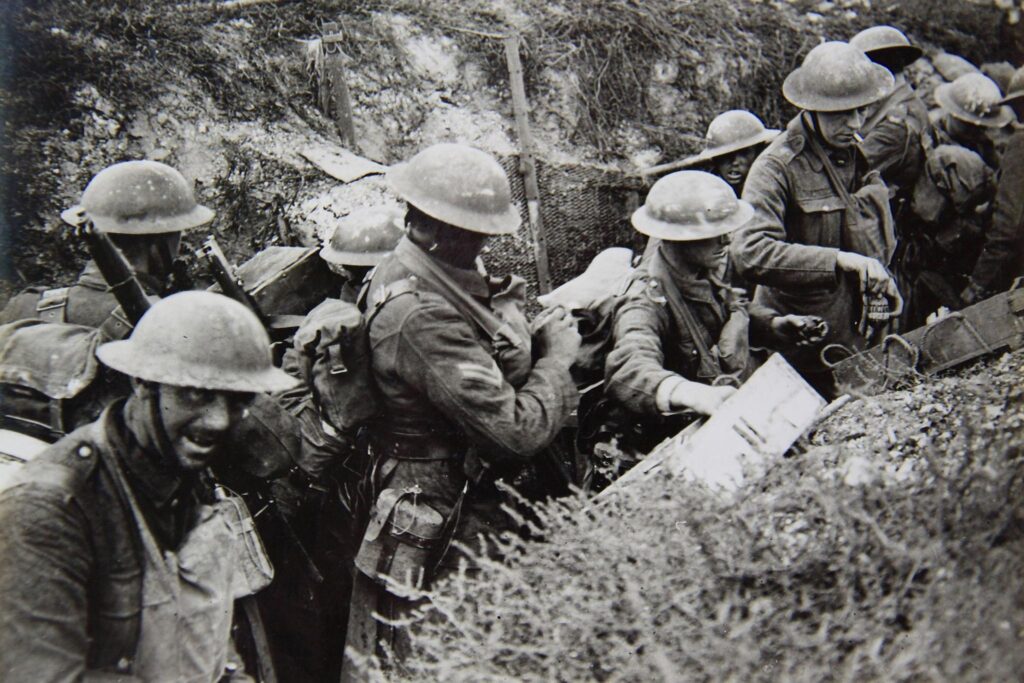
That night, they made their way up to the front line. “It started to rain, making the trenches all greasy, and the going hard. Each man was carrying three hundred rounds of ammunition, a two-gallon drum of water, and three empty sandbags slung through his belt. Each man also had a pick and shovel alternately. We cursed, stumbled and slipped along in the darkness, with the fore-sight of our rifles getting caught every now and then in the telephone wires. Eventually we reached our allotted position, and waited for dawn. All through the night it drizzled, and we sat and shivered.”
The barrage began at dawn: “Our artillery went mad; the shells screamed over our heads without a break… Our trench was falling in with the vibration of bursting shells. The roar as they skimmed over our heads was terrifying. It was like standing under a railway bridge with about twenty express trains thundering over all the time.”
The Battle of Loos is remembered as the first time Britain used chlorine gas, and the troops had to put their gas masks on. “I felt very lonely when I put mine on. I wanted the companionship of my neighbour badly. About quarter of an hour before zero hour, we were told to roll up our masks, but leave them on our heads.“
At five minutes to go, the barrage lifted. “Three minutes to go, boys.” How I wished I was home. An awful empty feeling was gripping my stomach.
“Get ready, boys, one minute to go.” We were standing on the lower rungs of the ladders now waiting, waiting for what?
“Half a minute to go, are you all ready? … Come on men, over we go.”
Over the parapet we went amidst encouraging cries from the engineers we were leaving behind. “Good old Jocks, slip it about them Seaforths.” Once we got moving things took on a different aspect. We soon found out that there was still plenty of life in the German trenches.
“Men were going down all over the place, some smiling because they had got a nice Blighty one, others with the death mask settling over their faces before they hit the ground. The artillery had cut the barbed wire very effectively in my part of the line, and it was not long until we were standing on the German parapet, firing down at the bottom of the trench. Some of them were flinging money and cigars at us.
“We jumped over the trenches and made for Loos, which was about a mile away over open ground…
“When we eventually reached the houses, we all split up into parties to go up the different streets and lanes. I found myself in a cabbage garden with two other men of my section.
“The Germans were potting at us from all the windows, and how we were not hit was a miracle, as the bullets were knocking lumps of brick all around us. By this time the three of us were alone in a lane, and a gang of Germans tried to run in at a doorway, and at the same moment another crowd tried to come out, with the result that all jammed. It did not seem sporty to fire into the grey bunch at forty yards range, but self preservation knows no law.
“The Germans got in eventually and we got up to the door, when we discovered the Germans had gone downstairs into a sunken flat. We could see them through the window and were going to leave them as our orders were to “get on”, when a bomber of our company came along. He had bandy legs and looked ridiculous in a kilt. I said, “This house is full of Germans.” He replied, “I ken that; haud this,” at the same time handing me his rifle. He slung a bomb through the window and the floor seemed to rise up in a cloud of dust. On going on, we came into a cross street, where we met more of our men, also numbers of Germans. There followed fierce, bitter fighting. Man met his fellow man face to face, and fought to the death with rifle butt, bayonet and bomb. Mercy was neither asked nor given.
“Our bombers were throwing bombs in windows, both upstairs and down. Some of the bombs were missing and hitting the wall, with the result that they fell back amongst ourselves with deadly effect. It was still raining, and the rainwater running down the gutters at the side of the street was crimson with blood.”
After more murderous fighting, they reached the edge of the town and were cheered by the sight of a line of Cameron Highlanders coming up at the double. Together, the Seaforths and Camerons reached the slopes of Hill 70.
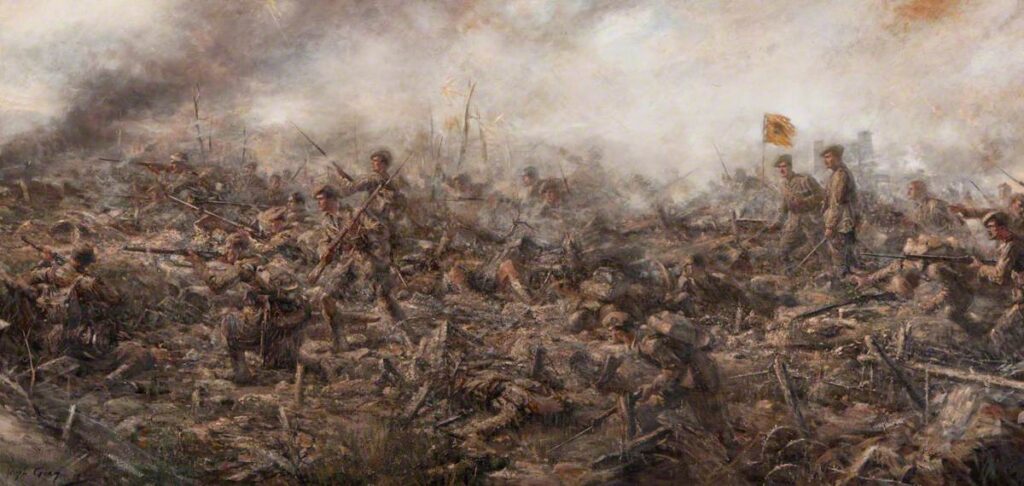
“On going up the slope our shells started falling among us, and quite a few were killed. Eventually the shells stopped altogether, and we went forward again. Again I was seized with a horrible lonely feeling, and found myself wondering if I were not in a dream, and we were only out on manoeuvres, and that in a short time we would form up and march back to camp. The awful loneliness would persist, and I knew I was never going back.”
When they reached the crest of the hill, the shelling stopped, as mist prevented either side knowing where the line was. The men rested and shook hands with each other. Their final objective was the town of Lens.
“After resting about twenty minutes or so, we got the order to advance, a most disastrous and foolish thing to do, as all the much talked about reinforcements were not in sight. We were just a wedge driven right into the heart of the German line. Anyhow, off we went, and had not proceeded far when a heavy fire opened on us.”
They were ordered to halt about two hundred yards in front of barbed wire entanglements protecting the Lens suburb of Cite St Laurent.
“I remember lying with my nose buried in the ground scooping the earth in front with my trenching tool. Lying there with my nose in the ground, the sweet smell of white clover, which was growing all around us, made one think what a farce it all was. Every now and then I would have a little peep to see how my mound was getting on, and wondering if there was enough to stop a bullet. As I scooped a hollow so did I worm myself into it.
“I wonder how many bullets were fired for every man hit? The tune of them sounded continuously. The ping, ping, as they went past one’s head, and the ripp, zipp, as they struck the earth beside one, got monotonous… For two hours we lay there waiting on our reinforcements to come pouring over the hill. Nothing to do but dig oneself in, no enemy to be seen, just wait on the reinforcements or death, with heavy odds on death.”
Orders eventually came to retire. “The left of our line started to get up and go back, so we all, that is to say all who were left, got up and started to go back up the hill. The line of dead and wounded could be seen stretching away into the distance. So this was war! We had not served any purpose by coming over the hill. What a feeling of despondency!
“So this was the result of our great advance. Someone had blundered. An experience like this should put any man against war, when thousands of men may be sent to their deaths without rhyme or reason and without inflicting any injury to the enemy…
“On going back up the hill, men began to drop faster and faster. I had a premonition that I would never get back, and thought I was going to be killed. I would look at a bunch of grass ahead, and wonder if I would be dead before reaching it.
“It was a very small handful of us that reached the crest again. I remember a man in front of me turn a somersault when, bang, I thought somebody had hit me with the butt end of his rifle. A chap said to me, “Are you hit?” On blood starting to run out of my chest I knew I was hit.
“I could see some of our men digging a trench about two hundred and fifty yards away, and knew I had to get there. My rifle began to get heavier and heavier, until at last I had to drop it. Then I became blind, but still conscious and on my feet. At last my knees began to get groggy, and eventually down I went, when all became blank. On coming to again, I managed to sit up with my hands on the ground behind to support me.
A crowd of Germans were coming up at the double towards me, and one who was running about fifty yards ahead came over with his rifle and bayonet ready to stick me. How I watched that German’s eyes as he approached me. I wondered if it would be very sore to have a bayonet stuck in one; would he stick me in the ribs or the stomach? Then I thought, I am dying anyhow, so this will only hasten matters. As the German drew near, I saw the look in his eyes change, and knew he was not going to harm me. He called “verwounded” and ran on.
“I fell back unconscious once more. I was wounded about mid-day, and when I came round it was getting dusk, and Germans were still running over the top of me. They were digging themselves in ten yards beyond me, I was ten yards on the wrong side of the line. The unthought of had come to pass – I was a prisoner.
“I was now lying a in a pool of blood, and every time I moved my right arm it gurgled out afresh… I now opened my tunic and shirt and had one look at my wound; oh horrors, it seemed my chest was blown out. My left hand was the only one I could use, so I opened my knife and started to cut off my equipment. I simply severed through everything until at last I managed to free myself…
“There was a small wooden hut about eight feet square standing on a brick foundation about four yards from me. I managed to crawl into this and flop down. I got my field dressing out, and bit the iodine bottle, letting the iodine soak on to the pad. I put the pad over the hole in my chest, and held it there with my hand. It was now pitch dark. I could hear the Germans digging themselves in. There was a barrel standing beside me in the hut, and I kept imagining it was one of my pals. Time and again I came to my senses to find myself talking to the barrel: “Why don’t you go and fetch the stretcher bearers then,” I found myself asking it several times.
“Sunday morning broke at last, and with it a most fearful bombardment from the British Artillery. The big shells were crumping all around me. What irony to be killed by my own side! Crump, whir-ir-ir, bang, and a piece of shell would land alongside the hut. A shell eventually hit or burst over the hut. Something happened anyway, and on coming round, I found myself lying amongst sticks, bricks, etc., and about three or four yards from the brick foundations of the hut. The barrage was getting heavier, and I thought I should go mad with terror as the shrapnel splinters were flying all around me. At last I got beyond the terror stage, and found myself watching the shells bursting quite calmly.
“Strangely enough, I found myself in a most comfortable position now, lying at a nice incline with bits of plank holding me up. After the intense bombardment had lasted for an hour or two, our infantry started to attack, but the Germans started running back into the trench, machine guns were hauled up from the bottom of it, and opened fire on our men, simply mowing them down. Bullets from the British rifles were now pinging around me. The Germans are good fighters and no cowards, and they stood firm. Our boys were unable to shift them and I had the terrible experience of seeing my own side falling back, I was not to be re-taken.
The shelling eased off after that, and the sun shone brilliantly, so I lay and thought, and swooned alternately. My water was all finished, and I was suffering greatly from thirst, but my wound had no feeling. When it got between 11 and 12 o’clock mid-day, I thought of all the church services that would be on at home, and imagined I could hear the old minister at Fort George praying, “Oh Lord, we pray for our soldiers in the trenches and our sailors on the sea, and especially, oh Lord, do we pray for those lying on the battlefield wounded sore unto death.” I felt quite important to think I came under the latter heading. My thirst was getting unbearable, and I kept thinking of all the burns at home running to waste, and I dying just for the want of one drink. When Sunday night came, I thought surely I will be dead by morning. I had several conversations with my old friend, the staple barrel. At last, my thirst became so unbearable, I started shouting (or trying to) to the Germans. They could come and finish me off or do what they liked, anything was better than the awful thirst.”
As daylight broke, two young German soldiers crawled out of the trench and hauled William Leask in. After a couple of days found himself in a hospital run by French nuns in Douai. He discovered later that he had been put in what he called the death ward. Doctors often told him later that he was very lucky to be alive. He was there for seventeen days until recovered enough to be sent to a hospital in Wesel-on-Rhine in Germany, which did its best for the patients but William said that he was always hungry and that this was to be a chronic complaint for the next three years.
At the end of December he was fit enough to leave. Before he left he received two letters and a postcard from home. For nine weeks his family and his fiancée, Mary Drysdale, had thought he was dead.
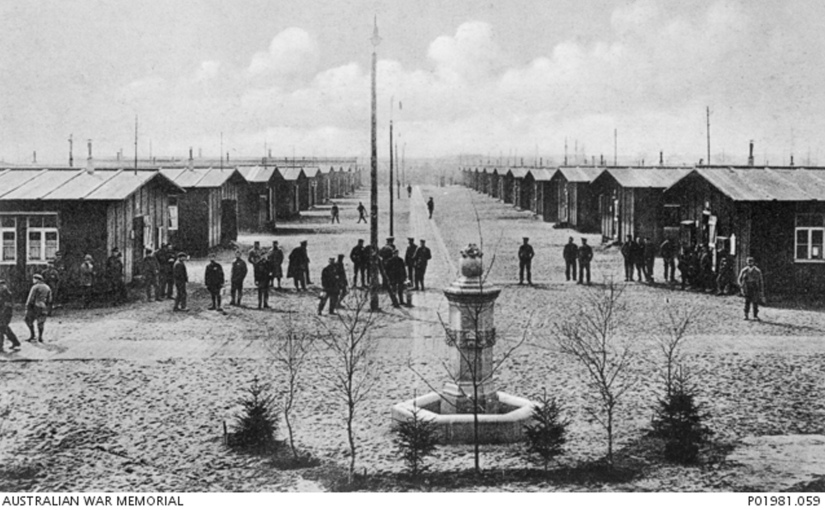
The first camp was in Dulmen, 32 kilometres from the Dutch border. It was bitterly cold and William felt it particularly badly as he was still weak, and just had a khaki uniform to wear. He had stolen the trousers to replace the kilt that had drawn far too much attention but he didn’t have a coat. After a week or two there, he was told there were two parcels for him.
“Never in all my life was I so thrilled to receive a parcel. Down I went to the parcel office, all excitement to draw them, and discovered one was clothes and one was precious food – could not have been better. The clothes parcel contained a greatcoat and a pair of thick trousers which I wanted to put on at once, but the censors took them away to get the brown bands sewn on. How excited I was to see the censor empty out my food parcel on the counter and see the various precious contents come to view – biscuits, bully beef, condensed milk, tea, sugar, cigarettes, and last but not least one of those glorious four pound tins of golden syrup. Shall we prisoners ever forget them?”
The Regimental Associations were in charge of sending the parcels and William said the Seaforth Highlanders would ever bless the name of their ministering angel, Vera, who headed the organising committee. Parcels came quite regularly and were vitally important as food became worse and worse. William was impressed that they were not intercepted by the German soldiers, even when their rations became pitifully scarce.
Shortly afterwards, William was sent to a camp in Dortmund, to work in the steel works. After just eight days, he made the first of his escape attempts, along with two other men, but his wound hadn’t quite healed and they had to give up after a couple of days. They were sent to a much better run camp, Munster Lager II in Westphalia, where the camp commandant, General von Bitten, was a soldier first and foremost.
“On one occasion a gang of us British prisoners were marching along to the camp, when we saw the old General standing. We pulled ourselves together and went swinging along, all in step. When we came up to the General he halted us, and going up to the sentry, who was marching in front, checked him for having his belt slack and being slovenly. He then told the sentry to look at the British prisoners and take a lesson from them how to come on parade.”
In October 1916 William was transferred to Soest, to work in a sugar-beet factory and made his next escape attempt six weeks later. This one again only lasted a few days, as he fell into a deep hole in the dark and hurt his leg too badly to carry on. William risked being shot during his escape attempts and spent three weeks on bread and water in solitary confinement every time but it didn’t stop him trying.
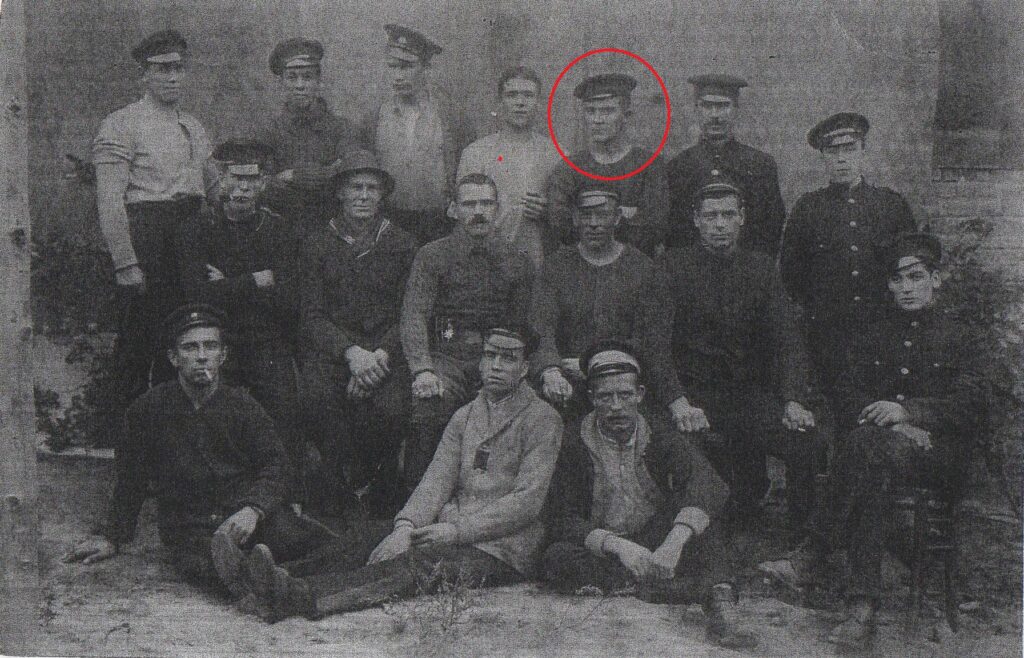
His next camp was Sennelager, which he described as “…quite a cheery camp, nearly all the prisoners there having been taken at the retreat from Mons in 1914.” They had a wonderful brass band as there were six regular army bandmasters who had been working as stretcher-bearers when they were captured at Mons. Unfortunately, the camp was broken up in January and William found himself at Minden, which he described as the worst camp he was ever in. The commandant, General Wolfe, hated the British and made the place “…a living hell.”
Sometime in the summer, William made his next escape attempt with two friends, Gerrard and Robertson. They got out through a loosened window in their hut and walked for six nights, to within seven miles of the Dutch border
“We could scarcely sleep through excitement that day; we pored over the map and made all sorts of plans. Would the next day see us free men in Holland? At nine pm we had a look round and discovered we were on the edge of a big moor which stretched in the direction we wished to go.
“There was not a sign of life and the only signs of habitation were a church steeple about three miles away to the left and what looked like an old ruin about one mile away, which lay directly in our course. We had our biscuits and waited until ten pm and as there was not a sign of life, although still daylight, we started off. This was a most mad action; there we were about six or seven miles from Holland and had been taking every precaution up till then, and when we should have been extra cautious we threw caution to the winds and moved off in day light. I can only put it down to excitement and nervousness.
“On crossing the moor we discovered it was all covered with trenches where they had been cutting peats and the men we had heard talking through the day had been engaged in that occupation.”
They walked for a while and struck a little used railway line that they started to walk along. Then two men and a large dog came up behind them – they had been seen crossing the moor. What they had taken as an old ruin was a convict station holding fifty prisoners who were cutting peat. They were told that another two hours would have got them across the border and if they had only waited another hour they would not have been seen.
“We bitterly cursed our folly and were so disgusted and fed up we dared not speak to one another.”
We were well treated during our stay at Velen but it was most tantalising to think freedom was only the distance of a pleasant evening stroll away. An old farmer with a waggon spoke to us through the fence for quite a long while. He was just leaving for Holland with a load of hay. Oh to have got in amongst the hay! We watched his load going down the road with yearning eyes. One hour and he would be in Holland, with a free road to Scotland before him if he so wished, while we were going back to the depths.”
William really was going to the depths; he was sent to work in dreadful conditions in a coal mine, with a ten mile walk there and back every day.
“There were times at the mine when I was too fed up and miserable for words. We knew we were on a punishment commando, but still we half expected to be treated like human beings, and not like badly treated beasts. I will give the unter officer credit for being able to prevent prisoners escaping. He did not leave one loophole.”
After several months, towards the end of 1917, William hurt his leg so badly that he couldn’t work for two months and was happy to be sent back to Sennelager. When he was fit again, he went to work on the railway in Dusseldorf and saw how desperate life in Germany was becoming. Food had always been poor in the camps, for the guards as well as the prisoners, but now butchers’ shops were only open one day a fortnight and sold what they had to the first in line. William’s fourth escape attempt ended after two days because he hadn’t realised that the lack of food was becoming so desperate that soldiers were guarding allotments at night.
William’s four escape attempts had now given him a very bad record and he was sent to another coal mine.
“My heart sank right down to my boots. In fact, I thought, “much more of this and the Germans will break my heart.” Then I had had three years of being knocked about from pillar to post, and I felt I could not stand much more of it.”
After a few months, William managed to get another compass, without which an escape attempt was impossible, and with two other men, a Londoner called Gailler and a South African called Cockcroft, he set off again, on the night of 10th November 1918.
They slept by day and walked by night for three days until they were found sleeping by two men who turned out be POWs who said, “Pack up, the bloody war’s over”. They wouldn’t believe him until shown a newspaper that listed the Armistice terms.
The POWs wanted them to stay and go home with them but William said that after three years, he was taking no chances. After a meal of hot rice and raisins and a mug of tea, which he described as one of the finest meals he ever tasted, the three men set off again, as the POWs sang “You’ll tak the high road and I’ll tak the low road.”
They walked on for another night, slept in a bed of bracken and set off for the frontier. It was very hard to tell exactly where it was and they crossed two and fro a few times until they saw a sentry standing in the road
“We hurriedly decided to walk up to him, and perhaps he would allow us to pass, seeing the Armistice was on. We had advanced a few paces when he shouted “Halt” and two other men came running out of a hut at the side of the road. As the sentry drew near, I saw he had a different head-dress from that worn by the Germans, so I asked in German if he was a Hollander. He replied, “Yes, you are in Holland now.” What a feeling! No words could describe it. It was all over at long last.”
It took three weeks but it was finally William’s turn to board a ship at Rotterdam, having first been kitted out again as a soldier.
“The following morning I saw the finest piece of organisation I had seen in the whole war. We were marched to the other side of the dock and into a shed. We went in single file and as we entered there were several military tailors standing waiting for us. In the sheds were several great stacks of full kit bags, and on entering we were sized up by a tailor and directed to a stack, according to our size. As we passed the stacks, a kitbag was slung at us and we continued moving without a halt. In the kitbag was a new khaki uniform, great-coat and underclothing. Continuing on we passed stacks of boots and on shouting our size a pair was flung at us. A little further on were stacks of caps, and one of these was flung at us on shouting our size. So it was a case of entering the end of a shed and marching right through without a halt, but on emerging we had a complete new outfit.”
“On entering the Humber boom, all the drifters sounded their sirens. When we went alongside the landing stage, there were thousands of people down, seeing it was Sunday. We old hands from Germany saw W.A.A.C.s, W.R.A.A.F.s, and W.R.E.N.s for the first time. It seemed as if we were coming into a strange land. When the actual moment came for landing, one could not help thinking, “What about the boys we left behind, who will never set foot on their own shores again. “ I think all the men had the same thoughts, for there was a dead silence. Not a man had a word to shout, not even to a girl. The moment was too great.”
William married his fiancée Mary Drysdale the following year and they emigrated to Southern Rhodesia, where they raised three daughters and established Coldomo Farm, named after the family home in Stenness.
On 30 January 1920, the London Gazette listed Lance Corporal WJS Leask of 8th Battalion Seaforth Highlanders as one of the names brought to the notice of the Secretary of State for War for gallant conduct and determination displayed in escaping or attempting to escape.