
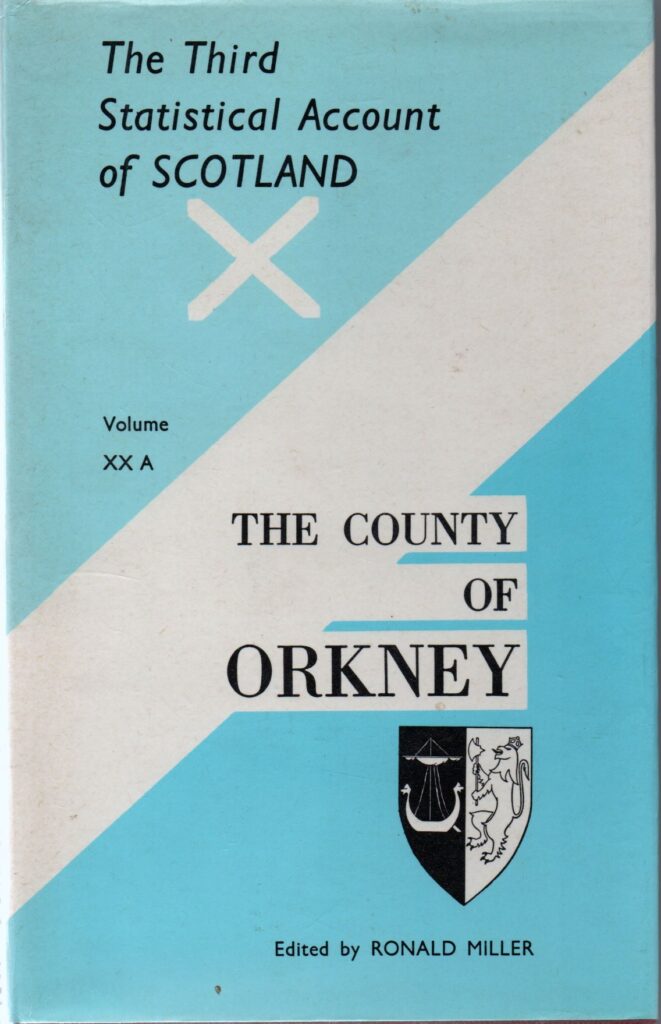
A detailed picture of Orkney around about 1950, part of The Third Statistical Account of Scotland, was finally published in 1985. The First Statistical Account, organised by Sir John Sinclair of Ulbster in Caithness in the 1790s, was quickly followed by the Second in the 1830s but the Third Statistical Account was only begun in 1947. The Account was compiled over the next few years but it took a long time for some of the counties to be published.
The editor of the The County of Orkney was Ronald Miller from Stromness. He had graduated from Edinburgh University in 1931, a member of the first class in Scotland to gain an Honours degree in Geography and retired as Professor of Geography at Glasgow University in 1976. His excellent book on Orkney, just called Orkney was published in the same year. He was not at first convinced of the value of publishing the Account.
It may seem odd – even absurd – to publish manuscripts which have been lying in store since around 1951. Surely they must be out of date, superseded by the great mass of publications that have dealt with Orkney since then. This writer must confess that these were indeed his own reactions when first invited to edit this volume of the third Statistical Account. On reading the essays, however, it became apparent that, like motor cars, they have passed from the stage of being merely out of date, obsolete, to become vintage material…
In the early 1950s, Orkney had just got its breath back after the tremendous effort and trauma of a World War. Many had just settled back after new and strange experiences in other, often distant lands and all were poised for the rapid changes which they were to share with the rest of the country. The Account thus pictures Orkney as it was before the start of the rapid evolution that has got us to where we are now.
Even though two essays are missing – Papay [Papa Westray] and Stenness [written by my grandfather, Peter Leith], the range of authorship is such that a rich, often very humane blend of views on the great variety within the parishes of Orkney emerges and in most cases the personality of the writer becomes as interesting as the parish he describes.
As a first example of those interesting essays, I have chosen Harray, written by Charles Borwick of Caperhouse.
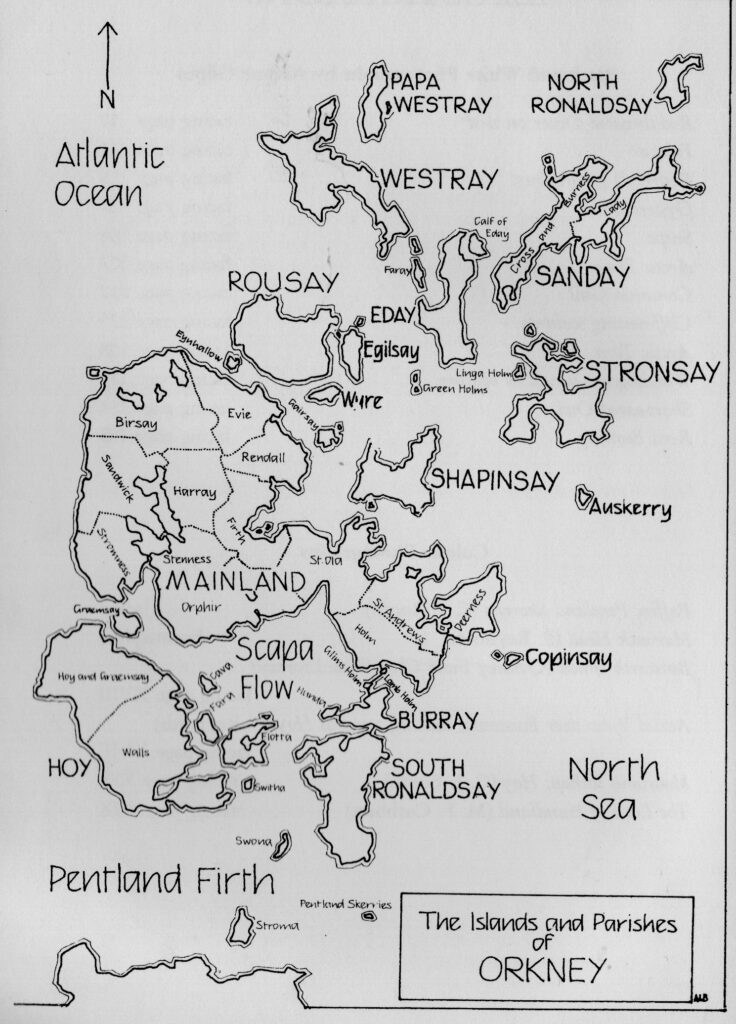
PARISH OF HARRAY by Charles W Borwick, Esq.
Harray is the only parish in Orkney which does not touch the sea. It lies about the centre of the West Mainland and is bounded on the west by the parish of Sandwick and the Harray Loch, on the east by the hills separating it from the parishes of Rendall and Firth, on the south by the parish of Stenness and on the north by the parish of Birsay, with which it unites to form a civil parish.
SURFACE
The surface is moderately flat, with (apart from the hills to the east) three main undulations. The first of these begins above the village of Dounby (in Sandwick parish) at the north end of Harray parish and includes parts of the townships of Knarston and Mirbister. The second is nearer the centre of the parish and includes a large part of the township of Brough, the highest point being the ancient broch now included in the churchyard, beside which stands St Michael’s Church. It is said that the first church was erected on this site by Sigurd the Stout almost 1,000 years ago. The third rising is named Stoneyhill, which separates the townships of Netherbrough and Bimbister from the township of Grimeston.
One of the chief features of the area is the patchiness of the land – the fertile land consisting of circular isolated areas separated by areas of barren heathery ground. In olden times this conduced naturally to the formation of townships, of which there are nearly a dozen. The frequent occurrence of small, steep knowes in arable fields makes tillage more difficult. The highest point in Brough, around St Michael’s Church, is all very fertile, but the rise of Stoneyhill, about a mile away, is very barren country. The nearness of black loam to very hard brecks is in some parts quite surprising. The best of the land will give place to the poorest in a distance of a few chains…
HISTORY OF THE LOCAL COMMUNITY
This parish has always been wholly agricultural, and it is safe to say that since man began to till the ground, no century has witnessed such great changes in all matters touching farming as the century 1849 -1949 – these changes, although many, have come about so gradually that it is hard for the present generation to realise what life and conditions were like in 1849, but if we look into the matter at all, and consider all the advantages presently possessed by the people, it is equally hard to believe this is still the same little parish of small farms.
In 1849 there was no cultivated grass, very little if any turnips, no fencing, no field implements or barn machinery as we know them, and the land, being continuously cropped, was down and out. Under those conditions, farming had no future at all, and young men who wanted to get on in the world had to go to sea, or to one or other of the new countries, and the best of every generation did go… In those days, the older generation worn out with hard work, poor food, and bad housing, were often in an enfeebled state of health when they were only sixty, and many of them spent much of their time in bed. Nothing shows better the vastly improved standard of living than the complete disappearance of this aftermath of working the life out to keep the life in. Far more people now reach the allotted span than was the case formerly, and all of them lead a normal active life until seized by a fatal illness.
The first event of importance to be noted may be the division of the commonty of the parish in 1854 – this involved the dividing of the whole area of the parish which lay outside the township dykes among the many proprietors. Land ownership has been in the hands of the occupiers from the earliest times, and it is so to the present day. After the end of the runrig system, the various proprietors in each township would have divided the infield or good land among themselves, while still owning the brecks (or heather-covered outrun) and hills in common. Landholders from parishes not too well supplied with peat were making a practice of cutting peats in the Harray hills, and the chief reason for the division of 1854 was to conserve the parish peat resources for the local proprietors. The division included all the low-lying heathery breck, which formed a considerable area, which at that time had no economic possibilities and this probably explains why little attention appears to have been paid to them as to the distance or other favourable factor, some allotments being a mile or two from the farms receiving them. If later developments could have been foreseen, a more sensible division might have been made.
FARMING PROGRESS
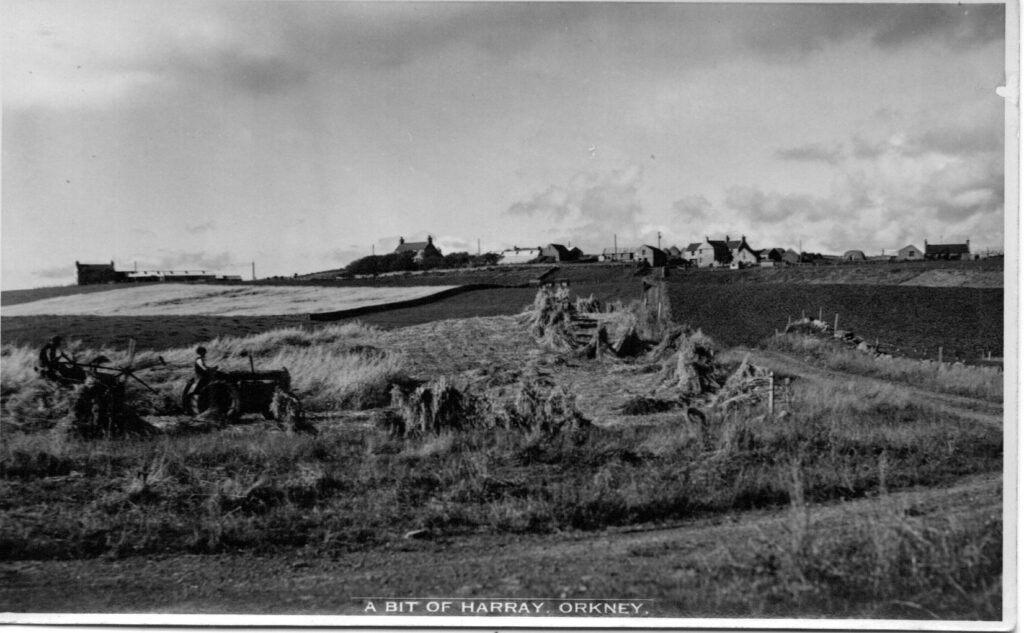
For most of this century, the farmers did not have plants, fertilisers or implements to develop the brecks [uncultivated slopes] but they were interested in their meadow areas, where the soil was deep and grass grew. This grass was very valuable then, being nearly all the grass they had, but after they began to grow grass in their arable fields, they thought their meadows could be ploughed and cropped. Flooding was the main trouble and to rectify this the water courses in several small meadows were straightened and improved, and about 1885, a new canal was cut through the Netherbrough meadow. When the meadows were ploughed, bulky crops of straw were grown, of which the farmers were in much need, but the grain was inferior. The scheme was not a permanent success, however, as the flood waters carried down silt, which choked the canal and cropping had to be abandoned. By this time, farmers were working their land to a proper rotation, including turnips, were using Peruvian guano and other fertilisers, buying reapers, reclaiming brecks, and generally seeing a ray of hope for their industry. This hope proved to be justified, as almost everything connected with farming had been improved, except the climate. This is still hostile enough to offer a challenge to each generation of farmers, a challenge which has always been accepted. Time and again, farmers have seen their prospects of profit reduced by late springs, sunless summers and wet and stormy harvests; but adversity, instead of producing pessimism, seems to have strengthened the resolution of the people. This resolution may be called a readiness to wrestle with their problems and it only needed a few scientific and mechanical discoveries to enable them to write ‘Success’ large over their farming enterprise. We can see now that the tradition of adversity was not wholly a bad thing, as it kept the people on their mettle, and their inherent optimism was preserved unimpaired…
SOCIAL LIFE
… Youth organisations are the youth club and the young farmers’ club. Women’s organisations are the S.W.R.I. (60 members) and Women’s Guild in connection with the church. There has been an amateur dramatic club in the parish for a considerable time. One or two plays are usually put forward to the local S.C.D.A. preliminary festival. The club won the local cup in 1948. Longer plays are staged from time to time and performed in this and surrounding parishes.
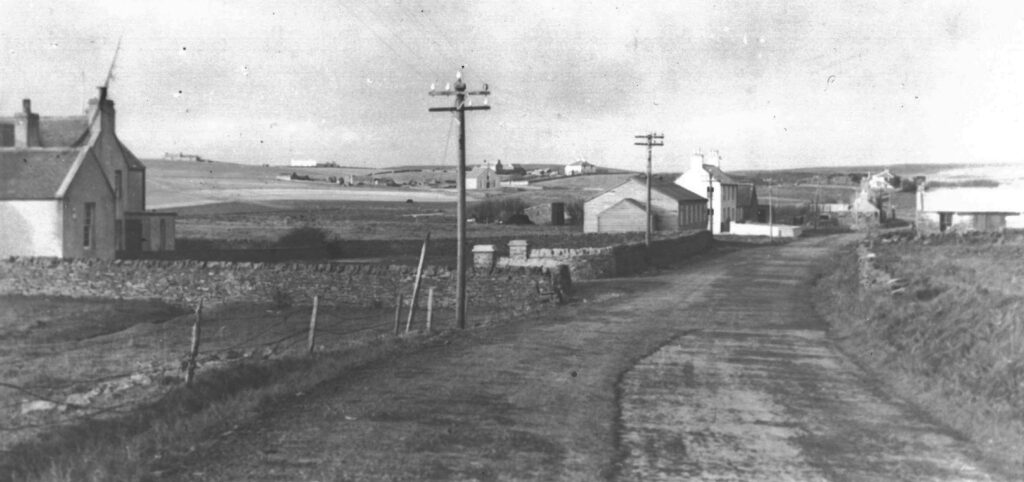
A Community Association was formed in 1946, to which most of the secular organisations in the parish are affiliated. The present membership is 140. A Community Centre consisting of a timber building on a concrete foundation was erected in 1946 in the centre of the parish, adjoining the main road. The cost of the Centre including furnishings and hard tennis court was £2,400 and a grant amounting to £1,235 was received from the Scottish Home Department towards the cost.
POPULATION
The present Harray population of 600 is somewhat less than the number in 1901 (viz 675), not to speak of the peak year 1861, when it totalled 810. As there has been hardly any emigration since 1914, the chief reason for the decline in numbers must be the present-day smallness of families. It is hard to state the cause of this undesirable trend, which is not confined to this parish. Our forefathers may have lacked almost everything which we consider essential to the good life, but they certainly had no lack of large families…
The population is well matched to economic opportunity, as there is work for everyone able and willing to work, either in farming, or County Council work on the roads, or with one or the other of the building firms who cater for the constructional needs of the parish.
PUBLIC SERVICES
Most of the usual public services demand a larger grouping of houses than there is at present anywhere in this parish, so it will probably be some time before they are all laid on.
Electric supply The North of Scotland Hydro-Electric Board now have a high tension line running the whole length of the parish to Dounby, and many farms and houses have electricity already installed. The townships not yet connected up are hoping that this will be done in the next year or two. There are several private plants.
Roads The parish is by no means over-roaded by public authority roads but the existing roads are all in good condition. The six miles of main Kirkwall-Birsay road is fairly adequate, but most of the side roads are too narrow for present-day traffic, having been made in the days of horse transport. More and better farm roads are needed.
HEALTH SERVICES

About the year 1880 the parishes of Birsay, Harray and Sandwick formed a Medical Aid Association. Householders in these parishes became members by paying an annual subscription. A doctor’s house was built at Dounby and the Association was able to guarantee a small annual salary to a doctor. Since that date there has always been a doctor located at Dounby. About 15 years ago the work of the Association was taken over by the Department of Health and now, of course, the scheme is included in the National Health Service. Nearly 20 years ago, the Department of Health appointed a resident surgeon to Balfour Hospital, Kirkwall. The great benefit of this service to the whole of Orkney can hardly be over-estimated, as many a sick person has been saved the ordeal of a sea journey to Aberdeen or Edinburgh for surgical treatment…
HOUSING
…It would, we think, be true to say that, with the general improvement of housing, and the reduced size of families, there is no overcrowding. The ideas of many people, however, as to what they need in the way of a house are still rather modest, but the tendency is always toward something better. One improvement which is being carried out by many farmers at the present time is the provision of piped water supply to farm houses, steadings and fields. Wind pumps, engines and hydraulic rams are being installed to force water from sources such as streams and wells to large tanks at farm houses, which supply water at all points where required, thus saving much labour.
There have always been a considerable number of houses in the parish occupied by tradespeople and others who were not farmers. In former times many of these were situated in rather out-of-the-way places, much nearer to the hills than to any highway. Inconvenience seems to have been no obstacle to our forefathers but perhaps the roads of those days were hardly worth considering when siting a house.
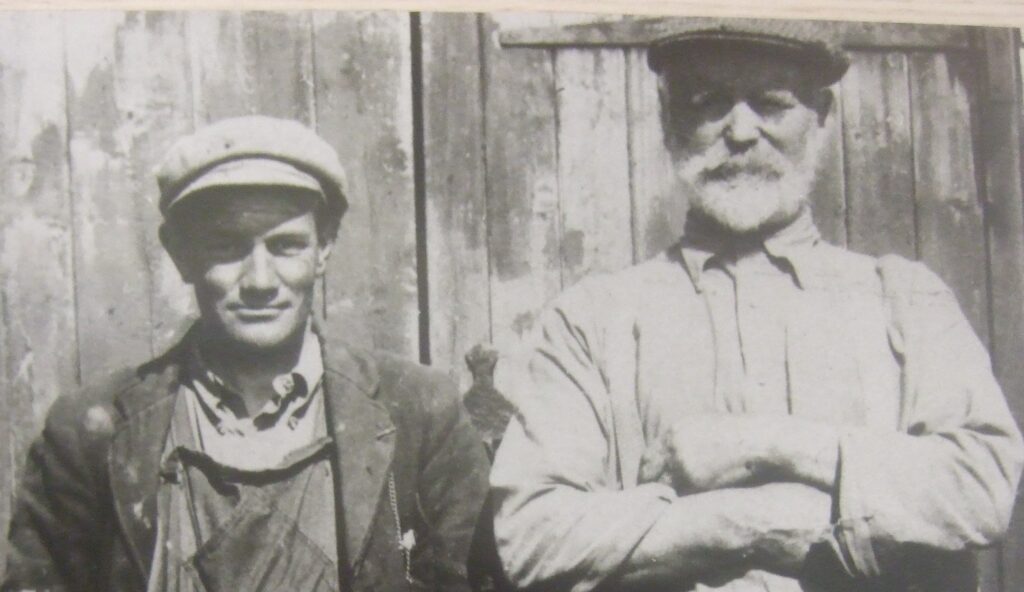
For a long time now, anyone erecting a house has preferred a site close to a public road and, since the motor era came in, this preference has become a ‘must’. During the past 50 years, an astonishing number of houses have been erected adjoining the 6 miles of main road from Dounby to Binscarth alone. A group of seven built at various times, but finished before the 1939 War, makes the Madras district between Brough and Corston quite a village. As costs and availability of materials for building have changed, so have the kinds of houses changed. The stone and slate type of house was proving too costly for private building, and other methods have been adopted. Just before the war, a number of timber houses were erected and concrete blocks were taking the place of stone. During the war, a large amount of temporary accommodation was brought to Orkney for military purposes, and this has proved very fortunate for ex-servicemen and others who have required dwellings during the last few years. The procedure has been – secure a site – buy a timber hut – erect it, put in concrete chimneys, face up the outside with concrete blocks, put asbestos sheets or other durable material on the roof – and the house is ready for the family to move in. In this matter of providing houses, as in some other matters, it is found that self-help is a good principle, and much more satisfactory than waiting around hoping that a State Department or some other public authority will provide something…
The people still make their own fuel by cutting and curing peats. The work is carried out in the same way as it was 100 years ago, except that the person lifting out the newly cut peat now does it with an ordinary fork, whereas the old people bent their backs and lifted them out by hand. The tractors and trailers make the carting of the peats much quicker and easier. There was a tendency to cut fewer peats and use coal instead but the recent scarcity and high cost of coal had brought peat back into favour.
The emergence of agriculture from the position of forlorn hope to one worth taking notice of is no doubt much in the minds of middle-aged farmers now. In fact, their generation is in the very unique position of being the only one which has worked the fields by the sweat of its brow with horses in its youth and now enjoys all the benefits of the tractor and mechanisation. In another thirty years, all these benefits will be taken for granted, the younger generations having known nothing of the time and labour their fathers put into field work. It is now uncommon to see a farmer following horses but there are still a fair number of horses kept for doing odd jobs. Many farms did not have binders until the tractor came, as they were too small to keep the three horses necessary to draw them. Now all the crops are cut with the binder. A tractor and binder makes short work of a five acre field on a fine afternoon. During the past fifteen years, progress in mechanisation has been rapid, most townships now have a number of tractors and many farmers not having tractors hire for field work.
One of the major changes in farming technique followed on the introduction of that wonder plant, Wild White Clover, about forty years ago, which changed well-nigh everything connected with husbandry for the better. Its time of growth is July-October, the very time when previously pastures were very bare, the stirks usually being sold in July, as poor land grew little grass in the autumn months. The nitrogen stored up in the soil stimulated other grasses to better growth and when the land was ploughed the cereal crop was very heavy. Under the old system the land was full of surface weeds, which flowered profusely in the summer, as the meagre crops gave them plenty of sunlight. Now, any land which has been decently farmed is very clean, as the heavy crops have smothered the weeds.
The clover also enabled the farmers to bring the brecks into useful service. Many enterprising men had been breaking in brecks with horses for a considerable time, a very hard, uphill job. It was found that the tractor could do this much easier. Then basic slag was used to complete the job. For twnty years the recipe for turning heather brecks into grassland has been to plough up, disc harrow thoroughly, apply shell sand and up to 1 ton per acre basic slag. Sow a seed mixture in June and the area will grow good grass for ten years if slagged every third year. Much of this improvement has been done in recent years, notably on Kingshouse and Howe, where upwards of 100 acres ave been reclaimed in each case…
In 1907 an agricultural co-operative society was formed in the parish, the main object of which was to improve the marketing of eggs. At this time the merchants were shipping eggs packed in straw in 144 dozen bozes and the producers’ price in the flush season was only 6d per dozen. The society, by packing eggs more carefully in 30 dozen boxes and shipping direct to the wholesalers in the south, raised the producers’ price to 8d. per dozen. The society continued in the egg business until 1942, when the wartime egg control was imposed and a packing station was started in Kirkwall…
SHOPS
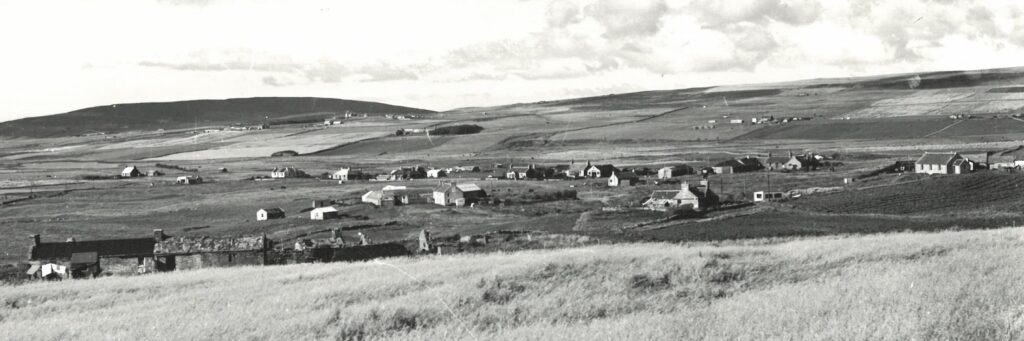
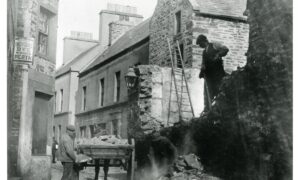
Photo by Wilfie Marr, courtesy of Orkney Library and Archive
The travelling grocery shop system was started by the late Robert Garden of Kirkwall about 70 years ago and this parish, lying as it does with Finstown and Kirkwall to the south and Dounby and Birsay to the north, was bound to be almost over-served by vans when this system was fully developed. There is at present one shop in the parish which sends out vans and two which do not. Two of the shops also run bakeries, and there is a local butcher…
People began to acquire cars, and a dozen years ago the parish became very road conscious, as cars could not run in the old cart tracks. The farmers have by their own efforts, financial or otherwise, made decent farm roads in nearly every township, which are proving very useful. The merchants are now sending their lorries to almost every farm for heavy goods and take out eggs and other produce. All the cattle are now sent to market in motor lorries, a practice which has been in vogue for a number of years.
EDUCATION
Until about ten years ago the education available in the parish was the usual elementary course up to the leaving age of 14. The weakness of this system was that with many classes and few teachers, pupils who passed the qualifying examination at the age of 12 were at a loose end until they were 14. Those who wanted Secondary education had to reside in Kirkwall or Stromness. Under the latest Education Acts, a bus is provided to convey pupils over 12 years of age daily to Stromness Academy. This arrangement is proving very suitable and is fully patronised. Since it started, three pupils from the parish have been Dux of the Academy in their year.
HISTORICAL MONUMENTS
Apart from a standing stone on Stoneyhill, about which tradition says that it was erected to mark the spot where the bearers of the remains of St magnus rested on their journey from Christ’s Church, Birsay, to Kirkwall Cathedral, the historical monuments of the parish consist almost entirely of the ruins of ancient brochs, most of which are mounds covered with turf and grass. Few townships are without one or two of these. It may be that some of the remains are not just broken-down brochs.
About the year 1903 the proprietor of Brettovale in the township of Mirbister removed entirely a small green mound on his property. On the ground level he found a paved area, 14 feet by 12 feet with two small semi-circular buildings about 2 feet high facing each other on opposite sides of the pavement, each small recess containing an image or bust of human shape. In the middle of the paved area rested a water-worn stone or pebble about the size of two human heads. Rather an unusual find, we think. Cists or graves in fields are common. In the winter of 1949-50 a tractor plough lifted the cover off one on the farm of Nistaben, Russland, in a field near Harray Loch; it contained human remains.
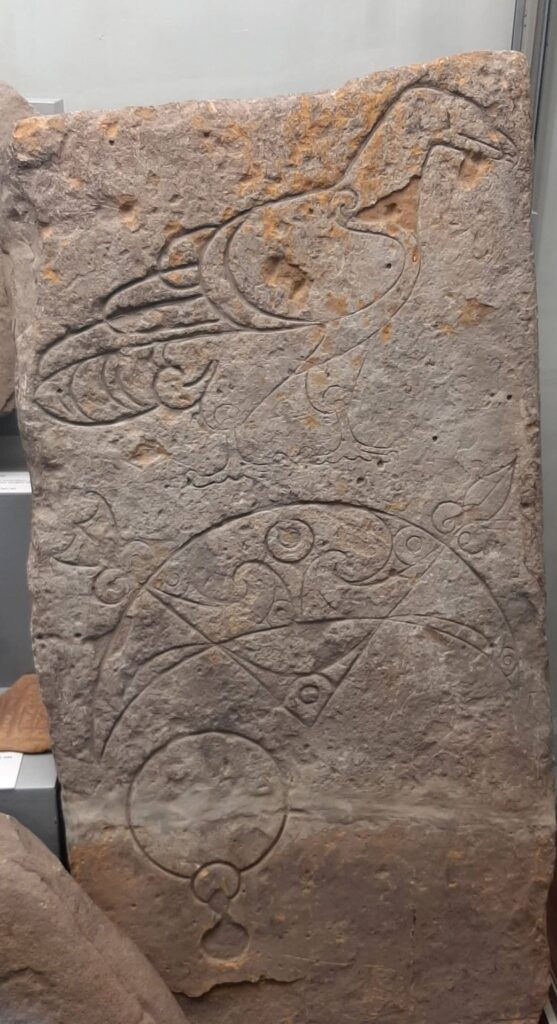
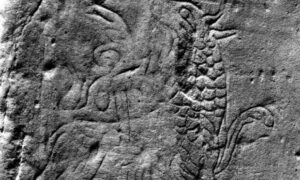
About 15 years ago a local man made a cutting through the large mound of Burrian, in Netherbrough. Many interesting things were found, including a fine symbol stone, with the figure of an eagle beautifully carved on it. This amateur enterprise was frowned upon by expert antiquarians however and we have reason to believe that shortly afterwards the owners of every similar monument in the parish were served with a warning notice by H.M. Commissioners of Works that no work could be done without giving the Commissioners 3 months’ notice.
WAY OF LIFE
… Work is the main hobby of the people. When they are not working, they are discussing what they have done, and what they are going to do. No doubt they find their work interesting, dealing as it does with life itself, with the production and encouragement of it in both the plant and animal worlds. The changing seasons too, change the nature of the work, and keep it from becoming monotonous. Now that it carries with it reasonable financial reward, we believe the rural life is one in which it is easy for a community to be contented and happy. One troublesome point, however, is that cows and calves do not lend themselves to being put on a shelf while their owner goes away for a fortnight’s holiday. But no doubt a means of solving this difficulty will be found by cooperation between farmers, now that the idea of going south for a holiday is developing.
As to the future, who can say what changes may yet be seen? One thing, however, is certain. The people have been used for so long to changes being for the better, that their outlook is now naturally one of hope. And, as far as we can see at present, both from a local and a national point of view, there is nothing to prevent our future from being more worth while than it could possibly be in the primitive past.


Superb, interesting read. I am an Orcadian, born and raised in Orphir. I remember the 1950s well back home while growing up, but failing to fully realise/appreciate the rich history that surrounded me on my own doorstep.
Fortunately I still have family there, and I still refer to Orkney as home.
I now live in Limekilns, a beautiful little village on the Forth River. Fife being my adopted home for over 40 years now. But Orkney will always be my home.
Hello Ken
I am sorry that it has taken me so long to find your interesting comment on my blog. I am glad you enjoyed it. I have very fond memories of Fife, but the other side of it. I spent 75 to 79 as a student at St Andrews. One of my daughters studied nursing at Kirkcaldy and I have a son living in Dundee so have managed to visit Fife fairly regularly in recent years.
I have just watched a You Tube video presented by OISFestival on the theologian John Oman; I thoroughly enjoyed the video. I bought Oman’s Grace and Personality and read it through three or four times. In spite of the difficulty of his presentation I was more than a little impressed.
Because I don’t know that I’ll hear back from you, I’ll only say that I’d like to learn more about him and any maybe the biography that you mentioned in the OISF video.
Thank you.
Dave Kratzmeyer