

Saturday 16 March 1940 was a quiet day in Orkney – until the light began to fade. It was then that the first serious air-raid of World War II began, as The Orcadian reported on the following Thursday.
It was dusk when the fighting began. People in every parish of the Orkney mainland and in the immediately adjacent islands readily recognised the drone of the enemy aircraft motors…
After dark – the raid lasted almost an hour and a half – the pale moonlight assumed periodic insignificance in the crimson illumination of many gun-flashes. Shells were fired at the raiders from ships and shore batteries in continuous streams...
The thunder of the heavy anti-aircraft guns shook Kirkwall houses, rattled windows and domestic utensils. The blast in some cases blew open the wooden shutters of windows, the sashes of which had been opened to avoid being broken by the concussion. The ground quivered when bombs fell considerable distances off.
Above the deeper toned noises of the heavy gunfire there shrilled the sound of lighter artillery. Against the moonlight, black bursts of smoke indicated exploding shells. Towards the heavens climbed lines of tracer bullets – like processions of ascending red-hot rivets. Invisible to the people there were other bullets between every two tracers. Every big gun flash lit up in red the whole area. Each flash was like crimson lightning.
At least fifteen German aircraft attacked Scapa Flow and HMS Sparrowhawk, the airfield on the outskirts of Kirkwall, but the worst effects of the raid were felt in Stenness. The German claim that airfields at Kirkwall and Stromness were attacked lends weight to the theory that the civilian airfield on the Stromness side of the Bridge of Waithe, used by Gandar Dower before the war, was mistaken for a military target.
The eye-witness accounts published in The Orcadian and Orkney Herald, although clearly reworded by the journalists, gives a vivid picture of the evening when everyday surroundings became so terrifyingly strange.
The Bridge of Waithe, which carries the Stromness-Kirkwall road over the sea entrance to the Stenness Loch, gave its name to the little cluster of buildings around the nearby junction with the Orphir Road. The building on the corner became famous after the war as Orkney’s night-club, the Golden Slipper, but in 1939 it was Willie Farquhar’s cobbler’s shop. Like many cobbler’s shops in Orkney, it was a place where men would gather in the evening so Willie and his mother Ellen had begun to sell lemonade, cigarettes and sweets. A young family lived at the other end of the little row: James and Lily Isbister with their three-month old son Neil. Another young family, Alfie and Cathy Linklater with ten-month old Freddie, lived in the house just behind them, at right angles to the road. Isa McLeod was in the house on the other side of the road.
The Orcadian interviewed Mrs Ellen Farquhar just a few days after the bombing
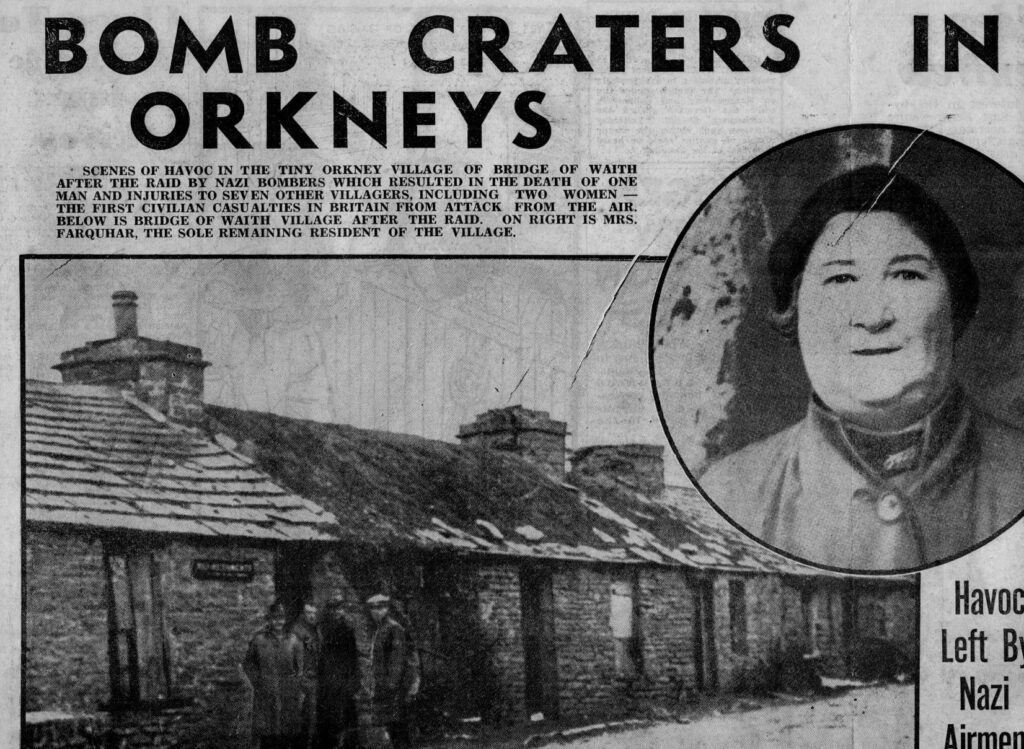
“My son had finished his boot mending for the week and was speaking to me while I was tidying the lemonade shelf and round about. Some of the young men of the parish who usually come about the shop on Saturday nights were hanging about. It was just in the gremlin [twilight]. The motor cars passing by had their wee bits of lights lit.
“One of the young fellows remarked on the noise of aeroplane engines but that was nothing unusual; the sounds were those of our own planes. Some gunfire broke out, but that was nothing unusual neither and nobody took much notice. The lads changed their minds, however, when gunfire such as I have never heard before lit up the whole district like red and shook the house. Quite plainly we then heard the different drone of German planes. There seemed to be quite a number of them. The noise of the guns was worse than ever and it was plain that the Germans were getting a right hot welcome.
“Several times we heard thuds and the boys said that that was bombs bursting. The young lads by this time were clearing off to their various homes. Some of them would be sure to be needed at home if the women and bairns became frightened. The men folk who live here were out several times; I was out myself but went back into the shop again. The glare made by so many red flashes from the guns shone over the hills and across the sky. All the time it flickered, as different guns were fired. The noise was frightsome.
“Above the noise we heard planes occasionally and then we saw one machine. It passed very near us and was supposed to be German. I was standing back inside my shop, quaking a bit, and holding on to the lemonade counter. Sometimes I was looking out of the door past William, my son, who was standing there. I heard no plane on this occasion, but one must have passed over in order to drop the bombs that suddenly fell here.
“I just saw a blue and white flame, which dazzled me at the same moment as a terrible explosion shook everything. The shop window crashed in and I was half choked with dust. I did not fall. I managed to keep my feet. Holding on to the wall and inside door, I rubbed my eyes and saw William sagging against the wall at the door. He was half-doubled up and I knew he had been hit. I struggled towards him but the sight went from me and I felt suddenly weak. I am nearly seventy years of age. When I more or less came to, William was attending to me, instead of me attending him. Blood was pouring from a wound in his thigh. When he got me all right, he told me to stay where I was and he left me to go and help any of the other folk who might have been hurt.
“Just then, Lily (Mrs Isbister) came towards our door, calling on William to help her to get her husband into the house. I managed to my door and saw that James Isbister had been hit. His wife and my son and some other folk were carrying him into his house.”
By the next week, The Orcadian had interviewed Willie, described as sitting up in bed at home, dealing with business correspondence:
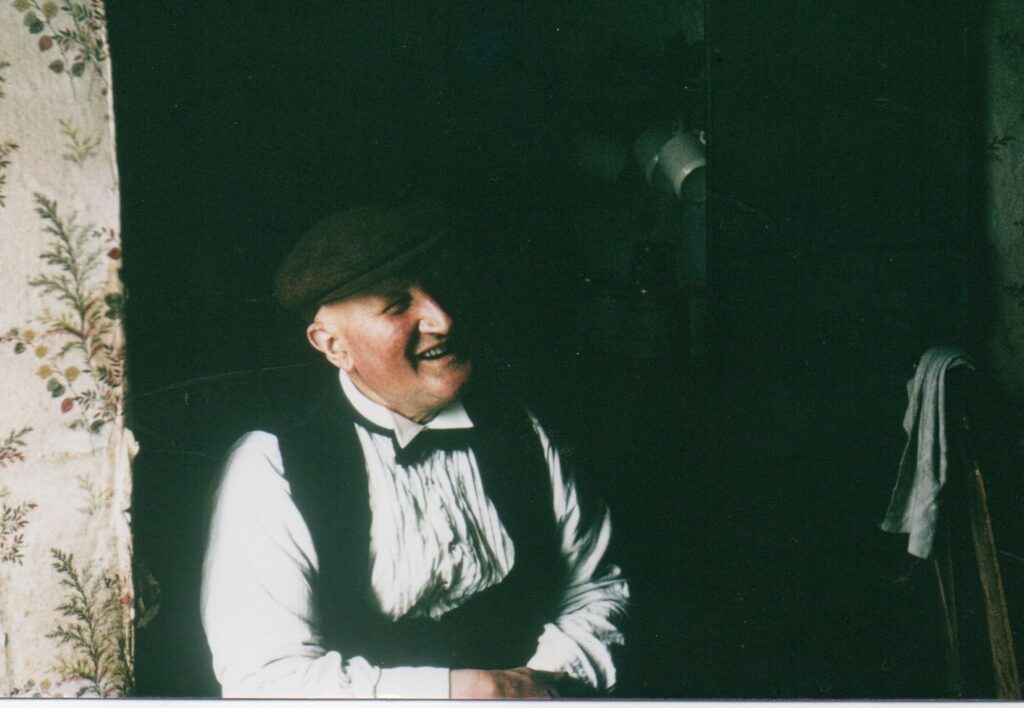
Willie Farquhar in the Golden Slipper c 1960 – with thanks to Victor Muir 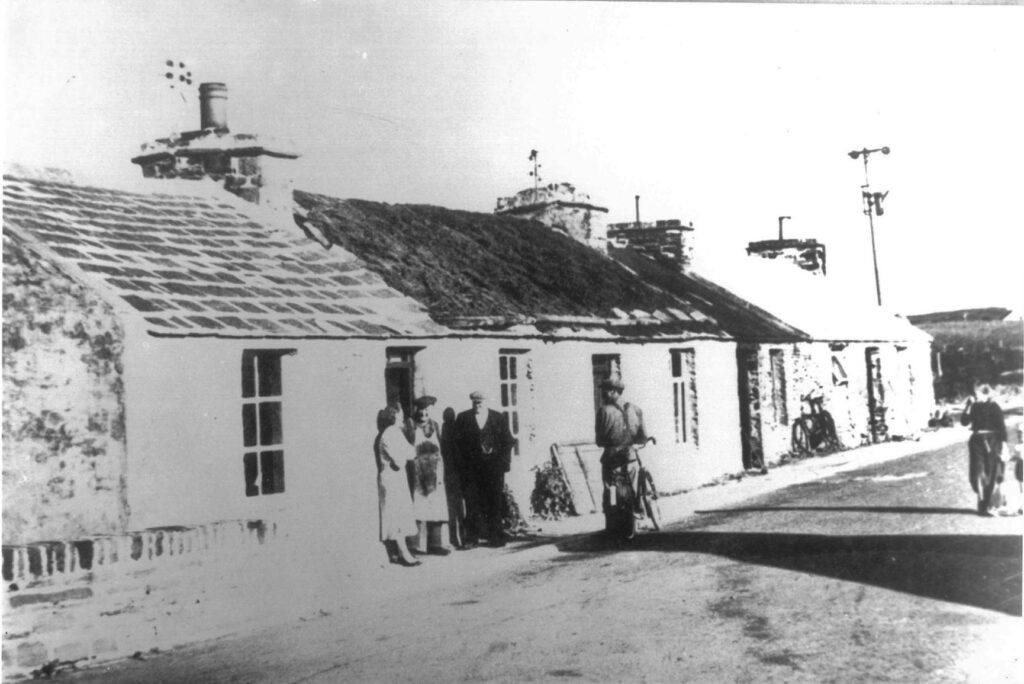
Willie Farquhar and Albert Leask at the door of the Golden Slipper – Orkney Library and Archive
“I was actually out on the hard surface of the road when the bombs fell, just one terrific ‘plump’ one after the other. The force of the nearest explosion bowled me head over heels back into the doorway, where I managed to grasp the side of the door and keep on my feet before I fell another time.
“My first thought was for my mother and I was relieved to see her on her feet. She was holding on to the lemonade counter. The two young lads were there too. Everybody was looking very scared, so far as I could see through a cloud of dust. When I saw that my mother was all right, I turned to the lads. The boy [Billy] Clouston was bleeding a little on the side of the nose and his wrist was cut, but he was showing no concern for himself. He just said that he was all right and would go out and see if everybody else was all right.
“When we got outside, the first thing I saw was Jim Isbister, lying in his doorway. His feet were outside and his head was inside. He was lying on his back, with his arms upwards, just as the force of the explosion had thrown him. Lily, his wife, was out by this time. She called to me to come and help her lift Jim inside. We made to lift him. I knew he was dead. I could see that the spirit had gone from him.
“Alfie Linklater came on the scene at a run. He was sort of limping. Like me, he was losing blood, but we were able to do something. We got Jim into the house and laid him on the bed. By that time, John Scott of Biggings was here and he got back into his car and went to Stromness for assistance.
“It is a terrible tragedy and nobody could do anything to stop it. We are all very sorry for the bereaved lassie and bairn. Anybody who was not here can have no idea what it was like; it was just awful. I consider myself lucky to have escaped with this wound.
“In this room in which I am lying, splinters of a bomb did some damage. One biggish splinter pierced an outer door in the next place, came in through an inside door, burst the corner of the wall at the communicating door between here and the shop and then buried itself in the opposite wall. Another splinter damaged the leg of this bed, which has had to be lowered to make it level all round; knocked a caster off the leg of a chair and shattered a stone hot water bottle which my mother had put on the floor. The windows all broke and dense clouds of dust were created.
“At the moment, we are struggling along in a mass of salvaged goods, including stuff from the home of Miss McLeod. I am thankful that my mother, despite her age, has come through the ordeal so well as she has. As long as she is kept busy it is keeping her mind off what she endured.”
Sad though the story is, it could have been much worse, as at least nineteen bombs fell within feet of the houses. The worst affected was Isa McLeod’s, as described by another eye-witness, John Flett, a local farm-worker, talking to The Orkney Herald:
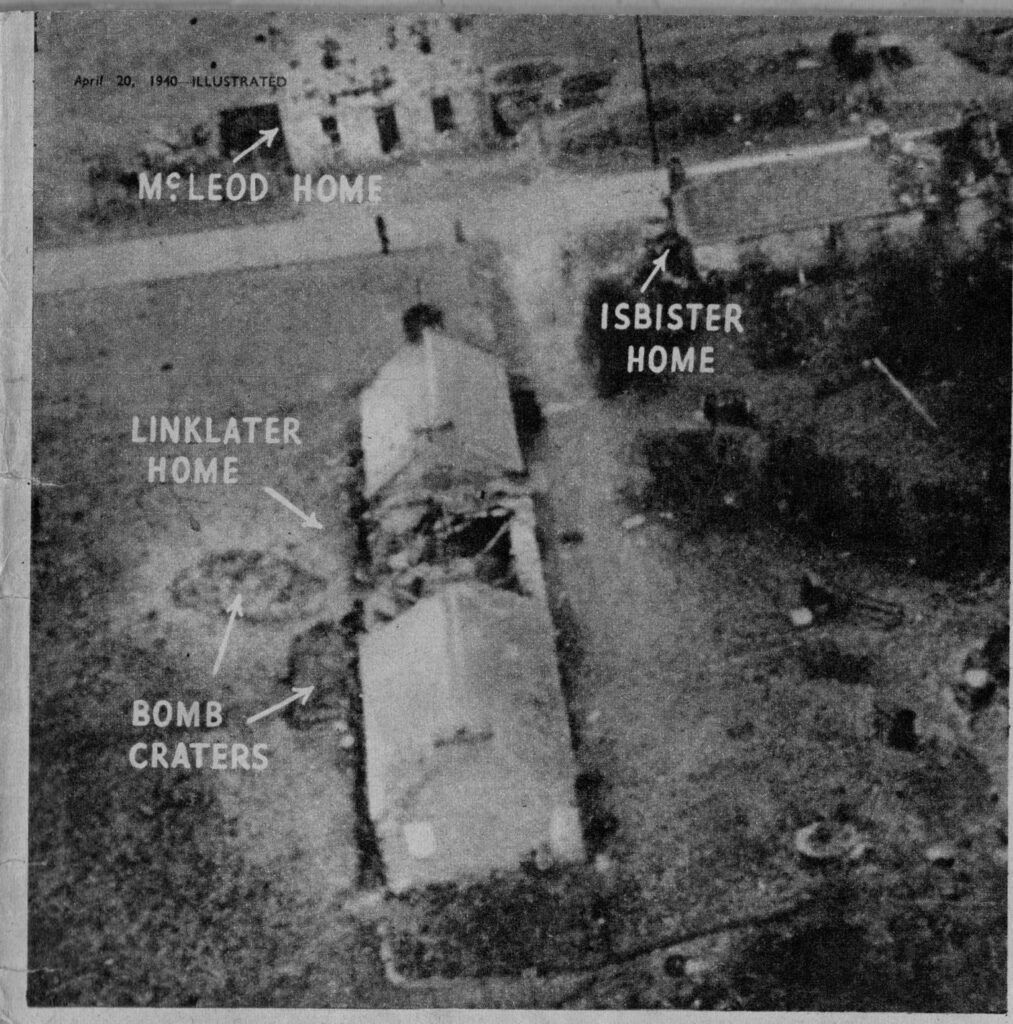
” I was in Stromness when the raid started,” he said, ” but I thought it was better to get out of the town into the open, so I got my bike right away and made for off. Just as I was leaving the outskirts of the town, the excitement seemed to be dying down but when I was approaching Howe aerodrome it started up again.
” I was just on the Stromness side of the Bridge of Waithe when I made out a couple of black silhouettes against a searchlight and heard a droning sound. At the same time, I saw a number of fires spring up about a mile away, and gradually come nearer. They were incendiary bombs, but I did not realise that at the time.
“I was just thinking it would be an idea to take cover when a whole string of shattering explosions nearly split my eardrums, and I saw the cottages at the join of the Orphir road outlined black amidst what seemed to be at least a dozen blinding flashes of flame. I admit I felt a momentary panic. I threw myself off my bike and went full length into the ditch at the roadside almost in one movement. There were more explosions, and I heard stones and divots pattering like hail on the road. Several clods landed on me as I lay in the ditch with my head well down. One bomb made such a crash that I thought it had gone off less than ten yards away, but it must have been more like fifty. Anyway, it was a bit too close for my liking.
“I lay in the ditch for a minute or so till the danger seemed to be past, and then I got on my bike again and pedalled like blazes for the cottages. The last bit of the way there I ran across a field and went sprawling into a bomb-hole.

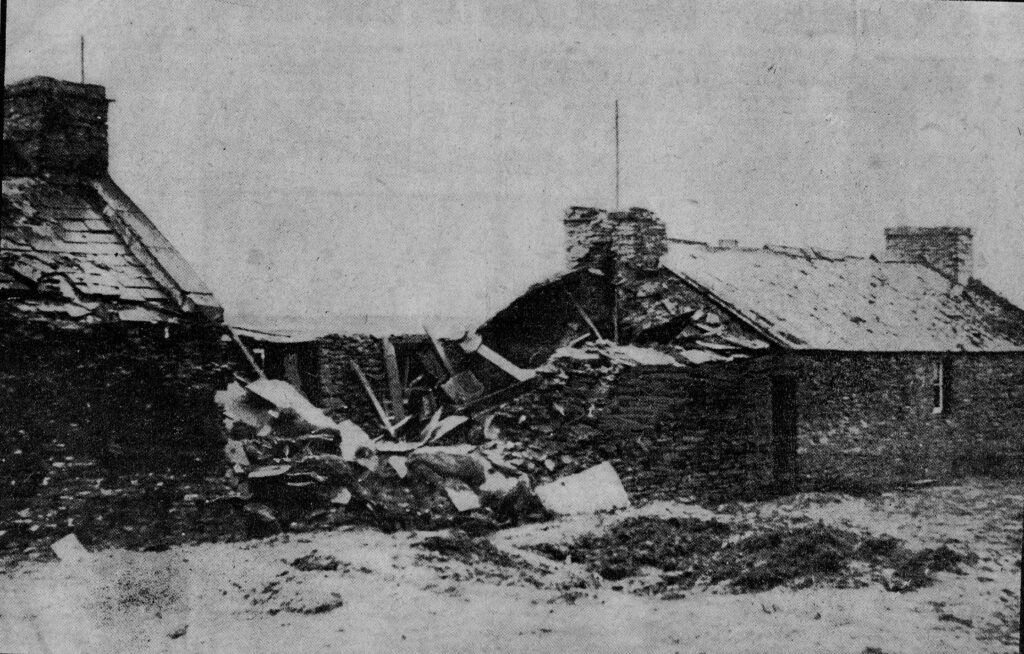
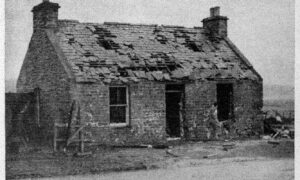
“I arrived at the back of the cottage that appeared to have got the worst of it. It was still standing, but it was absolutely shaken to bits. Half the slates were off the roof. and I could see the moon through it. Slates and plaster and brickwork were falling from it. There was a heap of wreckage at the door. Somewhere at the side of the house hens were cackling furiously. A man grabbed me by the arm and cried, ‘There’s a wife in that hoose.’ He and another man were making to go in when I saw the woman appear in the doorway among the wreckage. I helped the others to get her out into the road. She was obviously injured but when somebody asked, ‘ Are you hurt?’ she replied, ‘No so bad.’ It is a miracle she escaped instant death, in my opinion. Most of the roof fell in on her.
“I went to see if I could be of any help to any of the injured folk. They all took it very bravely. I heard one woman crying, but not hysterically. I asked one of the men who seemed to have been on the spot pretty soon if there was anybody badly injured. He told me one man had been killed in the act of opening the door of his cottage.“

A smithy used to stand at the junction and James Isbister’s brother John was the blacksmith. He had been at the smithy but had thought he should hurry home to where he lived at Upper Onston in case his family were worried. Just as he got under cover there, he heard the planes for a second time.
“Suddenly there was a series of explosions and I looked out in time to see bursts of flame on the ground at the Bridge of Waithe houses. Flames seemed to be scattered about the ground. Haystacks at Quina [the farm just to the east of Upper Onston] began to blaze and I realised that the planes were dropping incendiary bombs as well as the explosive bombs which had fallen at Bridge of Waithe. The incendiary bombs fell all in a line between Quina and our farm as the aircraft roared overhead.
“The children were screaming, frightened by the terrific explosions and I was relieved to hear the noise of the planes growing fainter. I left the house and ran down to the Bridge of Waithe, a few hundred yards. In the moonlight I saw pits every here and there – bomb craters. I was shocked to see what a havoc had been caused. Some people from nearby houses were at the Bridge of Waithe before me and they were helping the wounded. There was not much fuss, just a sort of undercurrent of fearful excitement. Everybody seemed to be stunned by what had happened.
“The first house I made for was that of my brother Jim. There was a bomb crater just across from his cottage. I feared the worst, learned with horror that Jim had been killed. They told me he had been hit by a bomb splinter. I don’t think I was much use in the way of help for a wee while. It is a terrible business altogether.”
Alfie, Cathie and Freddie Linklater went to stay with Alfie’s brothers Jimmac and Allie Linklater, millers at the Mill of Ireland. They were interviewed there by The Orcadian. Alfie said:-
“Early in the attack, the other men and I were out in the open and saw that the women folk took cover for the time being. As the time went on, however, some of us were out and in several times. There seemed to be no danger to us in this parish. We changed our minds, though, when planes began to fly in our neighbourhood. I was pleased to hear the well-known sound of our fighters and a bit worried later to hear the equally well-known noise of the German machines… We all took cover when we heard the German machines, because we knew that shell splinters would be sure to fall wherever the enemy planes drew the fire of our guns…
“My wife and baby and I were in the kitchen, not taking any particular shelter but just keeping indoors. My wife had cooled the bath water and actually had the baby in his tub. I was pottering around, supposed to be helping but more concerned with making fun with the baby. One cannot blame her, but my wife was more inclined to worry than to join in the usual fun of the bath-time. Several times she said she wished the ‘affair’ would blow by.
“All this time, you know, the gunfire was blasting away and the solid old house was trembling. Once or twice I heard British planes and once came the drone of either two or three German machines. I had one more look out of doors, saw the whole sky lit up in flickering red of the gun flashes, the searchlights illuminating a great area, and tracer bullets streaking skywards towards the raiders.
“I could not have been more than three minutes back indoors when the calamity occurred. The whole house shook violently, everything in it rattled, as a couple of terrible explosions deafened me. I heard my wife scream and then the baby began to scream too. I was aware of some objects whistling and whining through the kitchen and then saw the untouched lamp still burning safely through a cloud of dust.
“I groped my way round the table. The minute I moved I realised that I was wounded. There was a stabbing pain in my hip and I could feel blood trickling down. I got to the other side of the table , where my wife was kneeling on the floor. She was lifting the baby from his tub. I became afraid the roof – which is a heavy one – would fall in, so I pushed my wife and baby under the table. I got my head and shoulders in beside them.
“We stayed there a moment or two, and then I concluded that the roof was safe enough for the time being. I came out from under the table and quickly summed up the situation as best I could. I decided that the roof was definitely safe so I got my wife to go to bed with the baby. There I left them and proceeded outside. I was sure that some of the others would have fared worse, but that feeling, somehow, did not lessen the shock I got when I reached the door of the Isbisters’ home.
“I saw Jim Isbister lying there. Willie Farquhar (who was wounded) was trying to lift him into the house. When I got to them I realised that Jim was dead. We lifted him into the house and his wife helped us to lay him on the bed. There was nothing we could do…
“Tom Muir of ‘The Brig’ [now Bridge End] who lately came home from America, was about the first man to reach the scene of the wreckage. He ran across from his house, stumbling over broken telephone wires and through bomb craters. He did a sensible thing, which nobody else thought about – he tested for gas and told us that anything we were feeling the smell of was only the ordinary fumes of explosive and not poison gas…
“Of all the possessions that were damaged in the house, our bairn’s toys escaped hurt. Somehow I was touched and pleased about that . My wife has had cause to be thankful about it since, because these toys – perhaps more than anything else – have helped her to manage the bairn in his present upset state of health.
“Those of us who have lost our homes and who were wounded have much to be thankful for. We are all desperately sorry for Lily and her baby; they have lost Jim, who was a splendid husband and father.”
Alfie’s sister, Mary Watters, lived in Brims at the south end of Hoy and a letter that she wrote to Alfie and Cathie reminds us of how worrying it was when communication wasn’t as instant as it usually is now.
My Dear Brother and Sister
Just a line to say how glad we are to hear from yourself. We heard about you on Sunday from Lyness that Alfie was in Hospital and out again but I was afraid of shock. I’m sure you must have had an awful time. We also heard that Alfie had put you and baby under the table and that baby was blue with crying but I do hope you will get over it. It could have been worse. One never knows what is to happen next. Be sure and write soon and let us know how you all are.
Four other people were caught up in the bombing at the Brig that night. Mrs Jane Muir from Cuminess, the farm just along the Orphir Road, and her sister-in-law, Mrs Jane Burnett of Woodbine Cottage, about a mile east along the main road. Jane Burnett, the sister of Jane Muir’s late husband Frederick, had been visiting at Cuminess and, in the custom of the time, was being walked home along the road. When the raid began, the Isbisters invited them to take shelter in their house. Jane Muir was near the door when James Isbister was killed and was hit by shrapnel, though not badly hurt. Jane Burnett was further in the house and unhurt.
Two of the young men who had gathered at Willie Farquhar’s were still there when the bombs fell: 18 year old Tom Work and 16 year old Billy Clouston. Billy lived at the Hall of Ireland Cottage and was interviewed by The Orcadian.
“We watched the gunfire for a while and then we decided that it would be better to go indoors, as the ‘battle’ seemed to be swinging over in our direction. We had seen and heard enemy planes once or twice but nothing had fallen in the neighbourhood. The noise was still going on when suddenly there was a great explosion and the house shook and filled with dust. We were in Mrs Farquhar’s shop and with the stuff flying about and the dust choking us, I thought the place was tumbling down.
“Tom Work was all right and we found that Mrs Farquhar was all right too. Willie Farquhar, however, had been hit and for a moment we didn’t know what to do. Then I saw that he was coming in. He was hirpling [limping] but sort of smiling. He went to his mother, who was not saying anything; just standing where she was, holding on to keep herself from falling. She did not faint or anything. Willie Farquhar attended to his mother and then went next door to help with Jim Isbister. I went too and Alfie Linklater appeared. He was wounded too. He saw me and asked if I was all right. I said I was all right and offered to go along by and tell them at the Mill. Alfie said that would be a big help. I went round to where my bicycle was, expecting it to be damaged, but it was all right and I was able to ride it.
“Along the road a bit I had a moment’s feeling that the fighting was going to swing back over this district again but I heard no splinters fall as I pedalled along. Before I got to the Mill, everything was more or less quiet. It was funny to cycle along in quietness after all the noises of the gunfire and the planes.
“At the Mill Brae some of the folk were out, watching for someone coming along the road. I told them what had happened and they ran to see about getting help along to the Brig. I went to get the bleeding stopped on my face and wrist.“
The Bridge of Waithe wasn’t the only district in Stenness to be hit that night and there was one more casualty, as The Orcadian reported.
An incident not without parallel on an actual battlefield is reported from Stenness. Mr Jamieson of Bankburn,[now Happy Valley] one of the wounded, was carried to shelter, if not under shell-fire, at least in the face of the enemy.
Mr Jamieson was struck down by one of a cluster of bombs that burst on the land of Quoynamoan. He was on his way home after having paid a visit to his daughter, Mrs Linklater of Mill Cottage. He was halfway across the Quoynamoan land when the raid began and before he could reach shelter was wounded by exploding bombs. Some time later, Mr W T P (Theodore) Linklater of Quoynamoan, a brother of Mr Jamieson’s son-in-law, heard the older man calling for assistance. Incendiary bombs were blazing in various places round about the immediate locality and the enemy planes were flying overhead, not in sight but plainly to be heard. Nevertheless, Mr Theodore Linklater proceeded to Mr Jameison’s assistance, located him lying in a field and, single-handed, carried him to shelter. First-aid attention was given Mr Jamieson, who was later removed to hospital.
James Jamieson had been seriously injured and never fully recovered from a compound fracture of his right femur.
George Stewart, a joiner living at the Stenness Post Office, now Sutherland’s Garage, told The Orcadian about bombs that had fallen ‘in a locality bordered by Crookhutcheon, Anderswick, The Dams, Quoys, Housequoy and Barnhouse’. These were the farms just to the east of the Post Office and School. Mr Stewart was out of doors, along with his brother-in-law Thomas Cursiter, the Stenness sub-postmaster; Omond Muir of Tormiston; James Donaldson and William Scott, both farm servants, and some unnamed others.
“We heard the shooting begin and then the hum of German planes became louder and louder. We started to hurry homewards. There was the reflection of a big flash, a tremendous explosion and a blast of air, you would have thought, from the Bridge of Waithe. I realised that a plane was closer to us than appeared by the sound of its engine. Starting to run towards the house, I shouted to the others to ‘Beat it.’
“The firing increased in intensity and the drone of the plane or planes deepened. We got to the garage near the house and dashed into it. We were just in when dirt or something rattled on the metal roof, to the accompaniment of explosions some distance away. When that quietened down, we went to the house and found the women folk and children pretty nervous. We lined them up alongside the walls, wherever we saw places that offered safety within the houses. Nothing more happened in our direction, however.“
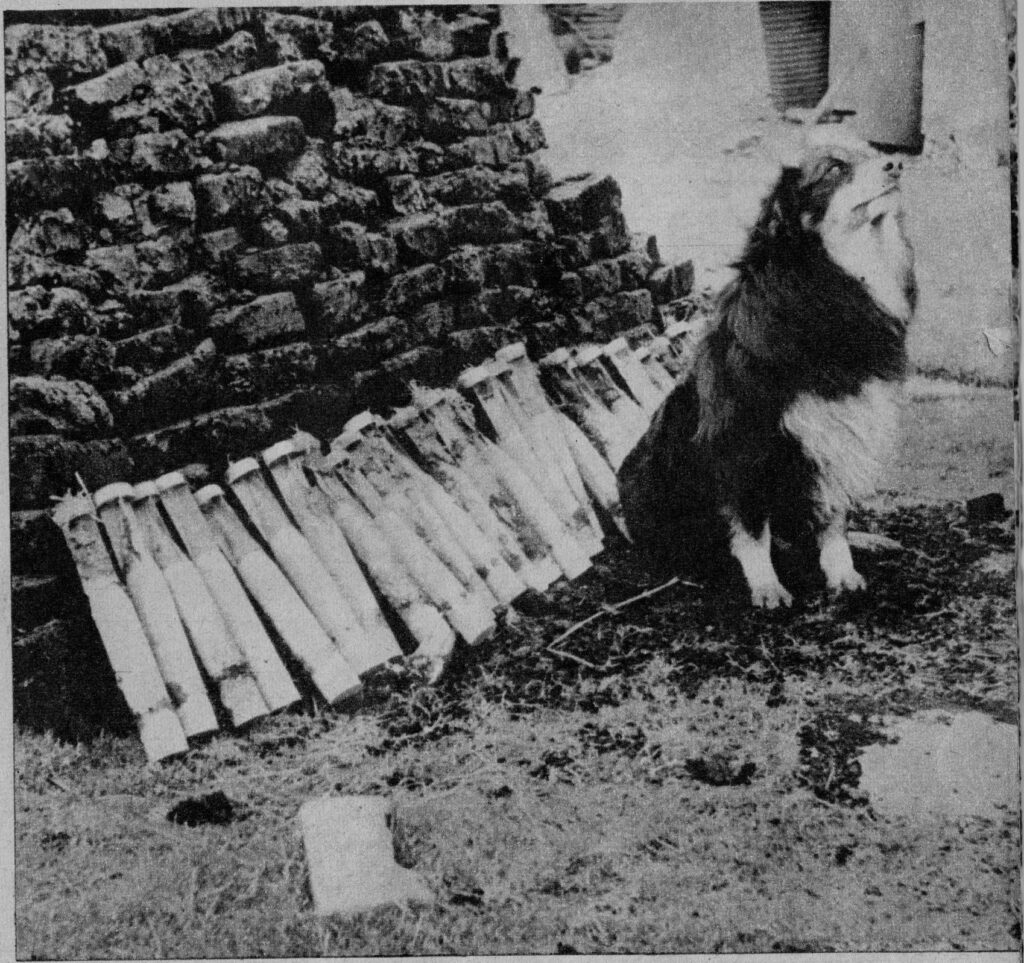
The Orcadian reported that sixty bombs fell on the 52 acres of Housequoy Farm. The farmer, James Donaldson, told the Orcadian that he and his family spent the first part of the raid sheltering in the implement shed but moved to an all-stone building during the first lull.
“As the incendiary bombs fell, the countryside became lit up, brighter than the best moonlight. When things quietened down a wee bit, I took a quick look round the buildings and at the back discovered that the implement shed was on fire. After discovering this, I felt myself sort of galvanised into action. We had the outbreak under control fairly quickly, as the roof was easily reached from higher ground at the back of the shed.“
Housequoy’s mill and barn was on the other side of the main road, beside the burn. A bomb broke through the slates but was luckily stopped by a rafter and rolled off, burning itself out on the ground.
“I got a shock afterwards when I found what a narrow escape the Mill had had. It was lucky that the bomb that broke the roof was not allowed, by the rafter, to fall into the building. The place contained a good supply of fodder. The mill machinery and other contents would have gone up in smoke if that bomb had got right inside the building. At the foot of the wall, outside, I found a little heap of white stuff, which smelled like burned-out carbide, and near it the tail of a bomb. Those little piles of white ash, scattered all over my farm, enabled me to count, roughly, how many incendiary bombs had fallen on Housequoy’s land. I lost count at 60.
“Although the bombs had been distributed all over the farm land, not one landed in the stackyard, and the one that set the implement shed on fire was the only one that landed among the farm buildings. The bombs fell in four rows across the land. They tell me that means that four planes crossed overhead, dropping the bombs as they went, or else that two machines passed over and did a return bombing trip. We heard them alright but did not look out to see them. We knew the sound of their engines, as apart from the British machines and that was good enough to us to take all the cover we could get.”
My father, Peter Leith, was twelve years old and remembers how terrifying that night was. Appiehouse sits a little way up the hill and they could see Quina’s stackyard blazing down to the west and the row of fires springing up at Housequoy to the east. One of my aunts had an even closer experience.
Margaret Work married my mother’s brother, Walter Leask. In 1940 she was about ten and living at Quoys, right beside Housequoy, with her parents, grandparents and sister Lilian. I once asked her what she remembered about that night.
She and Lilian had been playing at Housequoy and one of the farm-men called to them to run for home. Their father was away delivering eggs to the hotel and their mother and grandmother didn’t dare leave the byre, where they had been milking. Margaret and Lilian huddled by their grandfather, listening to the bombs getting closer and watching the oil lamp swing on its hook. They were told they would have to run outside if the lamp fell. The next day, soldiers came to take away the bomb fragments. I asked Margaret how big the craters were and she indicated the sitting-room floor.
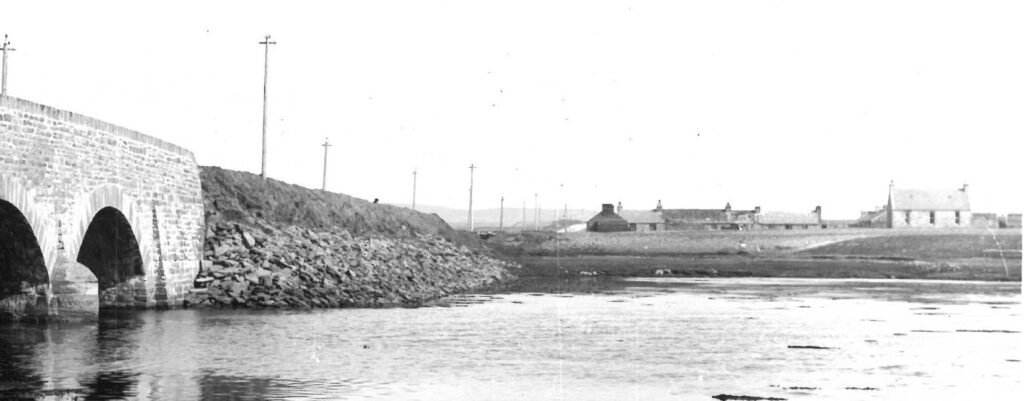
Hundreds of people visited the Bridge of Waithe on Sunday, including The Orcadian’s Stromness correspondent, J G Marwick.
All roads led to Stenness on Sunday afternoon, people arriving on foot, by push bike and motor car. Constable Wylie, Stromness, regulated the traffic and did his best to prevent eager sightseers from entering the damaged houses. Such a scene was never witnessed before in Orkney.
The Smiddy at the corner of the Stromness-Ireland road had its roof nearly blown off; possibly not one slate remained in position. The low dwelling-houses on the other side of the road were without windows – every one had been blown out; also some doors were shattered. But the most severe damage was done to a well-built house in which Miss McLeod lived. It was a centre of attraction and presented a sorry spectacle. The whole roof was shattered. Most of the blue Welsh slates were off; those remaining barely hung on and were liable to fall off any minute.
Craters, twenty-two in number, caused by the high explosive bombs, surrounded the houses, especially that of Miss McLeod, four of them being within a few feet of the side walls and gables. Every window frame was blown away and the interior presented such an appearance of destruction that one wonders how the woman inside escaped with her life. It is nothing short of a miracle.
The carcases of several hens, killed by the explosions, lay about, but strange to say, amid such a scene of destruction little damage was caused to the little wooden hen-house. Some of the craters were from four to five feet deep and the soil from them was scattered all over the fields and on the public road.
While I was viewing the destruction caused by the Nazi high explosive bombs, Mr William Leask of Aglath came up and in the course of conversation he told me with great clearness what he heard and saw. Mr Leask was a sergeant in the Royal Artillery during the Great War and knew what he was talking about from his experience overseas. He said:
“I was just outside our house at Aglath [just to the east of the Mill of Ireland] watching what was going on when I heard some German planes above me. They released bombs and I plainly heard them whizzing through the air, for I had heard the same sound many a time. I really thought they would drop on our house or nearby so I kept under cover. However, they landed far past us and I saw them strike the ground near the Bridge of Waithe. The concussion was terrible. The ground seemed to jump up at each explosion.”
Stenness bore the brunt of the attack on land but wasn’t the only part of Orkney to be affected. That will be the story for my next post.


John Scott of Biggings was on a motor bike. His daughter, Jean, told me his story from that time. Jean lives in Kirkwall.
what a brilliant story I know most of the people mentioned