In ‘The Northern Garrisons’, published by the War Office in 1941, Orcadian writer Eric Linklater gave a vivid account of the Army in Iceland and the Faroes but the most arresting part of the book is his description of being part of a North Atlantic convoy. He left Iceland on a convoy rescue-ship, equipped with a sick-bay, surgeon, rope ladders and rafts ready to be launched.
“Late on Friday afternoon, after an hour or two of searching roundabout – now plunging head to the waves, now rolling deeply, now lurching before a following sea – we discovered, far away on the port bow, something that looked like a small town. There was smoke, and a tiny row of dark excrescences that might have been the chimneys of a village street. Slowly we came nearer, and the chimneys became funnels, the houses were revealed as the upper parts of a merchant fleet. There were thirty ships in the convoy, and they were heading a little south of east.
We took our station in the convoy. It was sailing on a broad front, in eight columns, with a destroyer patrolling ahead, a destroyer astern, and corvettes like outriders on either flank. It was very pleasant to be in company, and as we examined our company more closely, and found it good, the sensation became exhilarating.
The thirty ships were of many different shapes, and of different nationalities, but all were alike in being deeply laden. Their holds were stuffed to the limit with war-gear for Britain, and many had cargo lashed upon their decks. Ahead and to starboard we could see a sturdy freighter that carried, in full view, half a dozen American fighter-planes. On the other side, on a strange looking vessel that sprouted derricks on both sides, were two submarine-chasers, American mosquito-craft. And tankers, low in the water, decks continually awash, were full as eggs with fuel for our ships, our bombers and our tanks. It was a goodly convoy, and as we slowly perceived the richness of it, we felt, as the most urgent desire of our hearts, a straining wish – it grew to be a prayer – that all might come safely home.
Darkness in those latitudes was short, and in the very early morning the ships again were visible. We grew familiar with them and searched the several columns to make sure that all were there. The weather was beginning to improve, and we ran mostly before a following sea, though every little while the course was altered, and the wind would come now on one quarter, now on the other.
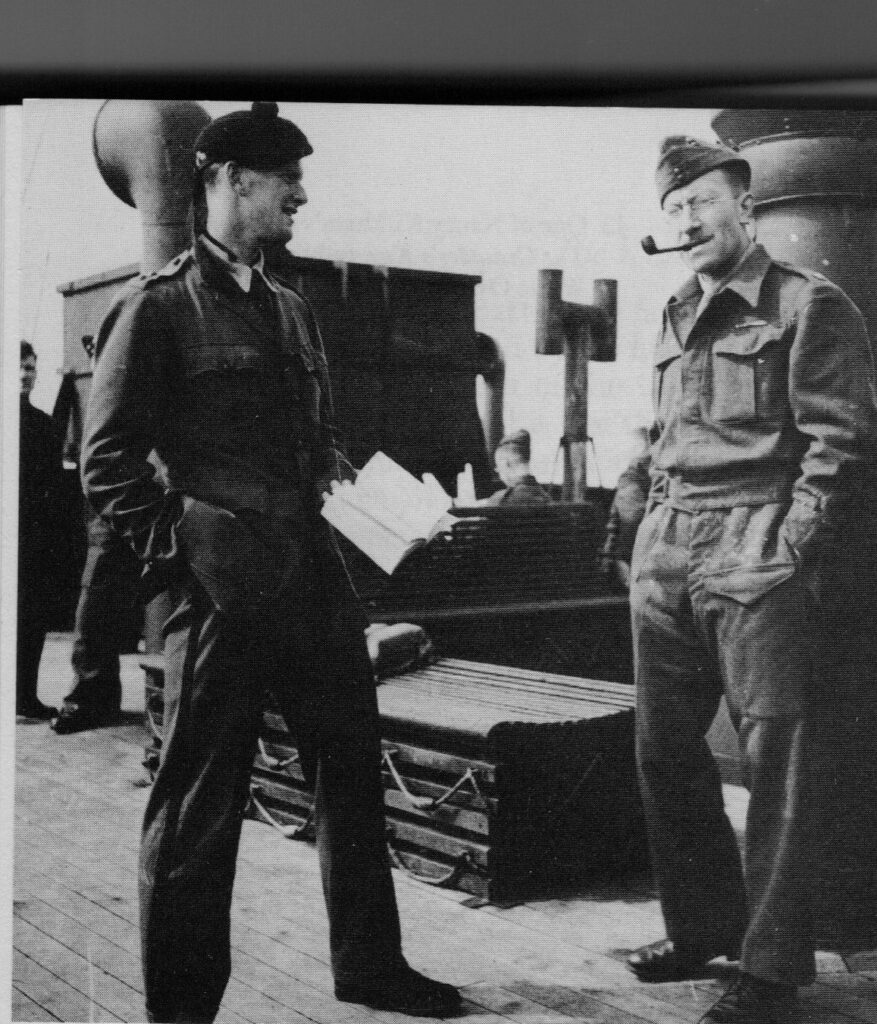
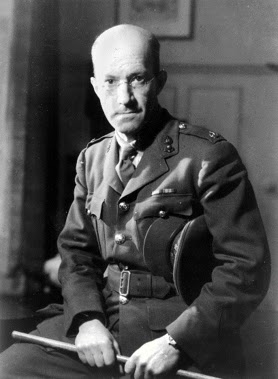
Image from ‘Eric Linklater’ by Michael Parnell
Suddenly one of the destroyers swung to the west and put on full speed. A couple of broad fountains showed where she had dropped a pair of depth charges, and presently we heard the crunch-crunch of their explosion. The convoy, which had been heading due east, turned sharply with a blowing of steam-whistles to the south-east, and a corvette joined the destroyer in a circling hunt. There was an enemy in the deep.
But their quarry escaped. Their quarry was cunning and determined to do mischief. He may have hidden himself below the convoy, where, in the passage of many ships and the thresh of many screws, the listening ears of the destroyer would find it hard to distinguish the particular note of a submarine. In the afternoon the steel hull of our ship again echoed the shake and the crunch-crunch-crunch of depth charges. Again, in interlacing circles, destroyer and corvette went hunting their elusive prey. Two flying-boats appeared from nowhere, as it seemed, and joined them in the search.
A little while before darkness came, one of the smaller ships fell to the rear and stopped. From her funnel blew a billowy unceasing cloud of steam. Her engines had failed her.
An hour or so earlier a Swedish tanker had had similar trouble and fallen behind. The convoy reduced speed to seven knots till she had made repairs and caught us again. To see her in distress, and threatened with desertion – for the convoy must go on – had filled us with anxiety, and our feeling of relief when she rejoined us was streaked with elation and sprinkled with joy. But now this little freighter was in more serious trouble and night was very near. She grew smaller on the horizon, and dusk enshrouded her. To be left in that Atlantic loneliness, with an enemy, it was likely, fathoms deep but waiting to surface at the cruel and proper moment, was a fate one shrank from contemplating. It weighed upon the heart with an immense anxiety.
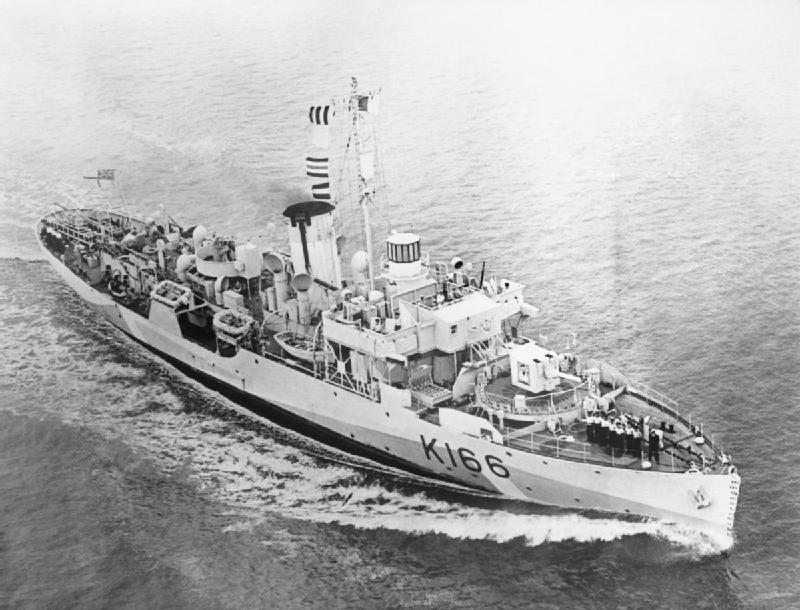
Then, most gladly, we saw a corvette return. The convoy went on, but the corvette would stand by the troubled merchantman. Some young Lieutenant in his first command, with a crew half-trained – landsmen six months ago – would patrol the darkening sea, and watch with straining eyes, listen with ears alert, for an ocean-beast to break cover and attack. We went to bed more cheerfully – but kept our trousers on.
Sunday morning came with sunshine and a calm sea. We looked immediately for the freighter, and there it was, in its old position in the second column from the left. It had made its repairs under the watchful eyes of the corvette, and rejoined us at dawn. The sun shone more brightly, and all the ships put on a gayer look. Black hull and buff topsides looked handsome against a sparkling sea, and an olive green Norwegian tanker – at which we had grumbled yesterday, because when changing course it nearly ran us down – was now, to clearer eyes, a most gallant sight. We were very close to the ship that carried aeroplanes on her deck, and their sleek painted bodies looked swift and beautiful.
Our hope, our anxious prayer, that all the convoy might come safely home, was by now a growing belief in its security. We had seen the Navy at its work, the ceaseless patrolling of the destroyer, the steady watch of the corvettes, with their sturdy trim and handsome lines. And what we had seen had given us confidence. The Navy was doing its work with zeal and efficiency, with a kind of brilliant steadiness. The tall-sided destroyers, moreover, were two of those that America transferred to us, and their blue patterned flanks – streaked with the rust of never-ending work – and their tall un-English funnels were a constant reminder of the other nation, so different from ours but yet alike in its love of freedom, that stood by our side in this war for the world’s good future…
We made good progress that night, with the wind, freshening again, still behind us and the convoy increasing speed to ten knots. Before noon we could see through a drifting haze a grey shape of land. Then, an hour or two later, land on the other side. Scotland on the one hand, Ireland on the other. A third of our convoy had already left us, for a rendezvous from which it would take fresh instruction and another escort. Now aeroplanes were continually above us, and in the narrowing sea we formed in double column, line ahead. We were nearly home.
Then the convoy divided into two and half turned to the south, the others to the north. But all were in home waters now, and thirty ships, laden to their full capacity, had brought their cargoes in to feed and strengthen us in war. Here, surely, was an earnest of our victory.
Then approaching us we saw another fleet, pointing to the west. We had brought home our gear, and they were seeking the same granary to fetch another harvest in.
Gallant ships, untiring and undaunted. May they have as good an escort and as bright good fortune as ours, we said.”
Eric Linklater included this account in his third autobiography, Fanfare for a Tin Hat, published in 1970. He added reflections on the work of the men of the Atlantic convoys that couldn’t be included in morale-boosting propaganda.
The war on land was punctuated by formal battle only at long intervals, but war at sea was continuous, and I had been watching a fragment of its daily routine. Few people, except those engaged in it, ever knew much of that dreary, deadly contest with unseen enemies – a contest that demanded ceaseless watch and never relaxed its assault on nerves and imagination – but it was, I think, the only continuing exercise of the second war which could be compared with the protracted brutality of trench-warfare a generation earlier. The crews of the little ships – frigates and small corvettes – which escorted Atlantic convoys suffered, not only the strain of constant danger, but constant discomfort of the most violent sort. Rolled to starboard, rolled to larboard – swept by breaking seas – in the winter months they were never dry, and their crews ate from plates that slewed in their hands as if they were picnicking on the edge of an earthquake. If I, suffering for my sins, were given a choice of punishment, I think I would prefer a month in the Salient to a month aboard a Flower class corvette on Atlantic convoy duty.
In Fanfare for a Tin Hat, Eric also described his call-up for WWII.
A letter from the War Office requested confirmation of my address, and I was reminded, to my surprise, that my name was still on the lists of the Territorial Army Reserve of Officers. The Lord Lieutenant of Orkney was Alfred Baikie, a man of minute stature and easy, genial authority and he, a little while later, asked me to go and see him. He had been commanded, he said, to raise companies or batteries of Anti-Aircraft Artillery, Coastal Artillery, and Sappers: ‘And I think you should come in and help us. The Ack-Ack battery is oversubscribed but I can give you a choice between Sappers and the heavy Gunners.’
‘I know nothing about either,’ I said.
‘No more does anyone else,’ said the Lord Lieutenant, ‘but we’ve got to try and do what we can, haven’t we?’
‘I’ve always hated loud noises,’ I said.
‘In that case,’ said the Lord Lieutenant, ‘you had better be a Sapper. I’ll send your name in and I hope you’ll be able to recruit your own company.’
In September 1938, Eric Linklater was commissioned as a Captain, in charge of the Orkney Fortress Royal Engineers. They were mobilised in August 1939 and were in charge of the searchlights and the generators for the defences. They were also prepared to defend Orkney from the feared invasion from Norway.
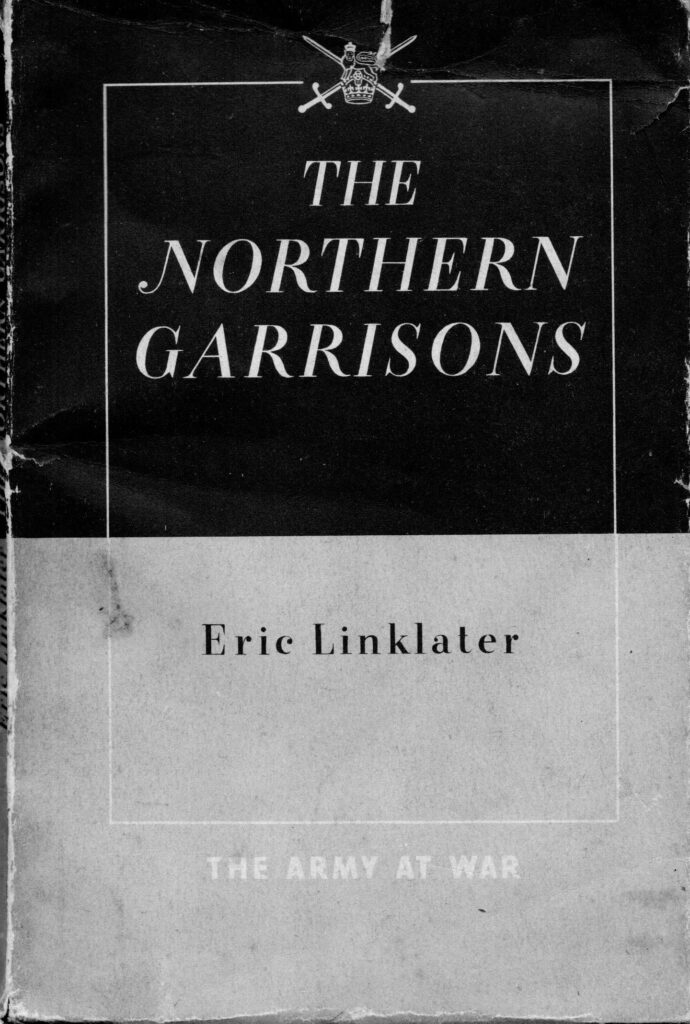
In mid-1940, the regular army took over the defence of Orkney and Eric moved on to projects for which he had the perfect combination of skills. He organised the Forces’ newspaper, The Orkney Blast and was then asked to write ‘The Northern Garrisons’ As his biographer, Michael Parnell, wrote, “It is the sort of excellent writing which gives propaganda a good name…it celebrates a convinced and convincing notion of the British soldier as essentially decent and efficient, doing a difficult job with patience and application… And he wrote as if the possibility of not eventually winning it had never entered his head.”
The Northern Garrisons ended with this wonderful evocation of war-time on the island of Flotta.
There is, in Orkney, an island that commands one of the entrances to Scapa Flow. There are batteries mounted on the cliff and fulmars, riding the breeze, sail past the muzzles of the guns. Gannets with a silvery splash dive deep into the sound. On a spring morning, against the staccato coughing of anti-aircraft guns at practice, you may hear the drumming of a snipe. A crofter ploughing his small field must drive his plough through the shadow of a barrage-balloon. And women coming from the byre stand to watch a battleship go out, or destroyers with a bone in their mouth come racing in.
Ask them where they have been and what will the answer be? Narvik, the Denmark Strait, or anywhere between.