

For us in the west, all roads lead to Dounby in early August. The County Show, held on the second Saturday in August, ends a week of agricultural shows and the West Mainland Show is held in Dounby on Thursday. It is right that the show should be held in Dounby because the village owes its existence to Orkney’s farming revolution.
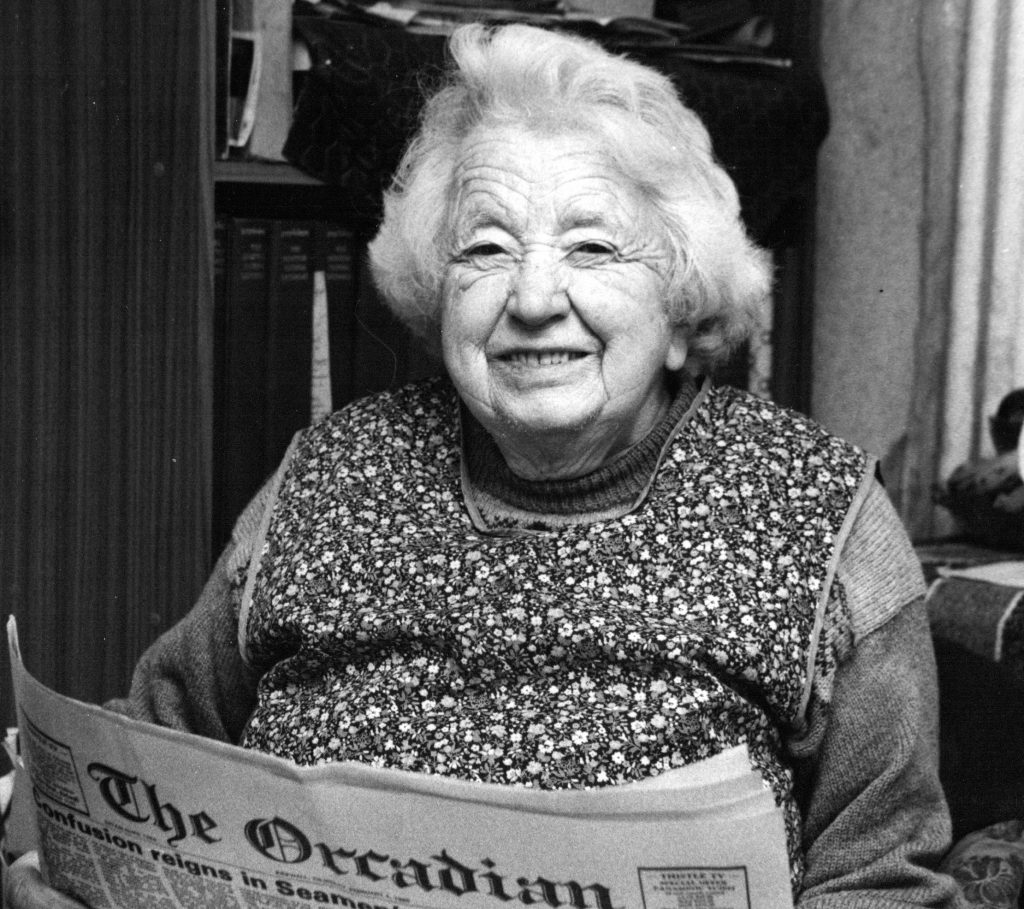
My grandmother, Johina (Ina) Leith, nee Kirkness, was born in 1899, at Newhouse, just north of Dounby, between the Northbigging Road and the Hillside Road to Evie. I have used the notes she wrote sometime in the 70s, along with what records I can access, to trace the story of how Dounby began.
In the beginning, there was Dounby Farm, (owned by my six-times great-grandmother, the wonderfully-named Hallow Hourston) and, a mile or so to the North, Hosen Market. Grandma wrote,
“The thrice yearly market of Hosen was held near the present Newhouse. It was held on the second Wednesday of February and June and the first Wednesday of November. The Hosen market used to be up near Hosen in Birsay but it gradually came down nearer the ale house of Peerie Geoth until it was opposite Newhouse. The market was now definitely in Knarston in Harray but the title Hosen market still applied. When the field was cultivated a few years ago some stakes were found in the ground where stock could have been tethered while, as one supposes, the owners could go to the alehouse for a “mug o’ ale” and still be in sight of their animals if anybody showed any interest.
“Peerie Geoth” still stands, now used as a farm steading. At that time, the ale house was nearby at Nether Geoth. This was kept by Magz o’ Geoth whose second husband, John Isbister, was known as Sir John, from his haughty manner. One day a neighbour asked Sir John “Whit kind o’ market has hid been the day? The reply was “Deed, a puir market. Hid’s no been a fight the day”
Looking the family up in the 1841 Census on the Orkney Family History website, I found John Isbister of Nether Guth listed as a publican. He had a daughter Ann, who was born in Canada, so I looked him up in the Hudson’s Bay Archives. The dates fit for a John Isbister who returned to Europe from Moose Factory in 1823, with children. He spent 24 years in Canada, rising to be Assistant Trader at Eastmain. If this is the right man, it could account for the haughty manner.
Grandma had been told that Joseph (Josie) Mackay, who had built the Smithfield Inn at the junction of the roads to Kirkwall and Stromness, was responsible for the market’s move, after Magz had given up the ale-house.
“It would be good for business to have the market near the ale house, so Josie marshalled public opinion into taking up a public subscription to buy a stance nearby with proper title deeds. Market day was now to be the second Thursday of every month.”
According to George Wylie, long-serving secretary of the West Mainland Agricultural Society, in his book, Showyard on the Heather, 1991, the subscription was raised in 1865 in Birsay, Harray, Sandwick and Stromness. £15-8-4 was paid for 3.854 acres of the area northeast of the Kirkwall-Birsay Road and now bisected by the Dounby-Evie Road. However, Josie Mackay and the market had arrived on that spot almost simultaneously, four years earlier.
The Society was formed in January 1859, to arrange the Ploughing Match. Two years later, they advertised a Cattle Tryst at Dounby, Tounship of Hourston. This was Dounby Farm, now owned by Hallow Hourston’s grandson, Magnus Smith. Trysts were to be held on the Friday before the first Monday of March, April and May and were established “for the dispersal of the Best Fat and Grazing Stock of the district.”
At that time, according to the 1861 Census, Josie Mackay, from Latheron in Caithness, was a labourer, lodging at Moss in St Ola. However, in May he bought half an acre of land, “opposite the new Harray and Sandwick Junction Road and bounded on the west by the main Harray and Birsay Road”. The land was bought from Magnus Smith, which gave the inn its name: Smithfield.
The Tryst was advertised in Aberdeenshire, as well as Orkney, and was part of Orkney’s Agricultural Revolution. The new roads, which followed the Orkney Roads Act of 1852, made it easier to move animals to other parishes and the new steam-ships to Aberdeen and Leith made it possible to export them. By far the best place for the Tryst was Dounby farm, where the two main roads to Kirkwall and Stromness met. It was just as good an idea to have an inn there, especially as buyers could be coming from further away.
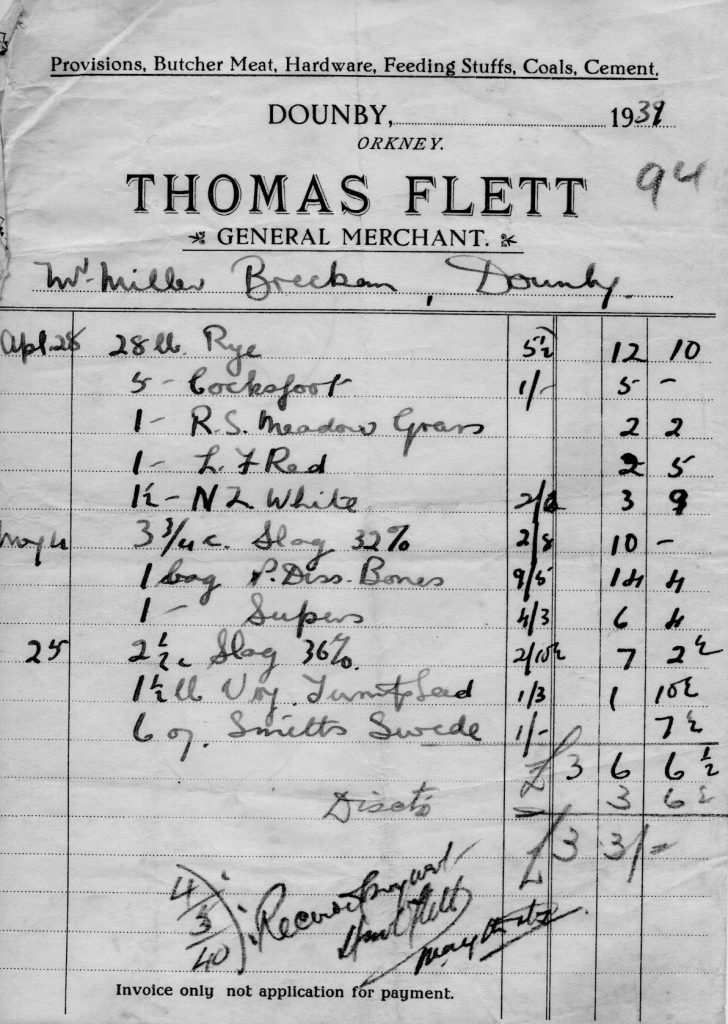
The inn wasn’t built in time for the 1861 Census but there is a tantalising glimpse of another business. At ‘Shop of Kingshouse’, which was a smithy in Grandma’s time and is now under the school, there was Thomas Flett, shoemaker, with his wife Sibbla and five children. Cobblers, such as Willie Farquhar at the Golden Slipper in Stenness, sometimes expanded into other business but whatever went on at Kingshouse was over by 1871 and Thomas Flett was farming at nearby Easthouse. It was one-year old Thomas, at Shop of Kingshouse in 1861, who went on to establish the biggest business in Dounby, selling everything from butcher meat to cement.
In 1862, Josie married Margaret Davie, from Grimbister in Firth. In June of the following year, the inn and the market were thriving, according to the Birsay correspondent in the Orcadian.
“The market stance at Dounby, it is believed, is the best in the mainland. The ground is dry at all seasons and the surface even and firm. It is central and easy of access from all quarters, being held at the intersection of two roads. There is a good and commodious inn on the ground, conducted in a superior manner by Mr and Mrs Mackay, where a variety of refreshments can be had and a rest enjoyed. Dealers from the south or others in quest of high bred stock will have a better opportunity of being suited here than at any cattle market in the mainland. The show of stock here is acknowledged superior to that at Stenness, Wasdale, Kirkwall or Stromness on every occasion.”
For some reason, Josie advertised the inn for lease in 1866.

To Let, for such number of years as may be agreed. That well-known, commodious and well-frequented house presently possessed by Mr Joseph Mackay, Innkeeper in Sandwick, Orkney, together with a Five-Stalled Stable attached thereto.
It is on the site of the Dounby Market, is centrally situated for Travellers and Tourists frequenting the West Mainland and commands an extensive business.
In 1871, Josie, Margaret and their three daughters were living at Kingshouse, now apparently just a house. There were two tenants at Smithfield, grocer Peter Johnson, with his wife Ellen and Inn-keeper Joseph Oag, with his family. This is the first appearance of another well-known Dounby business. Like Josie Mackay, Joseph Oag came from Latheron, Caithness. Ten years later, he was farming Rosebank but his son Alexander, now 23, was still at Smithfield. He was a bootmaker, with a journeyman and an apprentice. Ten years after that, he was a bootmaker at Arrowhouse, and his wife Jane was a grocer and merchant.
In 1871, Josie borrowed £100 from John Stanger, the ship-builder in Stromness. This would have been to build the new Smithfield. Grandma wrote,
Later Josie had three daughters, Janet, Williamina and Josephine so he built a bigger hotel, to house a public house for one daughter, a post office for the second and a shop for the third. Josephine died so the shop is no more.
Grandma thought that it was probably the Post Office who fixed the name of Dounby Farm onto the village and this seems very possible. The first official use of the name that I have found was in 1877, when the Dounby School opened.
Grandma could remember the Dounby Market
“Two Stromness banks attended on market days, which could be taken as a sign of prosperity in the neighbourhood. The Bank still attends on the second Thursday of every month but the monthly Dounby Market is no more. Market Day was the day that the School Boards of Birsay and Harray met in the Dounby School and when the meeting was lengthy we enjoyed a longer playtime. Animals sold at the Dounby Market were generally delivered at Finstown on Firth market days – the third Monday of every month. No cattle trucks in those days. The Dounby market day was the day that we school children felt wealthy as almost everyone had a penny to spend or maybe twopence as other businesses followed the ale house.
The West Mainland Agricultural Society formed a Show Committee, in 1890, to arrange a Show of Stock in July of the following year. The Convenor was the Society’s Secretary, Robert Gibson from Lochside, Stenness and the committee of twelve included Robert Scarth, Binscarth, Firth; Hugh Gibson, Garson, Stromness; James Corrigall, Northbigging, Harray; William Wood, Burgar, Evie; David Davidson, Hyval Sandwick and William Rendall, Mill, Rendall, so all the parishes were represented. Orphir only joined the Society in 1913.
The Show was held on a field loaned by William Hourie, tenant of Dounby Farm, and was a great success. There were over 200 entries and more than 800 spectators. The show was divided into two sections: Section I was for animals from farms with a rent or assessed rental of over £30 and Section II for farms of £30 or less. Most of the prize-winners came from Sandwick, followed by Birsay and Harray, but a few came from further afield. I was astonished to find that one of the furthest travelled was a Commended Leicester tup, shown in Section I by my g-g-grandfather Robert Leask, who farmed Coldomo, beside the Bay of Ireland. I went on to find that Robert and/or my great-grandfather, John Leask of Barnhouse, had won prizes at every pre-war Dounby Show but one. In fact, somewhere there is a Silver Medal which Robert got to keep, for twice having the best bull in the yard. It must have been quite an operation to get the animals to the Show then. Grandma had fond memories of seeing them heading home.
“At one time it was interesting to watch the animals come up from Dounby, past the corner and then turn for Harray, Birsay or Evie, each with their tickets on. Now everything is made easier for the exhibitor as big cattle trucks convey the animals straight from home to the show yard and home again.”
At the dinner in the Smithfield Hotel on the evening of the first Dounby Show, it was suggested that there should be a Flower and Produce Show and it was held in the Dounby School just six weeks later. That didn’t give time for the handicrafts, but there were pot plants, cut flowers, fruit and vegetables, dairy produce and hand-writing from the schoolchildren. There were so many visitors that a 30 foot by 60 foot marquee was hired from Aberdeen for the next three years, until the school was enlarged. After that first year, the two shows were on the same day and the crowds flocked to Dounby.
The reports in the Orcadian and Orkney Herald in the following years are mainly the list of prize-winners that have been such a trial to newspaper men and women ever since but an occasional detail catches the eye, such as the competition in 1893.
Four “most attractive damsels” competed in the Sunlight Soap Washing Competition. They were given a pail of cold water, half a bar of soap, two clothes pegs and a dirty tea cloth and competed before a large crowd, to see who could have the cleanest cloth hanging up in less than three minutes. Miss M A Hunter won a silver-plated cup and six boxes of Sunlight Soap.
The Stock Show was held on Dounby Farm until the Society bought their own show-yard in 1934. They decided to buy five acres, at £11 an acre, from James Flett of Curcabreck and advertised for tenders for a dyke around the showground. It was built by W D Firth, a contractor in Harray, but one of the unsuccessful tenders was from Grandma’s father, John Kirkness. I know this because I have found the rejection letter, from the Secretary, James Wood of Garson. The specifications of the dyke were also kept. It was to be 620 yards long and five feet high, with a main entrance gate and a small gate. Bids were invited for a stone dyke and a concrete dyke. It was decided at the meeting in March that the dyke was to be stone and that a quarry would be opened in the showground. Once the wall was built, what to do with the quarry? George Wylie wrote,
“It was decided that it should be filled in but before doing this, that a well should be put in, and this supplied all the water required for the washing and dressing of animals up until the installation of a mains supply. The infill for the quarry was, in fact, any old rubbish that lay about – old car bodies, which are not nearly so plentiful in Orkney then as they are now, and anything else that came to hand and, in fact, the part of the showground where the quarry had been was definitely out of bounds for heavy vehicles for quite a considerable time afterwards. But an interesting aside to this was the fact that, when the SCWS store at Dounby caught fire in 1949, this well was the only water supply for the fire engine when it came up from Kirkwall. The firemaster was at first reluctant to use it, as he naturally thought it would only last a few minutes, but on being told there was no other supply, he did use it and there was enough water to keep the fire engine pumping for forty-five minutes, just long enough for the fire to be put out.”
Ernest Marwick was born in Evie in 1915 and, in the Orkney Herald many years later, described the joy of the Dounby Show.
“Preparations for the trip were made well in advance. The cart was washed in the burn; it might even be painted. The horse was specially groomed, and the harness blackened. In the evening, a couple of “winlins” of straw were laid in handy proximity to the cart. In the house itself there was much washing of necks and knees, cleaning of boots and placing of sixpences and shillings into trouser pockets. There followed the sad business of “early to bed, to be fit for the morning.” It seemed that sleep would never come, but it did.
At six the next morning everyone was afoot. By seven, the cart, with its excited passengers sitting in the straw, began its journey. If the day was fine, every mile was an adventure, the tension mounting as the long stretches of moorland were passed and Dounby came into sight. It seemed to take an age before the horse was unharnessed and put on a tether to graze, but this done, the day really started.
But we find the day with its hordes of people, its tiny marvels, its adventures on the swings and roundabouts, its tea in the big tent, its shillings pressed on us by distant relatives, quite indescribable. We look back on it now with the same tongue-tied happiness that we used to know on those far-off evenings when we travelled homewards with a balloon on a stick for company and a bag of sweetie foals to eat on the way.” [Sweetie foals were big biscuits covered with ‘carvey’, sugar-coated caraway seeds.]
For us, the Dounby Show began, as it still does, with the Flower and Produce Show. Sometimes, we got a trip to Dounby on Wednesday evening, when the show opened. More often, we headed there in the morning. The first thing was the lovely smell of the onions and carrots in the porch and then a turn to the right, to the Juvenile Section, to see if we had won a prize for our pressed flowers, shell collection or drawing. Then there was the rest of the hall: first the outside circuit, where Grandma might have won a prize with a patchwork cushion and there was the lovely smell of sweet peas and carnations. Then the inner circuit, with the cakes, scones, cheese and jam all protected by chicken wire.
The other thing that had to be done in the morning was to go to the shops. We always went to the Dounby Drapery Store because the owner, Alfred Gibson, had served his apprenticeship with my grandfather, Hardy Leask, in Stromness. Flett’s laid in toys for the day so there are very early memories of buying a ball or a board game there.
I don’t know what most people did for their dinner in Dounby because we always headed up the Evie road, to Grandma’s sister, Cissie Bews, at Willow Cottage. She and her neighbours competed as to how many people they could boast of feeding on Show Day. The most I can remember in her tiny house was 13, with Cissie dealing out the plates like playing cards and spooning jelly from a jug.
Of course, we were keen to get down the road again because, in the afternoon, we went to the Market Stalls, known as the Showies, on the Market Green. Some things don’t change: the simple pleasure of rolling balls into numbered slots to get a winning score; trying to knock three wooden blocks over to win a coconut or hauling on the rope of a swing-boat. But some things do. Dad can remember going into a booth to watch a dark-skinned couple dancing in grass skirts and I can remember being taken into a tent to see a dwarf, sometime in the early sixties. He was a cheerful man in a white shirt and kilt who chatted to Dad for a few minutes.
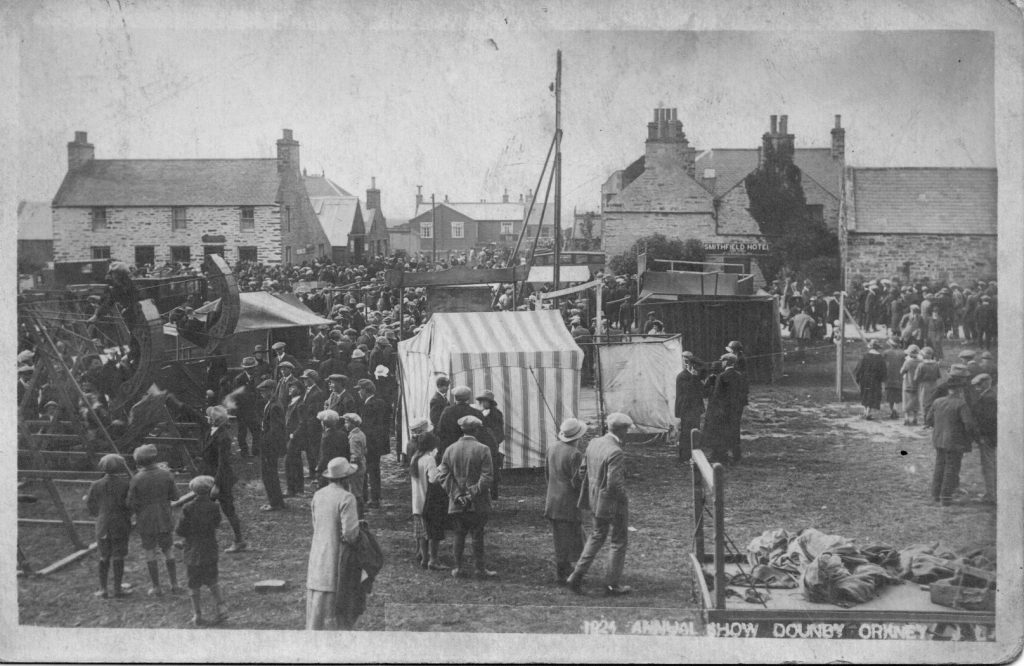

In the early photos, that corner of the crossroads is dominated by a large tent. This was Pinder’s Circus, which Dad can remember. It was a small circus, which had seen better days, but there was a good trapeze act and a boxing Shetland pony.

The Dounby Show used to have proverbially good weather but this luck didn’t hold and I can remember some wet days. One Show Day in the 1980s, Dad asked Mum what she wanted to do next and Mum said that she would like to go home, as she was soaked to the skin. Dad replied that her skin was waterproof, though he did agree to leave early. When Mum told my sister Anne this story, Anne drew the first of many cartoons, which is now framed on Dad’s wall.
Whatever the weather, I look forward to the Thursday before the second Saturday in August 2021, when all roads will lead to Dounby again.


Very interesting. Thanks! I hope to be at the Dounby show in 2022, I have many good memories from there. Yours, Sigrid from Ramsøy nr Bergen
What a great read, felt like I was there at the show.
The early dates, when my great great grandfather William Lyon (born1838) and family would have been living. Thank you.
Thank you. I am glad that you enjoyed it. It is good to think of how many generations have looked forward to the Dounby Show.
I really enjoyed your very informative story. I could just see it all in my minds eye. Thank you so much.
Regards
Marion
Really interesting account, thank you for researching and recording. A pedantic query: the first photograph of the crossroads showing the Smithfield on the right is surely looking north-west, rather than east? As all roads lead to Dounby, it probably doesn’t matter!
I am glad you enjoyed it. Thank you for pointing out the error, which has now been corrected
Thank you. I am very glad that you enjoyed it. Writing the article brought back many happy memories and I am glad to be able to share them.